Categories
Blog

Who is building the world’s most complex bridges

Top Bridge Construction Firms Building America

When you see big roads in Miami or Texas, you are seeing the work of bridge construction firms. These companies turn ideas into real bridges made of steel and concrete. Building a bridge is not just about crossing water. It is about moving big machines and keeping workers safe. Every project needs a team that can work fast and follow the rules.

The work starts long before the building begins. Engineers look at the soil and the water. They make sure the bridge can stand up to wind and heavy trucks for 100 years. This planning is very important.

Lifecycle of a bridge project from planning to maintenance - bridge construction firms infographic

What bridge construction firms Do

Modern bridge construction firms do many things. At Saga Infrastructure, we see that the best firms can do “heavy civil” work. This means they build big things like roads and bridges that everyone uses.

Main services include:

  • Design-Build: One team does the drawing and the building. This is faster and has fewer mistakes.
  • Heavy Civil Construction: This is moving lots of dirt and building the base of the bridge. To learn more, read our Building Futures: A Guide to Civil Construction Management.
  • Steel and Concrete: Most bridges use steel for strength and concrete to last a long time. Many firms make their own parts to make sure they are good.
  • Fixing Old Bridges: Many firms fix old bridges to make them safe again. They add new layers to the road so the bridge lasts longer.
  • Taking Down Old Bridges: Sometimes an old bridge must come down first. They use high-pressure water to clean off old concrete without hurting the steel.

Special Skills: From Walking Paths to Water Bridges

Timber pedestrian bridge in a natural park setting - bridge construction firms

Not all bridges are for big trucks. Some are for people walking or for trains. Some bridge construction firms are experts at special types of bridges. One company might be the best at wood bridges in Florida. Another might be the best at huge highway ramps in Texas. These special skills help keep our roads working.

To see how these fit in, read Heavy Civil Construction: Trends, Markets, and the Contractors Who Build It.

Types of Bridges

Big companies usually build these kinds of bridges:

  1. Highway Ramps: These are the big, curvy roads in cities. They are hard to build because cars are still driving nearby.
  2. Train Bridges: Working near trains is dangerous. Builders must follow strict rules, like the ones on Federal Contractor Safety and Labor Posters. Trains cannot stop fast, so the work must be timed perfectly.
  3. Water Bridges: Building in water needs special boats. Firms use big boxes to keep the water out while they work on the river floor. In Florida, salt water can hurt metal, so they have to be careful.
  4. Moving Bridges: These are bridges that lift up or swing open. They are beautiful and very smart pieces of engineering.

New Ways to Build Bridges

Building is getting faster. No one likes sitting in traffic. That is why bridge construction firms use Accelerated Bridge Construction (ABC). With ABC, they build parts of the bridge in a different place. Then they move them into the right spot in just a few days. This is much faster than the old way.

To learn why these projects matter, see Essential Infrastructure Projects Explained.

Fast Building vs. Old Ways

Infographic comparing traditional bridge building and ABC on traffic safety cost and off-site work - bridge construction

Helping the Earth

Builders now try to protect nature. This is a big part of getting jobs in states like Florida and Arizona.

  • Wood Bridges: Some firms use wood for small bridges. Wood is good for the earth and looks nice in parks.
  • Saving Fish: When building in water, firms use “bubble walls.” These bubbles stop loud noises from hurting fish and manatees.
  • Clean Water: They use special curtains in the water to keep mud from spreading. This keeps the water clean for plants and animals.

Local Experts vs. Big National Companies

Some people think bigger is always better. But local bridge construction firms are very important. They know the local dirt and the weather. They also know the people in town. They have worked with local leaders for a long time.

At Saga Infrastructure, we think The Best Civil Construction Companies Near Me are often the ones that have been in the town for years. People trust them.

Why Local Firms Matter

Local firms often feel like a family. We see this in companies where the kids and grandkids of the founders now run the business. They are building in their own backyard. In towns like Minneola, a local builder knows how the hot sun or rain will change the work.

  • Pride in Work: A local firm wants to do a great job because they live there. They want their neighbors to be proud of the bridge.
  • Local Knowledge: A firm in Florida knows how to build in sand. A firm in the North knows how to handle ice and snow. This saves time and money.
  • Fast Decisions: Local firms can move quickly. They do not have to wait for a big office far away to say yes. To learn more about the ground work, see From Ground Up: Everything You Need to Know About Earthwork Construction Companies.

Common Questions About Bridge Building

What kinds of bridges are built today?

Most highway bridges are made of steel or concrete beams. They are strong and easy to make. For long spans, you will see bridges with tall towers and cables. For parks, wood bridges are very popular.

How do firms keep workers safe?

Safety is the most important thing. Firms use training and special gear. Many now use drones to look at high places so people do not have to climb as much. They also use sensors to make sure the bridge is steady.

What is Fast Building (ABC)?

ABC is a way to build bridges much faster. By using parts made in a factory, a project that took two years can now be done in one summer. This is great for busy cities.

How long does a bridge last?

Most new bridges are built to last 75 to 100 years. If they are taken care of, they can last even longer. Using good materials helps them stay strong against the weather.

Why are bridges painted?

Painting is not just for color. It protects the steel from rust. Near the ocean, salt in the air can hurt metal. Paint acts like a shield to keep the bridge safe.

Conclusion

Bridge building is changing. It is getting faster, safer, and better for the earth. But we do not want to lose the local companies that built our towns. We want the names on the trucks to stay the same.

That is why Saga Infrastructure is here. We buy great local bridge construction firms. We give them more money and tools, but we let them keep their name and their team. We think a company’s history is very important.

Our plan is simple. First, we talk to you about your goals. Then, we make a plan that helps your team. Finally, we help you grow while keeping your legacy alive. We have done this with companies like Foshee Construction and RBC Utilities.

If you own a business in Florida, Texas, or Arizona and want a partner, Saga Infrastructure Business Owners can help. We do not just buy companies. We partner with you to keep your name on the trucks and your people on the job.

Let’s build the future together. We are ready to help you and your company.

Categories
Blog

Building Connections: Discover Premier Bridge Construction Firms

Building Connections: Discover Premier Bridge Construction Firms

Why Finding the Right Bridge Construction Firms Matters

Bridge construction firms are companies that design and build bridges. These bridges connect our roads and towns. Some firms are very big, and some are small. It is important to find the right one to fix our old bridges. Modern bridges need careful planning and strong materials.

Many bridges in America are getting old. They need to be fixed or replaced. These firms build all kinds of bridges. Some are simple, and some are very complex. Choosing the right firm depends on what you need. You might need a fast fix or a bridge that is good for nature.

I am Don Larsen, the leader of Saga Infrastructure. We partner with local construction companies. We work in places like the Southeast and Southwest. I have spent a long time in the construction business. I know what makes a bridge builder great. Read on to learn about the firms building our bridges today.
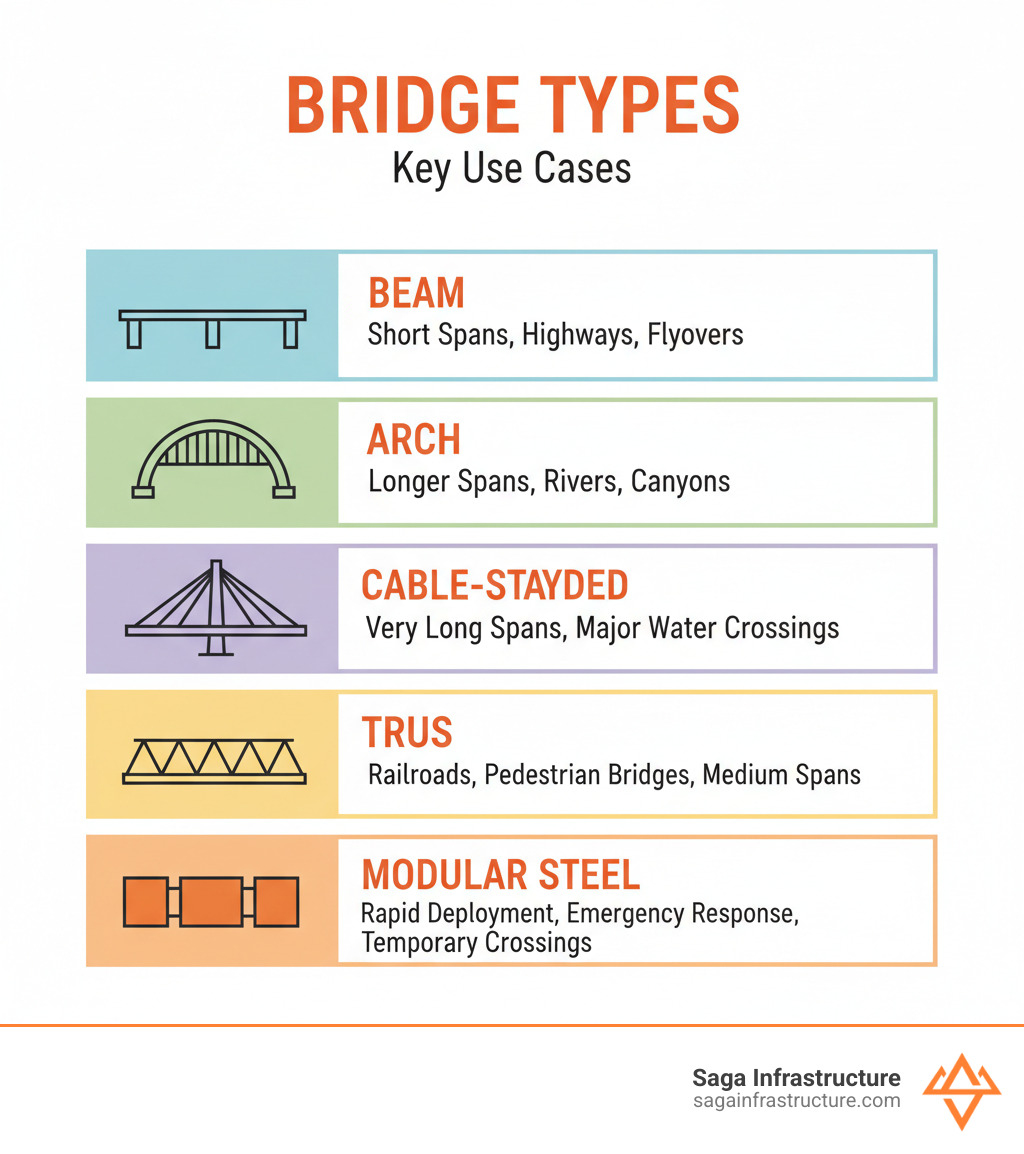
Infographic showing bridge types: beam, arch, cable-stayed, truss, and modular steel with key use cases - Bridge

Leading Bridge Construction Expertise Across the Nation

The best bridge construction firms have a lot of experience. In states like Florida, Texas, and Arizona, many people are moving in. This means we need more bridges for all the cars. These bridges must be very strong.

Top firms do more than just pour concrete. They handle the whole project from start to finish. They have special teams that make sure every bridge is safe and lasts a long time.

What Makes a Great Bridge Builder?

Great bridge builders work well with the government. They are often the biggest companies in the country. They can handle any project, whether it is a small bridge over a creek or a huge highway crossing.

Some of these companies have been around for over 100 years. They have seen every kind of problem. They follow rules from groups like the American Association of State Highway and Transportation Officials. If you are looking for The Best Civil Construction Companies Near Me, these leaders are the best in the business.

Building Big and Hard Bridges

Building a bridge over water is hard. It takes a lot of skill. The best firms have their own engineers to solve problems.

These companies have finished hundreds of big projects. They often make their own concrete parts. This helps them make sure the materials are perfect. It also helps them finish the work on time.

Specialized Solutions: Timber and Modular Steel

Not every bridge is made of heavy concrete. Sometimes, a steel bridge that fits together like blocks is better. Other times, a wooden bridge looks best in a park. Special bridge construction firms use new ideas to build these.

Fast Steel Bridges

Some firms make bridges out of steel parts. These parts are made in a factory and then put together fast. These bridges are great for:

  • Permanent Roads: For quiet roads that need a new bridge fast.
  • Temporary Paths: To keep cars moving while the main bridge is fixed.
  • Emergencies: To help people after a flood or a storm.
  • The Military: To carry heavy trucks in rough places.

These bridges can be shipped and built quickly. This helps towns keep their roads open.

Eco-Friendly Wood Bridges

In some parts of Florida and Texas, we must protect nature. Some builders use a “top-down” way to build. They stay on top of the bridge while they build it. This way, they do not hurt the plants or animals below.

These wood bridges look very nice. They are built to last a long time. They use special wood and care to keep them safe and pretty for many years.

Regional Excellence in Heavy Civil Infrastructure: Preserving Local Legacies

At Saga Infrastructure, we think local companies do the best work. They know the land. They know the dirt in Arizona and the wet air in Florida. They also know how people drive in Texas.

The Value of Local Knowledge

Local firms often have a long history. Some have been building for almost 100 years. They have built many bridges and helped many people. They are experts at building near trains and water because they have done it for so long in their area.

These firms are the first to help when things go wrong. If a big storm hits, local workers can get there fast. They have the tools and the people ready to go. This is part of the Heavy civil construction trends we see today. Knowing the local area is very important.

Growing in Busy Areas

Florida, Texas, and Arizona need a lot of new roads and bridges. Many people are moving there. Local firms are experts at building in these busy places. They build everything from big highway exits to small bridges for people to walk on.

By working in states like Oklahoma and Arkansas, they have earned a good name. They are known for being safe and doing good work. This helps them grow and help their neighbors.

Making Bridges Better

Builders are learning new ways to make bridges better. They use new methods to make bridges look thin and pretty but still stay very strong.

We also see more bridges for more than just cars. Some bridges are for trains, bikes, and people walking. Bridge construction firms are helping to make our cities better places to live.

Innovation, Safety, and Career Opportunities in Bridge Building

Building bridges is a big job. Safety is the most important part. The best firms train their workers very well. They help workers learn how to become master builders.

Building Hard Bridges and Tunnels

New ways of building often include tunnels. Some hard projects have both bridges and tunnels. The best firms have built many miles of tunnels. This helps them build famous bridges that people recognize in big cities.

These projects use special concrete made in a safe place. This makes sure every piece is perfect before it gets to the bridge. To learn more about how these big projects work, you can read Essential Infrastructure Projects Explained.

Working Together for Better Bridges

Modern building is about working as a team. Firms work with the owners to find better ways to build. They try to build faster and save money while still doing a great job.

This teamwork helps bridges last for 100 years. It makes everyone want to find a better way to work. If you want to know the difference between local and national firms, read our guide From Local to National: Uncovering the Best Construction Companies for Your Project.

Frequently Asked Questions about Bridge Construction

What do bridge construction firms build?

Most firms build highway bridges, river crossings, and train bridges. Some also build bridges for people to walk on or docks for boats. Big firms can also fix bridges very fast after a disaster.

How do these companies stay safe?

Safety is the most important thing. Workers have safety meetings every day. They get special training and use the best safety gear. Many firms say that keeping workers safe is more important than anything else.

What is a modular bridge?

A modular bridge is made of parts built in a factory. This makes the bridge much faster to build on the road. It helps keep traffic moving and costs less money. It is great for quick fixes.

Conclusion: Scaling Legacies with Saga Infrastructure

At Saga Infrastructure, we respect the people who build our country. Every bridge has a story. Many were built by family businesses that worked hard for many years.

Our goal is to protect those stories. We partner with local firms and give them the money and tools they need. We do not change who they are. We keep their names and their teams the same.

We work with firms like Foshee Construction in Florida and others in Texas and Arizona. We want to help them keep doing great work. By working together, we make sure these bridge construction firms can keep building for a long time.

If you have a company and want to protect its future, let’s talk. Together, we can keep building the things that help America.

Protecting What Built America

Categories
Blog

Why your city needs professional stormwater management contractors now

Why your city needs professional stormwater management contractors now

Why Every City Needs Professional Stormwater Management Contractors

Stormwater management contractors are experts. They fix and build systems that control rain water in cities and neighborhoods.

Here is what they do and who they help:

What They Do Who Needs Them
Clean and fix water ponds and pipes Cities and towns
Fix holes and broken drains Neighborhood groups
Follow government rules Builders
Fix problems after a warning Businesses
Build gardens that soak up water Schools and hospitals

When water systems break, it is bad. Floods damage homes. Dirty water gets into rivers. Cities have to pay fines. If you wait to fix a problem, it costs more money.

Old pipes are breaking. Storms are getting stronger. This is a big problem for our neighborhoods. Contractors help keep these systems working.

I am Don Larsen. I am the leader of Saga Infrastructure. We partner with local contractors. We help them grow so they can keep fixing our water systems.

Infographic showing who hires stormwater contractors, core services, and compliance requirements - stormwater management

Stormwater management contractors word roundup:

Essential services provided by stormwater management contractors

vacuum truck cleaning a storm drain - stormwater management contractors

Most people think of pipes that bring water to the sink. But pipes that take water away from streets are just as important. Stormwater management contractors keep these systems moving.

In places like Florida, Texas, and Arizona, it can rain very hard. These services keep streets dry and homes safe.

What we do:

  • Planning: We plan how water will move before we build.
  • Checking: We check new systems to make sure they work.
  • Cleaning: We clean out trash so water can flow.
  • Fixing: We fix broken pipes and drains.

To learn more about how we work with the ground, you can find more info about earthwork services.

Above and below the ground

Most water systems are hidden underground. Contractors must know about both types of systems.

  • Above the ground: These are ponds and grassy areas. They hold water and let it soak into the dirt.
  • Below the ground: These are big pipes and tanks under the street. In big cities, these are very important.

To learn more about the surfaces that catch water, check out this more info about grading and paving.

Emergency help

When a pipe breaks, you need help fast. Contractors use special tools:

  1. Water Digging: Using water to dig safely around other pipes.
  2. Big Vacuum Trucks: These trucks suck up mud and trash from drains.
  3. Flood Help: Using pumps to move water away from buildings.
  4. Pipe Cameras: Using tiny robots with cameras to see inside pipes.

Why regular maintenance saves cities and HOAs money

We have a saying: “Pay a little now, or pay a lot later.” It is cheaper to fix small problems before they get big.

Many people wait until they see a flood to call for help. By then, it is too late. Cleaning drains once a year is cheap. Replacing a broken road is very expensive.

To learn how to protect your land from water, you can don’t get washed away with erosion defense tips.

Keeping ponds and pipes healthy

In Florida, sand can wash into ponds. This makes the pond shallow. Then, the pond cannot hold enough water. This leads to floods.

Stormwater management contractors use plants to keep the dirt in place. We also clean out the mud to make the pond deep again.

What happens if you wait?

  • Sinkholes: Leaking pipes wash away dirt under the road. This makes the road fall in.
  • Damage: Water can get into houses and buildings.
  • High Costs: Cleaning a pond after 20 years costs a lot more than cleaning it every year.
Job Cost to Maintain Cost to Fix Later
Cleaning Drains Low High
Checking Ponds Medium Very High
Looking inside pipes Low Extreme

If you own a building or run a city, you must follow laws about water. The government has rules about how clean the water must be.

Systems must be checked every few years. If your system is dirty or broken, you might get a Notice of Violation. This is a warning. You must fix the problem or pay a fine.

We work in Florida, Texas, and Arizona. We also look at other places to learn. You can learn about Chesapeake Bay restoration efforts to see how they keep water clean.

Meeting the rules

Stormwater management contractors help you follow the rules by:

  • City Programs: Helping cities manage their drain systems.
  • Pollution Plans: Making plans to keep dirt out of the water during building.
  • Water Testing: Checking the water for oil and trash.

Fixing a warning

A warning can be scary. We help you fix it. We make a plan to repair the system. Then we show the government that everything is fixed.

Modern solutions for urban water challenges

The old way used concrete pipes. The new way uses plants and soil. This is called “green infrastructure.” It works like nature to clean the water.

In Arizona, we try to save rain water. In Florida, we clean the water before it hits the ocean. Modern stormwater management contractors use smart designs. These designs look good and help the earth.

Why you need an expert

You would not ask a gardener to fix a broken bone. You should not ask a regular lawn mower to fix your water system. Experts understand how water moves.

To learn more about how water affects nature, you can find scientific research on watershed protection.

How to pick a contractor

Do not just pick the cheapest one. Look for:

  • Badges: Do they have special training and certificates?
  • Local Knowledge: Do they know the weather in your town?
  • Big Tools: Do they have the big trucks needed for the job?

Before you start building, make sure you are ready. Check out this Ready, Set, Build: A checklist for site preparation to help you plan.

Frequently Asked Questions about stormwater management

How often should systems be checked?

Most cities say you must check your system every three years. We think you should look at it after every big rain storm. Checking for trash can stop a flood before it starts.

What is the difference between a contractor and a gardener?

A gardener makes the grass look pretty. A stormwater management contractor makes sure the water flows correctly. We are experts in engineering and laws. A gardener sees a pond. We see a system that holds thousands of gallons of water.

Why is this important for the earth?

When rain hits a parking lot, it picks up oil and trash. This “dirty soup” flows into rivers. A good water system filters the trash out. This keeps our drinking water safe and helps fish and birds.

Conclusion

At Saga Infrastructure, we want to help local experts. We work with the best stormwater management contractors in Florida, Texas, and Arizona. We give them the tools they need to grow while they keep their local heart.

Fixing our water systems is about more than pipes. It is about keeping our homes safe. If you run a city or a neighborhood, talk to an expert before the next big storm.

Let’s start the conversation about how we can help you protect your community.

Categories
Blog

How to Sell Your Family Business and Still Be Invited to Thanksgiving

How to Sell Your Family Business and Still Be Invited to Thanksgiving

How to Sell Your Family Business and Still Be Invited to Thanksgiving

The Keep-or-Sell Decision Every Family Business Owner Eventually Faces

Selling a family business is a very big choice. It is not just about money. It is about your hard work and the people who helped you build it.

Here is how the process works:

  1. Decide – See if selling is right for you.
  2. Prepare – Find out what the business is worth and plan for taxes.
  3. Structure – Pick how you want to sell.
  4. Execute – Work with experts to finish the deal.
  5. Transition – Plan what to do with the money and keep your family happy.

Selling is hard. Only 2 or 3 out of every 10 businesses that try to sell actually do. Many owners are getting ready to retire soon. But most do not have a plan yet.

This guide will help you through every step.

I am Don Larsen. I lead Saga Infrastructure. I have spent my career building and selling businesses. I know what it looks like when a sale goes well and when it does not.

Keep-or-sell decision tree for family business owners weighing heirloom vs financial asset - Selling family business

Deciding the Right Time for Selling a Family Business

There is no perfect day to sell. It depends on the market and how your family feels.

Expert John A. Davis says you should ask if your business is a “treasure” or a “tool.” A treasure is something the family wants to keep forever. A tool is something used to make money. If you see the business mostly as a way to make money, it might be time to consider selling a family business.

It is also good to sell when the business is growing. Buyers will pay more then.

Founder looking at a sunset over a construction project - Selling family business

Is Your Family the Best Owner for the Future?

Just because your family started the business does not mean they should run it forever. Ask these questions:

  1. Is the family good at running this business?
  2. Does the family want to own it?
  3. Is the business making enough money to be worth the risk?

If the next generation does not want to lead, you can hire a boss or sell. Harvard Business School researchers say that selling can help keep family wealth and peace.

Financial Readiness and Selling Family Business Stakes

Can you afford to sell? You need to know if the money from the sale will pay for your life. You will not have a regular paycheck anymore.

You should read your-legacy-your-sale-navigating-the-family-business-exit. You need to know your “number.” This is the amount of money you need after taxes to live the way you want.

Preparing for the Sale: Valuation and Tax Strategy

Once you decide to sell, you must get ready. Many deals fail because the owner was not prepared.

You need a real price for your business. An expert will look at your profits and your equipment. In places like Arizona and Texas, the price can change based on your contracts and your team.

Feature Internal Sale (Family) External Sale (Buyer)
Price Often lower Highest price
Speed Slow change Faster
Legacy Stays the same Might change
Taxes Gifting Capital gains

To get a better price, you should prepare a tax fact book. This paper shows your tax history. It helps the buyer trust you.

Taxes can take a lot of your money. In 2024, you can give away $18,000 to a person each year without a tax.

A new law called the OBBBA will change things in 2026. It will let families give away more money without taxes. You should check the IRS estate and gift tax FAQs and IRS Publication 551 to learn more.

Maximizing Value Before Selling Family Business Assets

You should clean up your business before you sell it.

  • Clean your books: Take out personal costs.
  • Build a team: Make sure the business can run without you.
  • Write it down: Have clear rules for how the work gets done.

Read our guide on how to maximize-your-exit-a-guide-to-selling-your-construction-company for more tips.

Managing Family Dynamics and Communication

Money can make family life hard. If one child works in the business and others do not, it can cause fights.

Cresset Capital says you should talk a lot. Have family meetings away from the office. Let everyone say how they feel. This helps keep the family together.

Maintaining Legacy and Post-Sale Unity

Selling does not mean the family stops working together. Many families start a foundation to give money to charity.

Deloitte suggests using family rules to help make choices. This keeps the family close even after the business is sold.

Alternatives to a Full Business Sale

You do not always have to sell the whole business. Here are other ways to step back:

  1. Family Succession: Give the business to your kids. Baton Market has a good plan for this. Treat it like hiring a new boss.
  2. Professional Management: Keep the business but hire a CEO to run it.
  3. Partial Buyout: Sell part of the business to a partner like Saga Infrastructure. This gives you some money now but lets you keep a stake in the future.

Read about navigating-the-world-of-civil-construction-acquisitions to see how these deals work.

Asset Liquidation as a Last Resort

If you cannot sell the business as a whole, you might have to sell the tools and equipment. This is called liquidation.

The IRS Bankruptcy Tax Guide can help if you are in this spot. It is better to have a plan than to rush.

Frequently Asked Questions about Selling a Family Business

How many family businesses actually sell?

Not many. Only about 20% to 30% of businesses that try to sell actually finish the deal. This is why you need a plan. The Exit Planning Institute says most owners do not have one.

Can I use an SBA loan for a family buyout?

Yes. The SBA 7(a) loan program helps people buy businesses. This is a good way for a child to buy the business from a parent.

What is a tax fact book?

As Deloitte says, it is a book that shows your tax history. It makes the buyer feel safe and can help you get a better price.

Conclusion: Protecting What You Built

At Saga Infrastructure, we know your business is more than just money. It is your life’s work. We want to help local builders keep their legacy going.

We do not just buy companies. We partner with owners. Kevin and Cindi Foshee sold their business to us. Kevin said, “Saga was the perfect partner. They cared about our team and made the process easy.”

We are here to help you, whether you are in Florida or Arizona. If you want to talk about the future of your business, let us know.

Learn more at buy-build-conquer-navigating-construction-ma or visit our page for business owners.

Categories
Blog

How to Retire from Your Construction Business Without It Collapsing

How to Retire from Your Construction Business Without It Collapsing

How to Retire from Your Construction Business Without It Collapsing

The Urgent Need for Succession Planning for Contractors

The construction industry is currently facing a “silver tsunami.” According to the National Center for Construction Education & Research, an estimated 41% of the current construction workforce will retire by 2031. This isn’t just about losing laborers; it’s about losing the institutional knowledge held by owners and field leaders who have run the show for decades.

In our experience across Florida, Texas, and Arizona, we see the same pattern: brilliant builders who can plan a multi-million dollar highway project down to the last bag of concrete, yet they haven’t spent an hour planning their own exit. Statistics show that 58% of contractors lack an ownership transition plan, and 28% of field leaders are expected to retire within the next five years. For many owners in the Sun Belt, from the growing suburbs of Phoenix to the busy corridors of Dallas, their business is their life’s work. It is not just a paycheck; it is a reputation built over decades of hot summers and hard-won contracts.

Without succession planning for contractors, a business faces several immediate risks:

  • The Leadership Vacuum: When an owner leaves suddenly due to health or retirement, employees often “jump ship” because they don’t know who is in charge.
  • Loss of Value: A business is worth much less if its success is tied entirely to the owner’s personal relationships.
  • Labor Shortages: With the Bureau of Labor Statistics reporting over 449,000 job openings in construction, finding an external replacement is harder than ever.

A busy civil construction site in Florida with a diverse team of workers collaborating on a drainage project - succession

Building Your Framework: First Steps and Valuation

You wouldn’t start a build without a blueprint, and you shouldn’t start a retirement without a framework. The first step in succession planning for contractors is understanding your starting point.

1. Business Valuation

What is your company actually worth? Many owners have a “number” in their head, but a formal valuation by a construction-specific expert is essential. They look at your equipment, your backlog, and your “goodwill” (reputation). For more details, check out our guide to maximizing your exit.

2. Define Your Retirement Goals

Do you want to walk away entirely on day one? Or would you prefer to stay on as a consultant or board member for a few years? We’ve seen many founders in places like Minneola and Clermont prefer a gradual exit to ensure their team is taken care of.

3. Stakeholder Input

Talk to your spouse, your partners, and your key leaders. If you assume your son or daughter wants to take over but they actually want to paint landscapes in France, your plan is doomed before it starts.

Feature Internal Valuation (Do-It-Yourself) External Professional Valuation
Cost Low Moderate to High
Accuracy Often biased or outdated High; based on market comps
Surety Impact Minimal High; builds trust with lenders
Tax Use Not accepted by IRS Required for estate/gift tax

Choosing the Right Path: Ownership Transfer Options

There is no one-size-fits-all way to hand over the keys. Here are the most common paths for succession planning for contractors:

  • Third-Party Sale: Selling to an outside buyer or a strategic partner like us. This often yields the highest price but requires the most “cleanup” of your financials. Learn more about navigating construction M&A.
  • ESOP (Employee Stock Ownership Plan): You sell the company to your employees over time. This is great for culture but can be complex and expensive to set up.
  • Buy-Sell Agreements: A legal contract between co-owners that dictates what happens if one person leaves, dies, or becomes disabled.
  • Installment Sales: Selling the business to a successor who pays you over time using the company’s future profits. This can provide you with a steady retirement income while deferring capital gains taxes.

Succession planning for contractors in family businesses

Family businesses are the heartbeat of the infrastructure industry, but they are notoriously difficult to transition. Research shows that only 30% of family businesses survive into the second generation, and a measly 3% make it to the fourth.

The biggest killer of family firms isn’t bad markets—it’s poor communication. To avoid nepotism and conflict, we recommend setting clear “employment rules” for family members (e.g., they must work elsewhere for three years first) and holding regular family meetings. For a deeper dive, read about navigating the family business exit.

Training the next generation for succession planning for contractors

Identifying a successor is only half the battle; you have to train them. This process should take years, not months.

  • Mentoring: Take your successor to every high-level meeting with developers and city officials. Mentoring is more than just talking. It means bringing your successor into the room when you negotiate with a major developer in Clermont or a city planner in Minneola. They need to see how you handle pressure and how you maintain those vital local relationships that keep the backlog full.
  • Job Shadowing: Let them spend time in the field, in estimating, and in accounting.
  • Leadership Workshops: Invest in their “soft skills.” A great project manager isn’t always a great CEO.

A senior construction executive mentoring a young project manager over a set of site blueprints - succession planning for

Protecting Your Assets: Surety, Taxes, and Professional Advisors

In the construction world, your reputation is your currency, but your bonding capacity is your lifeblood. A sudden change in leadership can make surety companies nervous. If they pull your bonding, you can’t bid on new work, and the value of your company plummets.

The Role of Professional Advisors

You need an “outside team” to keep things objective. This usually includes:

  • CPA: To handle the complex tax strategies and clean up the books.
  • Attorney: To draft the buy-sell agreements and transfer documents.
  • Valuation Expert: To provide a defensible price for the IRS and buyers.

Long-term success through succession planning for contractors

Tax planning is where many contractors lose a fortune. Between federal estate taxes (which have high exemptions but are subject to change) and capital gains taxes (up to 20%), a poorly structured sale can eat half your profit. Using tools like Grantor-Retained Annuity Trusts (GRATs) or gifting shares over time can significantly reduce this burden. According to research on contractor tax strategies, starting early allows you to use annual gift tax exclusions ($18,000 per person in 2024) to move ownership to heirs slowly and tax-free.

A construction company owner meeting with a CPA and attorney to discuss succession strategy - succession planning for

Avoiding Pitfalls and Ensuring Business Continuity

The biggest mistake we see is “succession by default”—waiting until a health crisis forces a sale. This leads to a leadership vacuum and a fire-sale price. When you wait too long, you lose your leverage. Buyers know when a sale is desperate, and they will price their offers accordingly.

Another common pitfall is the “Knowledge Gap.” If all the project history, vendor contacts, and “tricks of the trade” are in the owner’s head, they disappear when the owner leaves. Think about the specific way your team handles drainage issues in the sandy soil of Florida versus the clay in North Texas. If that knowledge isn’t written down or stored in a system, your successor will have to learn it the hard way—through expensive mistakes. Modern contractors use technology to solve this. ERP (Enterprise Resource Planning) software acts as a digital warehouse for your company’s brain. By documenting processes and centralizing data, you ensure the business can run without you.

Frequently Asked Questions about Contractor Succession

When is the ideal timeline to start a succession plan?

The best time was ten years ago; the second best time is today. Ideally, you want a 5-to-10-year runway to groom leadership, clean up financials, and maximize value. However, even a 3-year plan is better than nothing.

How does a sudden exit impact my bonding capacity?

Surety companies base their support on the “Three Cs”: Character, Capacity, and Capital. A sudden exit creates a “Capacity” question. Proactive succession planning for contractors involves introducing your successor to your bonding agent early to build that trust years before the transition.

What are the most common tax pitfalls for retiring contractors?

The biggest pitfall is failing to account for “double taxation” in C-corporations or neglecting the impact of depreciation recapture on equipment sales. Always consult a construction-focused CPA before signing a letter of intent.

Conclusion: Your Legacy Deserves a Future

At Saga Infrastructure, we believe that your name and your reputation shouldn’t vanish just because you’re ready to hang up the hard hat. We specialize in acquiring regional civil construction firms—like our partners at Foshee Construction in Minneola—and providing them with the national scale and capital they need to grow, while keeping their local culture and teams intact.

We aren’t here to dismantle what you’ve built; we’re here to protect it. We offer a path for owners who want to secure their financial future and ensure their employees are taken care of for the next thirty years.

If you’re ready to start the conversation about the future of your firm, we invite you to reach out. Let’s build the next chapter of your legacy together.

Connect with an Advisor

Categories
Blog

Why Professional Material Hauling Services Are a Total Groundbreaker

Why Professional Material Hauling Services Are a Total Groundbreaker

Why Professional Material Hauling Services Are a Total Groundbreaker

Why Material Hauling Services Are Important for Every Project


Material hauling services are companies that move big piles of stuff. They move things like dirt, rocks, sand, and mulch. They take these things to or from a building site.

Here is a quick look at what they do:

What Details
Materials moved Dirt, sand, rocks, mulch, and trash from building
Who uses them Builders, yard workers, and city workers
Project size Small homes, big stores, and new roads
Main benefits They arrive on time, have safe drivers, and fair prices
Common trucks Dump trucks and big flatbed trucks

Every building project needs one thing: materials must move. If the wrong dirt shows up late, the whole job stops.

That is a big problem. Waiting costs money and makes the job take longer. Getting materials to the site on time is very important. It is the start of every good project.

Pro hauling companies have the right trucks and good drivers. They make sure the job gets done right. This is true for a small driveway or a huge road project.

I am Don Larsen, the leader of Saga Infrastructure. I have worked on many big building projects. I know that good material hauling services are key to keeping a job on track. I will help you learn how to pick the best hauling partner for your project.

Infographic showing the material hauling lifecycle: source, loading, transport, delivery, and site placement - material

What Are Material Hauling Services?

Simply put, material hauling services pick up and move things used for building. But it is more than just driving a truck. It is a special part of earthwork construction companies. It needs big machines and people who know how to move heavy loads safely.

Hauling usually goes two ways: bringing good materials in and taking waste out.

Common Materials They Move

  • Dirt and Sand: This includes good soil for parks or plain dirt to level the ground.
  • Gravel and Rocks: These are used for grading and paving roads and driveways.
  • Mulch: This helps plants grow and makes yards look nice.
  • Big Stones: Large rocks used for walls or riprap erosion defense to protect the land from water.
  • Trash: This is the cleanup. It means moving old concrete or extra dirt away so the next part of the job can start.

Whether the load is small or very large, pro haulers make sure it gets to the right spot.

Why You Should Hire Pro Haulers

You might think you can move the dirt yourself. But for big jobs, you need material hauling services. Here is why hiring pros is a smart move.

They Are on Time

In building, time is money. If workers are waiting for rocks, you lose money. Pro companies use GPS to make sure trucks arrive exactly when they should.

Safe and Good Drivers

Driving a truck with 20 tons of rock is hard. It is not like driving a car. Drivers need a special commercial driver’s license (CDL). They know how to drive on messy job sites without getting stuck or hitting things.

Clear Prices

No one likes surprise costs. Good hauling services tell you the price upfront. They usually charge by how much the load weighs. This helps you plan your budget.

They Protect Your Property

Heavy trucks can break a driveway if the driver is not careful. Pros know how to move these big trucks to keep your land safe.

Less Waiting

Pro haulers keep their trucks in good shape. If a truck breaks, they have another one to take its place. This keeps your project moving. This is a big part of commercial site preparation.

Pro Hauling vs. Doing It Yourself

Feature Pro Hauling Doing It Yourself
How much it carries 20 tons or more Usually less than 1 ton
Safety Trained drivers High risk of accidents
Trucks Special dump trucks Small trucks or trailers
Cost Set price High rental and gas costs
Speed One trip for big jobs Many trips needed

Different Types of Hauling

Not every job is the same. You might need different things moved. We see these jobs most often.

Moving Rocks and Sand

This is the most common job. It moves crushed stone and sand. It is very important for essential infrastructure projects like roads and bridges.

Moving Mulch

For big parks or yards, mulch is moved in large amounts. This helps plants stay healthy in the hot sun.

Taking Away Trash

After a building is torn down, there is a lot of trash. This can be old concrete or pipes. Pro haulers take this to the right place to be recycled or thrown away.

Delivering Soil

Whether you need sand for a pool or dirt for a house, getting the right kind is key. Pro haulers know where to get the best dirt for your job.

Aggregate materials being unloaded from a large dump truck on a site in Florida - material hauling services

The Trucks They Use

The trucks are the most important tools for material hauling services. A good company has many trucks that work well. Some companies have 40 trucks and their own mechanics to fix them.

Special Trucks for the Job

  • Quad Axle Dump Trucks: These are the main trucks used. They carry a lot of weight but can still turn on city streets.
  • Aluminum Box Dumps: These trucks are light. This lets them carry more sand or dirt without being too heavy for the road.
  • Rock Boxes: These are made of strong steel. They can carry big rocks or old concrete without getting damaged.
  • Live Bottoms: These trailers have a belt on the bottom to move the load out. They are great for working under power lines where the truck cannot tilt up.
  • Flatbeds: These carry things like big pipes and barriers for utility infrastructure jobs.
  • Tandem Trucks: These are smaller. They are good for home jobs where a big truck will not fit.

Keeping trucks in good shape means fewer delays for you. When a company takes care of its trucks, it takes care of your project.

How Much Does It Cost?

The price for material hauling services is not the same for every job. A few things change the cost.

  1. Type of Material: Rocks usually cost more than plain dirt.
  2. Distance: If the truck has to drive a long way, it costs more for gas and time.
  3. Load Size: Trucks can carry a lot. If you only need a little bit, you might still have to pay a minimum fee.
  4. Hard Jobs: If the driver has to go into a very tight spot, it might cost more.

How to Pick the Best Hauler

Whether you are building a home project like The Vue Clermont or a big highway, you need a good partner. Look for these three things:

  • Experience: Ask if they have done jobs like yours before. The best haulers have been doing this for many years.
  • Many Trucks: Do they have the right truck for your job? A company with many types of trucks is a better choice.
  • Local Knowledge: A company that knows the local roads will be faster and better at the job.

Common Questions About Hauling

What things do you move?

Most material hauling services move dirt, sand, rocks, mulch, and trash from building sites like concrete and asphalt.

How do you set the price?

Prices are based on how much the material weighs, how far the truck drives, and the type of truck used. Good companies give you a clear price before they start.

Why is a pro better than doing it myself?

Pro hauling is safer and faster. Pros have the right insurance and big trucks. They can move 20 tons in one trip. If you did it yourself, it might take 20 trips!

Conclusion: Building Your Project with Help

Material hauling services do more than just move dirt. They keep your project moving. When materials arrive on time, everything else stays on schedule. This includes grading a driveway or building a foundation.

At Saga Infrastructure, we know this work is important. We work with local experts like Foshee Construction. We give them the tools they need to grow while keeping their local heart.

We want to help local builders. We are here to help them do even more. Whether you are a builder or a business owner, we want to build the future with you.

Let’s talk at Saga Infrastructure. We have the local knowledge and the strength to get your job done right.

Categories
Blog

Step-by-Step Guide to Erosion Control Solutions

Step-by-Step Guide to Erosion Control Solutions

Step-by-Step Guide to Erosion Control Solutions

Why Erosion Control Solutions Matter More Than You Think

Erosion control solutions are ways to stop dirt from washing or blowing away. They help protect the land, water, and buildings from damage.

Here is a simple list of the best ways to stop erosion:

Solution Type Best For How Long It Lasts
Planting plants Hills and river banks A very long time
Erosion blankets Building sites and bare hills Short time to long time
Mulch Protecting seeds and keeping dirt wet Short time
Silt fences Keeping dirt on building sites Short time
Rock bags and big rocks Shorelines and fast water 50 years or more
HydroTurf Very fast water and dams 50 years or more
Special fabrics Holding up hills A long time

Every year, over one billion tons of good dirt is lost around the world. It takes hundreds of years for just a little bit of new dirt to form. Once it washes away, it is gone for a long time.

When dirt moves, it causes big problems. It fills up rivers and hurts fish. It also makes floods worse and breaks roads and bridges. Building projects can lose a lot of dirt if they are not careful.

I am Don Larsen, the leader of Saga Infrastructure. I have seen how much money is lost when erosion is not stopped. I will show you the best ways to keep your land safe and follow the rules.

Infographic showing the soil erosion cycle, topsoil loss rate, and top erosion control solutions by type - erosion control

Why Soil Erosion Happens and How to Spot It

To pick the right erosion control solutions, we need to know how erosion works. Erosion is when wind, water, or gravity moves dirt from one place to another.

Nature vs. People

Nature moves dirt very slowly over thousands of years. But when people build new roads or houses, erosion happens much faster. This is because we remove the grass and trees that protect the ground.

Without plants, a big rainstorm can wash away a lot of dirt in one day. Research on soil erosion and global warming shows that bigger storms are making this a bigger problem.

The Four Stages of Water Erosion

Water is the main thing that moves dirt. It happens in four steps:

  1. Splash: A raindrop hits the dirt like a tiny bomb. It knocks dirt into the air.
  2. Sheet: Water flows over the ground like a flat sheet. It carries away a thin layer of good dirt.
  3. Rill: Water starts to make small paths in the dirt. These look like tiny streams.
  4. Gully: Small paths turn into big ditches. These can break roads and house foundations.

different types of water erosion from splash to gully formation - erosion control solutions

When dirt leaves a site, it goes into lakes and rivers. This makes the water dirty and can kill fish. It also clogs up pipes and causes floods in cities.

Top Plant and Natural Erosion Control Solutions

At Saga Infrastructure, we like to work with nature. Natural ways to stop erosion are often the best and look the nicest.

The Power of Plants

If you want to stop erosion, plant something! It is a simple way to keep dirt in place. How trees help reduce runoff shows how nature works.

  • Leaves: They act like an umbrella. They stop raindrops from hitting the dirt too hard.
  • Roots: They act like glue. They hold the dirt together so it does not wash away.
  • Drinking Water: Plants drink the water so it does not flow away.
  • New Forests: Planting trees can stop a lot of erosion.

In dry places like Texas and Arizona, we use plants that do not need much water. These plants have deep roots that hold the dirt on hills.

Using Mulch and Blankets

Before seeds grow, the dirt needs a cover.

  • Mulch: Spreading straw or wood chips over the dirt helps right away. It keeps the dirt wet and stops the sun from making it too hard.
  • Natural Blankets: These are mats made from coconut hair or straw. They hold seeds in place on hills. Since they are made of natural things, they eventually turn into food for the dirt.

Best Products for Soil Protection and Management

Sometimes nature needs help from tools. On busy building sites, we use special products to keep the dirt still.

New Tools for Building Sites

We try to stop the dirt from moving at the very start.

  • Silt Fences: These are black fabric fences. They let water through but trap the dirt.
  • Filter Socks: These are long tubes filled with wood chips. They are great for preventing sediment runoff near drains.
  • Erosion Blankets: These come in two types:
    • Natural: Made of straw or coconut. Good for animals and the earth.
    • Plastic: These break down when the sun shines on them.
Feature Natural Blankets Plastic Blankets
Material Straw or Coconut Plastic mesh
Safe for Animals Very safe Okay
Best Use Near nature Temporary building
What Happens Later Turns into dirt Breaks into tiny bits

Picking the Right Tool

Every place is different. A flat yard needs different tools than a steep hill.

  • Hard Covers: For very fast water, we use big rocks. This is called the ultimate riprap defense. The rocks stop the water from washing the dirt away.
  • HydroTurf: This looks like grass but is strong like concrete. It is cheaper than concrete and better for the earth.
  • Rock Bags: These are bags filled with stones. They protect shorelines and can last for 50 years. They also give small fish a place to hide.

Frequently Asked Questions about Erosion Control

What is the best way to stop erosion?

Planting plants is the best way for the long term. A fence might work for a few months, but a forest can protect the dirt for hundreds of years. Roots hold the dirt tight and get stronger as they grow.

What are 5 easy ways to stop erosion?

Here are five things you can do:

  1. Plant Grass: Keep the ground covered so dirt is not bare.
  2. Use Mulch: Put wood chips on garden beds to stop rain from hitting the dirt.
  3. Build Steps: On hills, making flat steps stops water from moving too fast.
  4. Fix Drains: Use pipes to lead water away from soft dirt.
  5. Use Blankets: Use a mat to hold seeds in place until they grow roots.

How long do these products last?

It depends on what they are made of:

  • Short-term tools like straw mats or silt fences last about 6 to 24 months.
  • Medium-term tools like coconut mats can last 3 to 5 years.
  • Permanent tools like Rock Bags or big rocks can last 50 years or more.

Conclusion: Building Things That Last

At Saga Infrastructure, we know that building a better country means protecting the ground. Whether we are fixing a beach in Florida or a road in Texas, the right erosion control solutions are very important.

We work with local experts to get the job done right. We help local companies grow while keeping their teams safe. This is the Saga way.

We want to make sure the things you build today stay strong for a long time. If you need help with a big project, let’s start the conversation. Together, we can build a strong future.

Categories
Blog

Why Your Sloped Yard Needs a Retaining Wall Right Now

Why Your Sloped Yard Needs a Retaining Wall Right Now

Why Your Sloped Yard Needs a Retaining Wall Right Now

How to Stop Your Hill from Washing Away

Retaining wall erosion control is a great way to stop dirt from washing away on hills. These walls hold the soil in place and slow down rainwater.

Here is how it helps:

Problem How Walls Help
Dirt slides down The wall acts like a fence to hold it
Rain washes dirt away The wall slows down the water
House damage The wall keeps the ground steady
Yard is too steep Walls make flat spots for playing
Dirt goes into drains The wall keeps dirt in your yard

If your yard has a hill, you might be losing dirt. Even light rain can wash away the good soil that helps plants grow. If you don’t stop it, the moving dirt can crack your driveway or even your house.

A good wall does more than just look nice. It fights gravity and water to keep your land safe and flat.

I’m Don Larsen, the boss of Saga Infrastructure. We work with building companies all over the country. I have seen how a good wall can save a yard. I will help you learn how to do it right.

How rain washes away topsoil on sloped yards and how retaining walls stop erosion - retaining wall erosion control

What is Soil Erosion?

Soil erosion is when the top layer of dirt moves away. This happens because of water, wind, and gravity. In states like Florida, Texas, and Arizona, big rains can wash dirt away fast. This is a big deal in places with site conditions like sandy or clay soil.

When rain hits a hill, it speeds up. It acts like a scraper, taking your good dirt with it. You might see tree roots or bare spots where grass won’t grow. The real danger is that the ground can slowly move. This can crack your house foundation or your sidewalk.

Rain water carving a path through a dirt slope - retaining wall erosion control

How These Walls Help

A retaining wall is a strong wall built to hold back a hill. It fights gravity to keep the dirt from sliding down.

The wall does three main things:

  1. Stability: It keeps the hill from falling down.
  2. Water Control: It stops water from rushing down the hill. It slows the water down and moves it away safely.
  3. Protection: It keeps the ground around your home flat and dry.

Sometimes, you might need extra help. You can read about Don’t Get Washed Away: The Ultimate Riprap Erosion Defense to see how big rocks help too.

Picking the Right Wall

Not all walls are the same. You have to pick the right one for your yard.

Wall Type Best For Good Things Bad Things
Gravity Walls Short hills Very simple to build Can’t be very tall
Cantilever Walls Tall hills Very strong Hard to build
Block Walls Most yards Easy to fix and move Needs mesh if tall
Basket Walls Near water Good for drainage Looks like a cage

Block Walls

Many people use block walls. These blocks fit together like toys. They don’t need glue. This is good because the ground moves. The wall can move a little without breaking. We also use a strong mesh to help hold the dirt behind the wall.

Tied-back Walls

If you have a very heavy hill, we use tied-back walls. These use long rods driven deep into the ground. They act like anchors to keep the wall from moving. This is great for steep hills in Florida.

How to Build a Strong Wall

Most walls fall down because of water. Water is very heavy. When dirt gets wet, it pushes hard against the wall. This is what makes walls lean or break.

Moving the Water

To keep your wall strong, you need three things:

  • Pipes: A pipe at the bottom to carry water away.
  • Rocks: Clean rocks behind the wall so water can flow down to the pipe.
  • Cloth: A special cloth to keep dirt from clogging the rocks.

Using Mesh

If a wall is taller than four feet, we use a strong mesh. This mesh ties the wall and the dirt together. It makes the wall and the dirt act like one big heavy block. This makes it very hard to tip over.

Taking Care of Your Wall

Retaining walls are strong, but you should still check on them.

  1. Check after storms: After a big rain, look at your wall. Look for new cracks or water leaking out where it shouldn’t.
  2. Clean the holes: Make sure the small drain holes aren’t blocked by dirt or bugs.
  3. Watch the plants: Don’t plant big trees too close. Their roots can push the wall over. Small bushes are better.
  4. Look for gaps: Small cracks are okay at first, but big gaps mean you should call someone to look at it.

When to Call a Pro

Building a small garden wall is a fun project. But if the wall is taller than four feet, you should call a pro. Most cities require a permit for tall walls.

Why? Because a tall wall has to hold back a lot of weight. If it falls, it is a big safety hazard.

Call a pro if:

  • The wall is taller than four feet.
  • There is a driveway or shed at the top of the hill.
  • The hill is very steep.
  • The dirt is very sticky or wet.

Pros have big machines to pack the dirt down tight. If the dirt isn’t packed tight, the wall will lean later.

Common Questions

Why is my wall leaning?

It is usually because of water. If water can’t get out, it pushes the wall. It could also be that the bottom of the wall wasn’t buried deep enough.

Do I need a permit?

Usually not for small walls under two feet. But you should always check with your city first!

How long do they last?

A stone or concrete wall can last 50 to 100 years. Wood walls usually rot after 10 or 15 years.

Final Thoughts

At Saga Infrastructure, we want to help you protect your land. We work with local experts who know your area. We use our national resources to make sure every project is done right.

Your yard is important. A good wall is like an insurance policy. It keeps your yard from washing away. Don’t wait for the next big storm to fix your hill.

Download the checklist for your next project and let’s start talking about your yard.

Categories
Blog

The Best Underground Utility Contractors for North Texas Sewer Repair

The Best Underground Utility Contractors for North Texas Sewer Repair

The Best Underground Utility Contractors for North Texas Sewer Repair

When You Need Sewer Pipe Repair in Texas, Here’s What to Know First

If you need sewer pipe repair Texas homeowners usually have two choices. You can fix the pipe without digging a big hole, or you can dig up the yard. Here is a simple guide:

Option Best For Cost Time
No-Dig (Lining) Small cracks $60-$250 per foot 3-4 days
Pipe Bursting Very broken pipes $60-$250 per foot 3-4 days
Digging a Hole Fully crushed pipes $6,000-$25,000+ 4-8 weeks

The main point: If your pipe has a crack or roots inside, the no-dig way is faster and cheaper. If the pipe is totally crushed, you may have to dig.

Most people in Texas do not think about their sewer pipes. They only think about them when they break. Then it becomes a big, scary problem.

Sewer lines carry away everything you flush or drain. In Texas, the ground moves a lot. The dirt gets big when it is wet and small when it is dry. This can break pipes fast.

The good news is that new ways to fix pipes are fast and do not ruin your yard.

I am Don Larsen. I lead Saga Infrastructure. We work with local teams to fix pipes and roads. I know a lot about sewer pipe repair in Texas and how to help homeowners.

Infographic showing trenchless vs traditional sewer pipe repair options, costs, and timelines in Texas - sewer pipe repair

Common Signs You Need Sewer Pipe Repair Texas

We use our pipes every day. We don’t think about them until the water stops going down the drain. If you see a problem early, you can save a lot of money.

water backing up in a sink or tub - sewer pipe repair texas

In Texas, look for these signs:

  • Funny Noises: If your toilet bubbles when you use the sink, you might have a clog or a crack.
  • Bad Smells: You should never smell sewer gas in your house. If it smells like rotten eggs, your pipe might be leaking.
  • Slow Drains: If all your sinks are slow, the main pipe is the problem.
  • Water Backing Up: This is a big red flag. If dirty water comes up into your tub, call for help right away.
  • Very Green Grass: Is one spot of your grass greener than the rest? Your pipe might be leaking “food” for the grass into the dirt.
  • Cracks in Walls: In cities like Dallas, a leaky pipe can make the ground move. This can crack your home’s foundation.

If you see these things, you need Professional Trenchless Sewer Line Services. Don’t wait, or the pipe might break completely.

Modern No-Dig Ways to Fix Pipes in Texas

For a long time, the only way to fix a pipe was to dig a huge hole in your yard. This ruined grass and driveways.

Now, we use “no-dig” tools. We can fix your pipes from the inside. This saves your yard and your money.

Our teams in Texas and Florida know that families want the job done fast. These new ways let you stay in your house while we work. Most jobs take just a few days.

You can read more about what utility infrastructure contractors build to see how this helps our towns.

Two Ways to Fix Pipes Without Digging

There are two main ways for sewer pipe repair Texas projects:

  1. Pipe Lining: We put a soft tube inside your old pipe. Then we make it hard with heat or light. It becomes a brand-new pipe inside the old one. It is very strong.
  2. Pipe Bursting: If the old pipe is too broken, we use a tool to break it apart from the inside. At the same time, we pull a new pipe into its place. We don’t have to dig a long trench.

Which Way is Best?

We help you choose the right way:

  • How Old is the Pipe? If the pipe is still mostly there, lining is great. If it is falling apart, we might need to replace it.
  • Where is the Pipe? If the pipe is under a big tree or a pool, the no-dig way is much better. You won’t have to move the tree or the pool.
  • Warranty: Many no-dig repairs have a 50-year warranty. This means the pipe will stay fixed for a very long time.

Costs and Time in Texas

Most people want to know the price first. In Texas, the cost depends on how deep the pipe is and what the dirt is like.

Factor No-Dig Repair Digging a Hole
Cost per Foot $60 – $250 $50 – $150
Total Cost (100 ft) $3,000 – $15,000 $6,000 – $25,000+
Fixing the Yard Very Cheap Very Expensive
Time to Finish 3 – 4 Days 4 – 8 Weeks
Mess Very Low Very High

Digging a hole might look cheaper per foot. But you have to pay to fix your yard and driveway after the work is done. For a normal house in Texas, the no-dig way usually costs between $10,000 and $20,000. Digging can cost $40,000 or more when you add in the cost of new grass and concrete.

Why Texas Dirt and Weather Break Pipes

Texas has “black gumbo” soil. This expansive clay soil is like a sponge. It gets big when it rains and small when it is hot. This moving dirt can break your pipes.

How Moving Dirt Hurts Pipes

In places like Dallas and Houston, this moving dirt causes problems:

  • Saggy Pipes: The dirt moves and the pipe loses its support. It sags and creates a “belly.” Waste gets stuck there and causes clogs.
  • Pipes Pulling Apart: Old pipes are made of pieces. When the ground moves, the pieces pull apart. This lets roots get in and sewage get out.
  • Cracks: Even plastic pipes can crack if the ground moves too much.
  • Rust: Old metal pipes can rust. This makes the pipe thin until it leaks.

Tree roots are also a problem. They find tiny cracks in the pipe to get to the water. Then they grow big and block the whole pipe.

Common Questions

Does insurance pay for sewer repair in Texas?

Usually, no. Most insurance in Texas does not pay for old pipes that just wear out. But if a pipe breaks suddenly because of a freeze, they might help.

We suggest you add “Service Line” coverage to your insurance. It is usually cheap and helps pay for broken underground pipes.

How do you find the leak?

We don’t guess. We use a sewer camera. It is a tiny camera on a long wire. We put it in the pipe to see exactly where the problem is. You can even watch the video to see the damage yourself.

How long does a no-dig repair last?

These repairs last a long time. The materials we use do not rust. Most come with a 50-year warranty. Since the new pipe has no seams, roots cannot get inside. It is a very good fix.

Conclusion

At Saga Infrastructure, we want to keep our towns safe. We work with local builders who have helped Texas for a long time. We use the best tools for sewer pipe repair Texas so your home stays safe.

Whether you live in Dallas, Austin, or Florida, we are here to help. We want to fix the pipes that keep your home running.

If you own a utility business and want to grow, talk to us. We want to help your company do great things for the next generation.

Let’s protect our homes together.

Learn more about our mission at Saga Infrastructure

Categories
Blog

How to Prep Your Shed Site Like a Pro

How to Prep Your Shed Site Like a Pro

How to Prep Your Shed Site Like a Pro

Why Preparing the Ground for Your Shed is Important

Site prep for shed projects is the most important step. If you do it wrong, your shed will rot. The floor will bend, and the doors will not open. If you do it right, your shed will stay strong for a long time.

Here are the main steps:

  1. Pick a good spot – It should be dry and easy to reach.
  2. Check the rules – Ask your town if you need a permit.
  3. Call 811 – They mark underground wires for free.
  4. Clear the ground – Remove grass, weeds, and roots.
  5. Make it level – Use string to see if the ground is flat.
  6. Use gravel – Put down 4 to 6 inches of crushed stone.
  7. Fix water flow – Make sure water flows away from the shed.
  8. Get ready – Finish the work 10 days before the shed arrives.

If you skip these steps, your shed might break. You might also lose your warranty.

Many people only think about the shed itself. But a shed on bad ground will fail fast. Water is the biggest danger. If a shed sits on grass, the wood drinks up water. This makes the wood rot. You might not see the rot until it is too late.

I am Don Larsen, the head of Saga Infrastructure. I have spent years building big things. I know that a good base makes a building last. I will show you how to do it right.

8-step shed site preparation infographic showing location selection through delivery prep - site prep for shed infographic

A Simple Guide to Shed Site Prep

When we talk about site prep for shed work, we mean keeping your shed safe. A shed is a big investment. It needs a flat, strong base. If the ground is not ready, it will shift. This makes the shed twist. Then the doors won’t lock and windows might crack.

Water is a big enemy. If you put a shed on grass, the wood gets wet. This leads to mold and rot. In places like Florida or Texas, the wet ground can ruin a shed in just a few years.

Good prep helps with:

  • Lasting a long time: Your shed stays dry.
  • Staying flat: The floor will not bend when you walk.
  • Working doors: A level shed means doors open easily.
  • Keeping bugs out: Gravel stops animals from living under the shed.
  • Keeping your warranty: Many shed makers require a level base.

To learn more about why these steps matter, read this How to Prepare Site for Shed [Complete Guide].

Shed with visible bottom rot and warped siding due to poor ground contact - site prep for shed

Picking the Best Spot and Following Rules

Before you dig, pick a good spot. It should look nice, but it also needs to be dry.

Water and Sun

Do not pick a swampy spot. If water stays there after rain, it is a bad spot. Pick a high spot. Sunlight is good because it dries the ground after a storm.

Space to Move

Think about how the shed will get to your yard. A big truck needs a clear path. Leave 3 feet of space all around the shed. Also, look for low tree branches that might hit the shed.

Rules and Property Lines

Check your local rules. Some towns say you cannot build too close to your neighbor’s yard.

If you are not sure where your yard ends, you can look at Demystifying the ALTA Survey for Real Estate Professionals to learn about yard lines. Sometimes you might need to apply for an easement to get special permission.

Call 811

Always call 811 before you dig. It is free. They will mark where gas and water pipes are. Digging into a power line is very dangerous and costs a lot of money.

How to Clear and Level the Ground

Now it is time to work. Site prep for shed projects starts with clearing the ground. You must remove grass, weeds, and roots.

Why remove grass? When grass dies, it leaves holes in the dirt. Your shed will sink into those holes. Dig down about 4 to 6 inches to get all the roots out.

Making it Square

To make sure your site is a perfect rectangle, use the 3-4-5 rule.

  1. Measure 3 feet on one side.
  2. Measure 4 feet on the other side.
  3. The space between the marks should be 5 feet. If it is, your corner is perfect.

Leveling the Site

A yard might look flat, but it might not be level. Use stakes and string to check. If one side is much higher than the other, you must fix it.

Dig out the high side or fill the low side with crushed stone. Never use dirt to fill the low side because it washes away. You can learn more about moving dirt in our guide From Dirt to Driveway: Mastering Grading and Paving.

Making a Gravel Pad

We think a gravel pad is the best choice for most sheds. It is cheaper than concrete and drains water well.

How to build a gravel pad:

  • Stone: Use 3/4-inch crushed stone. Do not use round pebbles because they roll around.
  • Depth: Make the gravel 4 to 6 inches thick.
  • Size: Make the pad 1 foot wider than the shed on all sides. This stops rain from splashing mud on the shed.
  • Fabric: Put a special cloth under the stone to stop weeds.
  • Frame: Use thick wood to hold the gravel in place.

Using stone is a smart way to stop water damage. Read more here: Don’t Get Washed Away: The Ultimate Riprap Erosion Defense.

Tips for Sloped Yards

If your yard is on a hill, you can still have a shed. You might need to dig a flat shelf into the hill. Or you might need to build a small wall to hold the dirt back.

Warning: Never use more than a few blocks to lift a shed. It could tip over in high winds.

Comparing Different Bases and Costs

Pick a base that fits your budget. If you just have a lawnmower, gravel is great. If you have very heavy machines, you need concrete.

Base Type Best For… DIY Cost Pro Cost
Gravel Pad Most sheds $5 per sq. ft. $10 per sq. ft.
Concrete Slab Heavy stuff $9 per sq. ft. $18 per sq. ft.
Blocks Small sheds $100 total Not recommended
Concrete Posts Steep hills $200 – $500 $800 – $1,500

Gravel Pad Facts:

  • Fast to build.
  • Lets water soak into the ground.
  • Keeps air moving under the shed.

Concrete Slab Facts:

  • Needs a few days to dry.
  • Must be the perfect size.
  • Very strong and permanent.

For a list of how to get ready for big buildings, see our Complete Checklist for Commercial Site Preparation.

Common Mistakes and When to Get Help

Even if you try hard, things can go wrong. Here are common mistakes:

  1. Using Sand: Sand washes away in the rain. Your shed will become unlevel.
  2. Forgetting 811: Breaking a wire is very expensive.
  3. Small Pads: If the pad is too small, water will rot the edges of the shed.
  4. Not Packing Stone: You must press the gravel down so it stays firm.

When to Call a Pro

Building a small pad is a good weekend job. But sometimes you need The Best Civil Construction Companies Near Me.

Call a pro if:

  • The ground is very steep.
  • You have big trees or rocks in the way.
  • The dirt is thick clay that stays wet.
  • The building is very large.

Pros have big machines to do the work fast. To learn more, read Everything You Need to Know About Earthwork Construction Companies.

Common Questions

Can I put a shed on grass?

No. Grass holds water. This will rot the floor of your shed. The shed will also sink into the dirt. You need a gravel base.

How much does it cost?

For a medium shed, doing it yourself with gravel costs about $800 to $1,200. Hiring a pro costs about $1,500 to $2,000. Concrete costs even more.

Do I need a permit?

In some towns, small sheds do not need a permit. But you still have to follow rules about where the shed can go. Always check with your town first!

Conclusion

At Saga Infrastructure, we know that every building needs a good base. We build things that last for a long time.

Preparing your shed site is the best way to protect your money. If you pick a good spot and use gravel, your shed will stay nice for many years.

If your project is bigger than a shed, we can help. We have the tools and the team to build big things.

Ready to start? Contact Us today to see how we can help you build.