
Everything You Need to Know About a General Boundary Survey
What a General Boundary Survey Actually Is (And Why It Matters)
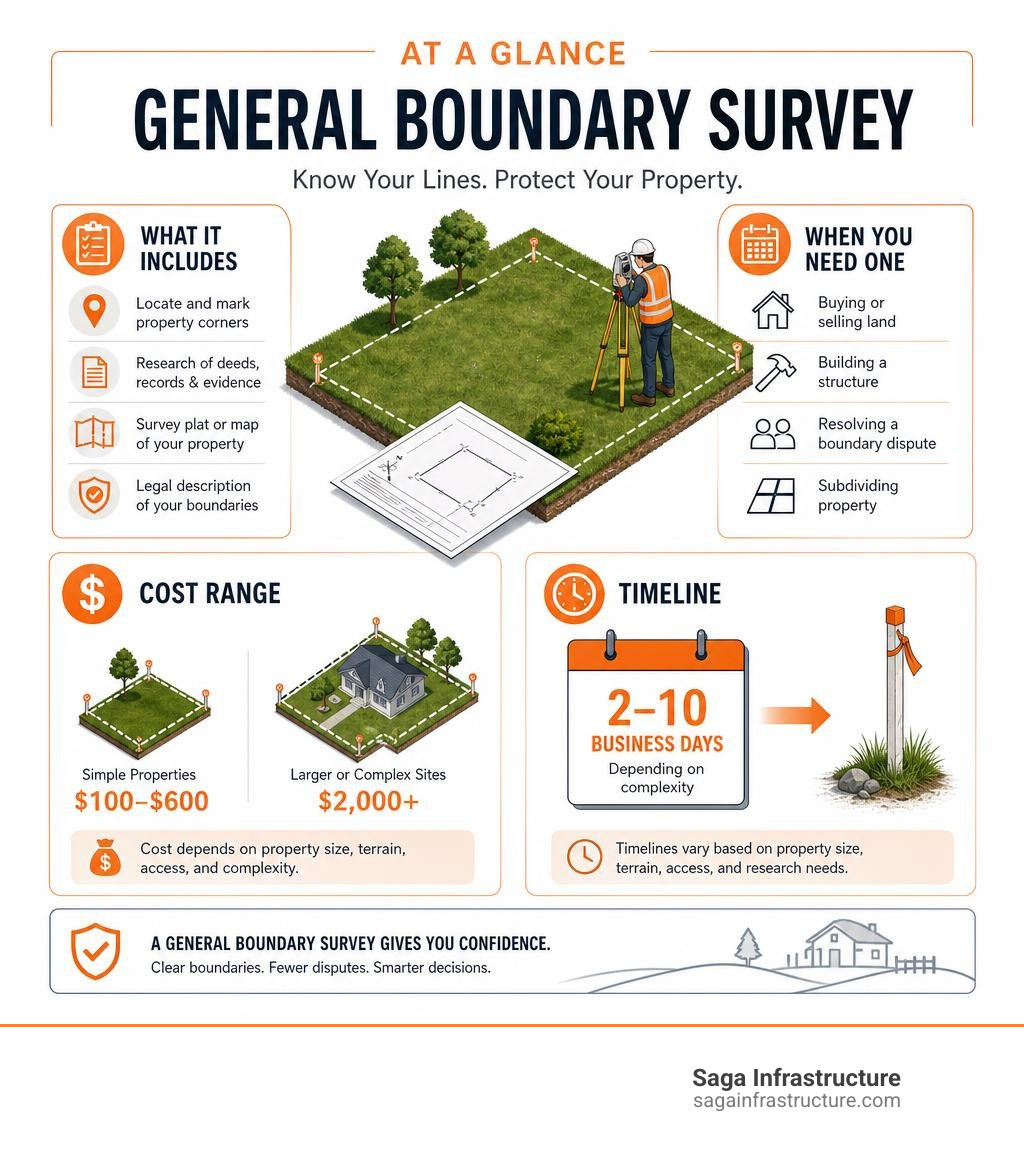
A general boundary survey is a way to find and mark the exact lines of a piece of land. A professional uses old records, deeds, and clues on the ground to do this.
Here is a quick summary:
- What it is: A map that shows where your land starts and ends.
- Who does it: A licensed land surveyor.
- What you get: Marked corners, a map of your land, and a written description of your property lines.
- When you need one: Before you buy or sell land, build a fence, or split your land.
- How long it takes: Usually 2 to 10 days.
- What it costs: About $100 to $600 for small yards, and $2,000 or more for big areas.
Many people do not know where their property lines are. This can cause big problems. You might build a fence on your neighbor’s yard by mistake. Or you might have trouble selling your house.
A general boundary survey stops these problems. It shows everyone exactly who owns what.
My name is Don Larsen. I am the CEO of Saga Infrastructure. We partner with great local companies across the country. Many of these companies do general boundary survey work every day. I know how important good surveys are for any building project.
General boundary survey word guide:
What is a General Boundary Survey?

A general boundary survey is like a checkup for your land. It is not just about using a tape measure. It is a careful process that uses history, law, and math.
First, a surveyor looks at old papers. They read old deeds and maps at the county office. This shows what the land should look like. Next, they go outside. They look for clues like old iron pipes, stone markers, or fences. They match the old papers with what they find on the ground. This tells them where your property lines really are.
To learn more, you can read the official Boundary Survey Definition. This definition shows that a survey is a real legal paper. It can help you if you ever have an argument with a neighbor.
Many people believe wrong things about property lines. To avoid mistakes, read about these 5 Common Myths About Land Surveying Services. For example, many people think a fence is always the true line. But fences are often built in the wrong spot! Only a real survey can find the true line.
Defining Property Line Boundaries
To find your property lines, a surveyor looks at three things:
- Monuments: These are objects in the ground that mark corners. They can be iron rods, concrete posts, or even big trees.
- Deeds: These are legal papers that say who owns the land and where the lines should be.
- Easements and Encroachments: Easements are areas where others can use your land, like power companies. Encroachments are things that cross your line by mistake, like a neighbor’s shed.
Surveyors must follow strict rules. For example, the Property Boundary Survey Regulations say what kind of metal rods surveyors must use. These rules protect land owners in states like Florida, Texas, and Arizona.
How a General Boundary Survey Differs from Other Land Surveys
Not all land surveys are the same. A general boundary survey only finds property lines. Other surveys do different jobs:
- Topographic Surveys: These show the shape of the land. They map out hills, trees, and buildings. They do not show legal lines.
- Construction Surveys: These show builders where to put roads and buildings.
- Subdivision Plats: These are used to split one big piece of land into smaller lots.
If you want to build a fence, you need Boundary Surveying Services. This is the only survey that protects your land rights.
Classifications and Accuracy Standards of Boundary Surveys

Land surveying must be very exact. Land has different values, so surveys have different classes. A survey for a big city building in Houston needs to be much more exact than a survey for a giant farm in Arizona.
Surveyors measure accuracy in two ways:
- Error of Closure: This is how close the survey ends up to where it started. If you walk around a yard and end up a tiny bit off, that is the error.
- Angular Error: This measures how exact the angles are when using survey tools.
For government lands, there are very strict rules. You can read about them in the Survey Tract Reviews and Cadastral Surveys guide.
Here is a simple chart that shows the different classes:
| Survey Class | Type of Land | How Exact It Must Be | Allowed Error |
|---|---|---|---|
| Class AA | Expensive City Land | 1 : 20,000 | 0.05 feet |
| Class A | Normal City Land | 1 : 10,000 | 0.10 feet |
| Class B | Neighborhood Yards | 1 : 7,500 | 0.12 feet |
| Class C | Farms and Ranches | 1 : 5,000 | 0.15 feet |
Understanding Class AA, A, B, and C Surveys
- Class AA: This is the most exact survey. It is used in big cities where land costs a lot of money.
- Class A: This is used for normal city properties. It keeps buildings and parking lots from crossing onto other properties.
- Class B: This is the standard for neighborhood homes. It is great for putting in fences or pools.
- Class C: This is used for big farms and ranches. Since the land is so big, a tiny error is okay.
State-Specific Accuracy Rules
Every state has its own rules. In North Carolina, where our partner RBC Utilities works, city surveys must be very exact. In Florida, Texas, and Arizona, surveyors use high-tech GPS tools to make sure the lines are perfect. This keeps your land safe.
How a General Boundary Survey is Conducted
Doing a general boundary survey takes a lot of careful work. Surveyors do research inside and work hard outside. They do not guess where lines are. They use high-tech tools to find the truth. To see these tools, read our guide on Top Tier GPS Land Surveying Equipment for Every Budget.
Step-by-Step General Boundary Survey Process
- Deed Research: The surveyor looks up old papers. They find the deeds for your land and your neighbors’ land.
- Field Measurement: The crew goes to your property. They look for old markers like iron pins or concrete posts in the ground.
- Traverse Running: The crew sets up temporary points around the yard. They use special tools to measure the exact angles and distances. To learn more, read The Ultimate Guide to Modern GPS Land Surveying Techniques.
- Data Analysis: Back at the office, the surveyor compares the new measurements with the old deeds. They figure out where the true lines should be.
- Boundary Marking: The crew goes back to your yard. They put down permanent iron rods to mark the corners. They often add bright tape so you can see them easily.
What is on a Survey Map?
When the work is done, you get a map called a survey plat. This map shows:
- True Boundary Lines: The exact lines and lengths of your land.
- Easements: Areas where utility companies have the right to go on your land.
- Improvements: Where your house, driveway, and fences sit.
- North Arrow and Scale: To show you which way is north.
- Surveyor Stamp: A special stamp that proves the map is official and correct.
ALTA/NSPS Land Title Surveys vs. Standard Boundary Surveys
If you are buying a business property in Florida, Texas, or Arizona, a normal survey might not be enough. Banks and insurance companies often ask for a special survey. This is called an ALTA/NSPS Land Title Survey.
These surveys must follow very strict rules. You can read them in the Minimum Standard Detail Requirements for ALTA-NSPS Land Title Surveys – 02-23-2026 document.
Here is how they are different:
- Standard Boundary Survey: This is for regular homes. It finds and marks your property lines. It is perfect if you want to build a fence or a shed.
- ALTA/NSPS Survey: This is for business properties. It shows the property lines, but it also shows utility lines, water features, and zoning rules.
To learn more about these surveys, read our article on Demystifying the ALTA Survey for Real Estate Professionals. If you are working on a big business project, you should also read Navigating Commercial Real Estate: A Comprehensive Guide to Surveys.
Cost, Timeline, and Modern Technology in Boundary Surveying
When you start a project, you always want to know: How much will it cost? and How long will it take?
If you live in Central Florida, you can talk to Minneola, FL Surveyors to get a price. Usually, a simple home survey costs between $100 and $600. Big business properties or large farms can cost $2,000 or more.
What Changes the Cost and Time?
A few things can make a survey cost more or take longer:
- Size of the Land: Big yards take longer to measure.
- Type of Ground: Flat, open yards are easy. Steep hills, thick woods, or wet swamps make the work slow.
- Plants and Trees: Thick bushes mean the crew has to cut paths to walk.
- Old Records: If the old papers are hard to read, the surveyor has to spend more time researching.
Using Drones and New GPS Tools
At Saga Infrastructure, we love using new technology. It makes the work safer and faster. Today, surveyors use drones and lasers (called LiDAR) to do their jobs.
- Drones: A drone can fly over a big piece of land in just a few hours. It takes clear pictures from the sky. This is much faster than walking.
- LiDAR: This tool uses lasers to map the ground. It can see right through thick trees and bushes.
These tools keep workers safe. They do not have to climb dangerous hills or walk through deep swamps. It also saves you money because the work gets done faster. In big states like Texas, the Texas General Land Office Surveying office uses these tools to keep land records correct.
Frequently Asked Questions About Boundary Surveys
How often should you get a new survey?
You should get a new survey every 5 to 7 years. You should also get one when you buy, sell, or build on your land. Even if your lines do not move, other things change. A neighbor might build a fence in the wrong spot. Or local rules might change. A new survey keeps you safe.
What is the difference between a boundary survey and a topographic survey?
A boundary survey is about legal lines and ownership. It shows where your land ends and your neighbor’s land begins. A topographic survey is about hills, trees, and flat areas. It shows the shape of the land. Builders use it to plan where water will flow and where to build.
What if a neighbor’s fence is on my land?
If a survey shows your neighbor built something on your land, do not worry. First, talk to them nicely. Most people make honest mistakes. You can sign a simple paper that lets them keep it there. If they will not cooperate, you may need to talk to a lawyer. Your survey map is your best proof.
Conclusion
A general boundary survey is the first step to owning land safely. It does not matter if you are building a fence in Florida or a big project in Texas. Knowing your lines keeps your money safe and stops fights with neighbors.
At Saga Infrastructure, we help local companies grow. We partner with great local businesses like Foshee Construction in Florida and RBC Utilities in North Carolina. We give them the tools and money they need to do great work. But we keep their local teams and cultures the same.
Kevin and Cindi Foshee started Foshee Construction. They said:
“When we wanted to sell our company, we wanted a buyer who cared about our team. Saga was the perfect partner. They respected our culture and helped our workers. They made the process very easy.”
We protect what others built. If you own a civil or utility business and want to grow, we want to help you.
Let’s talk. Visit Saga Infrastructure today to see how we can work together.