
Top-Tier GPS Land Surveying Equipment for Every Budget
Why the Right GPS Land Surveying Equipment Can Make or Break Your Project
GPS land surveying is now a key part of modern building work. It helps crews measure land with great care. It uses signals from satellites in space.
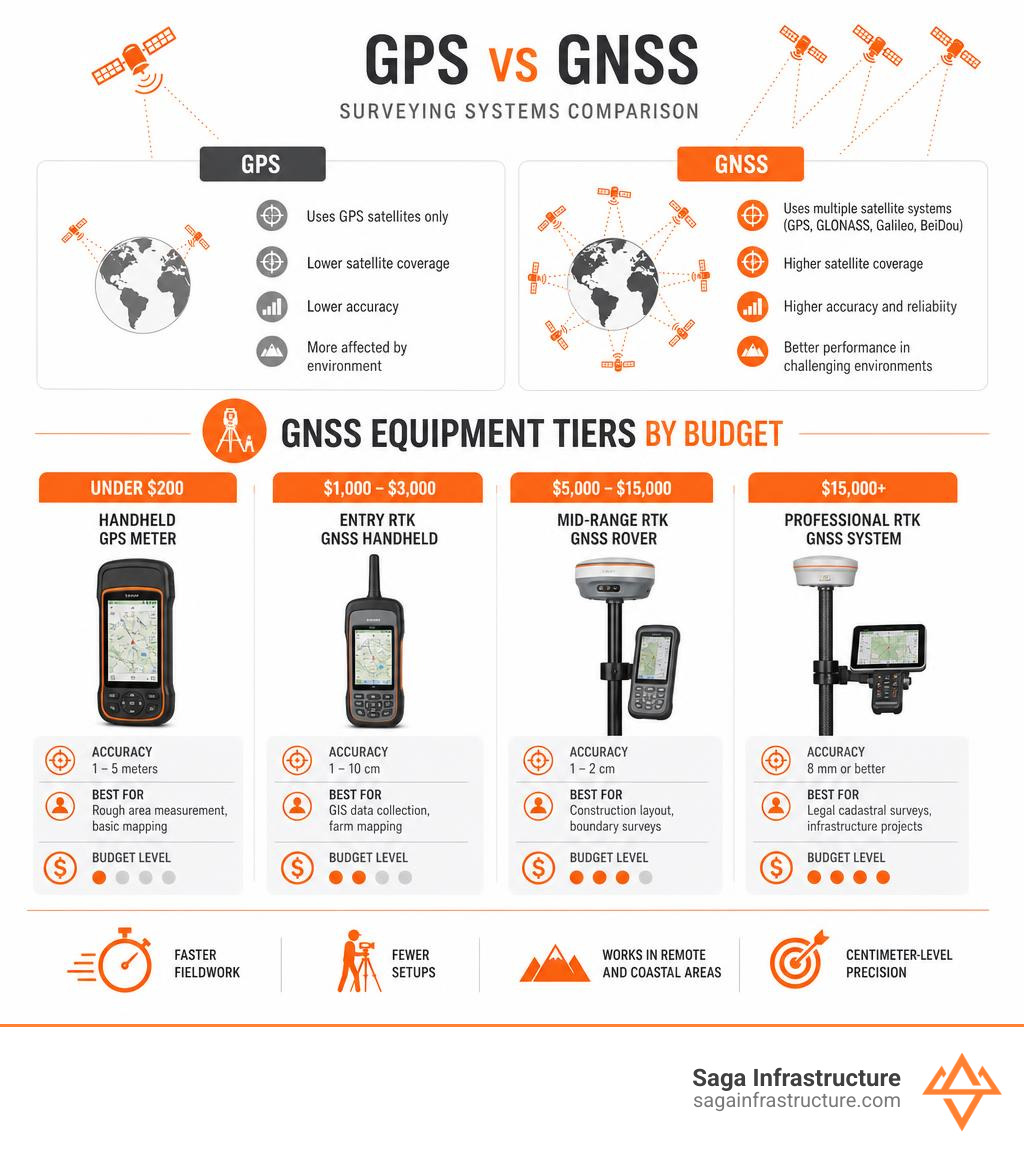
Need a quick answer on what to buy? Here is a simple guide:
| Budget | Equipment Type | Typical Accuracy | Best For |
|---|---|---|---|
| Under $200 | Handheld GPS meter | 1-5 meters | Rough land size checks and simple maps |
| $1,000-$3,000 | Entry RTK GNSS handheld | 1-10 cm | GIS work and farm maps |
| $5,000-$15,000 | Mid-range RTK GNSS rover | 1-2 cm | Building layout and boundary work |
| $15,000+ | Professional RTK GNSS system | 8mm or better | Legal surveys and large projects |
Old survey tools often need a clear view from one point to another. GPS tools do not. This helps crews work faster. It also means fewer setups. It can work well in remote places and near the coast.
The world market for GNSS survey tools was about $2.8 billion in 2023. It may reach $4.5 billion by 2030. This shows that more teams are using satellite tools for careful work.
I’m Don Larsen, CEO of Saga Infrastructure. I lead a national group of local civil and utility companies. Our teams use GPS land surveying to build with care and trust. My work in construction helps me know which tools work well in the field.
Common GPS land surveying words:
What is GPS Land Surveying and How Does It Work?
Long ago, surveyors used tools that needed a clear view. They had to see from one point to the next. A hill, trees, or a building could slow the job down.
Modern GPS land surveying helps fix that problem. It uses satellites that move around Earth. A receiver on the ground listens to signals from many satellites. It measures how long each signal takes to arrive. Then it finds the exact spot on the ground.

Surveyors use a few main methods to get very careful results:
- Static Baseline Surveying: This is very accurate. Surveyors place two receivers on steady points. The receivers collect satellite data for at least 20 minutes. Some jobs take hours. This can give results as close as 5 millimeters. It is good for setting control points on big job sites in Florida, Texas, or Arizona.
- Real-Time Kinematic (RTK) Observations: RTK is used a lot in construction. It uses one fixed receiver called a Base. It also uses one moving receiver called a Rover. The Base sends fixes to the Rover by radio or internet. This gives the worker accurate points right away.
- CORS (Continuously Operating Reference Stations) Networks: You may not need your own Base station. A CORS network can help. These are fixed stations that send correction data over the internet. A Rover can use this data to get RTK-level accuracy.
For more detail on these work methods and rules, read the Guidelines for the use of GNSS in surveying and mapping. You can also read our guide, The Ultimate Guide to Modern GPS Land Surveying Techniques.
Key Equipment Tiers for GPS Land Surveying
The right tool depends on your job and your budget. You do not need a $20,000 system to map a trail. But you should not build a bridge with a $150 handheld tool. Here are the main choices.
1. Consumer-Grade Handhelds and Meters (Under $200)
These are simple tools. Hikers and landowners often use them. Some handheld GPS land meters cost between $78.90 and $199.99.
- Accuracy: Usually 1 to 5 meters.
- Best For: Rough land size checks, basic property line checks, forestry, and simple maps.
- Limits: They do not use RTK correction networks. They are not accurate enough for building layout or legal boundary fights.
2. GIS Data Collectors & Entry-Level GNSS ($1,000 – $3,000)
These tools are better than basic handhelds. They may look like strong tablets or phones. They can run mapping apps like the Land Map – GPS Land Survey & M app.
- Accuracy: About 10 to 30 cm by itself. It may reach centimeter accuracy with a budget RTK antenna.
- Best For: Utility maps, nature studies, asset tracking, and farm maps.
- Limits: They may not work well under thick trees. They may not have advanced tilt tools found in top systems.
3. Professional RTK GNSS Systems ($5,000 – $20,000+)
These are the top tools for civil construction and engineering. They are built for hard work. Brands like Trimble, Leica, and high-end SMAJAYU systems are common in this group.
- Accuracy: About 1 centimeter side to side. About 1.5 to 2 centimeters up and down.
- Best For: Roads, foundations, utility digging, and legal boundary surveys.
- Limits: They cost more. Crews also need training to use them well.
To learn what these accuracy levels mean on real jobs, read our guide on 5 Common Myths About Land Surveying Services.
Key Features to Look For in Professional GNSS Systems
If you plan to buy professional GPS land surveying tools, focus on what matters in the field. Do not get pulled in by fancy screens. Look for these features first:

Multi-Band Technology
Older GPS units listen to one signal type. This is often called L1. Better units listen to several types, like L1, L2, and L5. This helps the receiver spot and reduce errors. It also helps the tool start faster and stay accurate.
Multi-Constellation Support (GNSS)
People often say GPS for all satellite tools. But GPS is only the U.S. satellite system. GNSS means the tool can use many satellite systems at once:
- GPS (United States)
- GLONASS (Russia)
- Galileo (Europe)
- BeiDou (China)
When a receiver can see more satellites, it works better. It may track 30 or more satellites instead of only 8 or 10. This helps near trees, tall buildings, and deep valleys. For official guidance, see the RICS standard on the Use of GNSS in land surveying and mapping.
IMU Tilt Compensation
In the past, a surveyor had to hold the pole perfectly straight. If the pole tilted, the point could be wrong. Modern receivers can have an IMU. This sensor knows how much the pole is tilted. It can still find the right ground point. This can make field work faster. It can also help workers stay safer on slopes.
Ruggedness and Battery Life
Survey tools must handle rain, mud, heat, and drops. Look for an IP67 or IP68 rating. This means the tool is protected from dust and water. Also look for batteries you can swap without turning the tool off. This helps keep the satellite connection.
Key Uses of GPS Land Surveying in Modern Infrastructure
At Saga Infrastructure, we see these tools help on real jobs every day. We use GPS land surveying for water lines in Clermont, Florida. We use it for large sites in Texas. We use it for utility paths in the Arizona Sun Corridor. It helps every part of the job stay on track.
1. Civil Construction and Site Grading
Before a bulldozer moves dirt, our teams map the land with RTK GNSS tools. This map can go into GPS-guided machines. The machines use a 3D model to guide their blades. This helps shape the site the right way. It can also help stop flooding and protect buildings.
2. Utility Installation and Asset Mapping
When crews install water, sewer, or gas lines, exact locations matter. We record the location of each pipe and valve before the trench is covered. This creates a clear digital map. Years later, crews can find a buried valve fast. This helps avoid damage and danger.
3. Boundary and ALTA Surveys
For commercial real estate, buyers need to know the exact property lines. They also need to know about easements and anything that crosses a line. Professional GNSS tools help surveyors connect local property corners to trusted national data.
To see how these surveys protect your investment, read Demystifying the ALTA Survey for Real Estate Professionals and Navigating Commercial Real Estate: A Comprehensive Guide to Surveys.
Frequently Asked Questions About GPS Land Surveying
How accurate is GPS land surveying compared to older methods?
Older tools, like total stations, can be very accurate over short distances. But they need a clear view. They also need more setup time. RTK GNSS tools can reach centimeter-level accuracy across large areas. They are often about 1 cm accurate side to side and 1.5 cm up and down. For legal boundary work, surveyors may use both GPS and older tools to check the results. You can learn more in this guide on the Purpose: GPS Cadastral Survey Procedure, Leica GPS System 1200.
What is the difference between GPS and GNSS in GPS land surveying?
GPS is a satellite system run by the United States. GNSS is the larger name for all satellite systems. It includes GPS, Russia’s GLONASS, Europe’s Galileo, and China’s BeiDou. A professional survey receiver is usually a GNSS receiver. This means it can use many systems at once.
How do trees, buildings, and weather affect RTK GNSS accuracy?
GNSS tools need signals from satellites. Trees, tall buildings, and cliffs can block those signals. Metal objects and water can also bounce the signals. This can cause wrong readings. Surveyors check signal quality before they trust a point. If satellite signals are poor, they may use optical tools instead.
Conclusion
Buying the right GPS land surveying tools is not about picking the most costly option. It is about choosing the right tool for your job, your team, and your land.
At Saga Infrastructure, we know strong projects need good tools and local know-how. We partner with strong local civil and utility contractors. We give them national scale, capital, and better technology. We also protect their local names, teams, and legacies.
One example is our partnership with Foshee Construction in Minneola, Florida. Foshee has deep roots in its community. Saga brings national support and resources. Together, we help deliver careful work on important projects in the region.
If you are a local contractor looking to improve your field tools, we can help. If you are a founder thinking about your company’s future, we can help too.
Let’s talk. Visit Saga Infrastructure to learn how we join local skill with national strength.