Categories
Blog

Don’t Let Your Roof Leak: The Importance of Regular Inspections

Don’t Let Your Roof Leak: The Importance of Regular Inspections

Your Roof Protects Your Home — Don’t Ignore It

Roofing inspection services are when a pro looks at your roof. They find small problems before they become big, expensive ones.

Quick Facts:

Question Quick Answer
What is it? A pro checks your roof for damage
How often? Once a year and after big storms
Who does it? A trained roof expert
How much? Prices vary, but some are free
When is it needed? Before buying a house or after a storm

Most roofs last 20 to 50 years. But you must take care of them. Damage can hide where you can’t see it. A small leak can hurt your whole house.

Checking your roof is the best way to save money.

I am Don Larsen. I lead Saga Infrastructure. I help take care of the buildings in our towns. I know a lot about construction. In this guide, I will help you learn about roof inspections.

Infographic showing roof inspection process: annual schedule, checklist items, inspection types, and post-inspection steps

What is a Roof Inspection?

A professional inspection is more than just a quick look. A pro checks every part of your roof. They look at the shingles, the wood underneath, and the gutters.

Think of it like a check-up at the doctor. A doctor finds health problems early. An expert in roof inspection services finds leaks before they ruin your house.

At Saga Infrastructure, we know that small details matter. A roof has many parts. If one part fails, the whole roof can leak. This is like how experts use ALTA surveys to learn about land. Both help protect your money.

Homes vs. Business Buildings

Inspections are different for houses and big stores. For houses, pros look for broken shingles or bad vents.

For big stores with flat roofs, pros use special tools:

  • Heat Cameras: These find water hiding under the roof.
  • Core Samples: Pros take a tiny piece of the roof to see if it is wet inside.
  • Planning: This helps owners of many buildings decide which roof to fix first.

Drones and New Tech

Technology helps us see roofs better. Drones can fly over your house and take clear pictures. This is safe because no one has to climb up.

These pictures are saved on a computer. You can use them to show your insurance company if a storm hits. This helps prove what the roof looked like before the damage.

When to Get Your Roof Checked

Don’t wait for water to drip from your ceiling. Most experts say you should get a check-up once a year. If you live where it rains or storms a lot, this is very important.

You should also call a pro if:

  1. A Big Storm Hits: Wind and hail can break shingles fast.
  2. You Are Selling Your House: You need to know if the roof is good before you sell.
  3. Insurance Needs It: Some companies want to know the roof is safe.

Image of a roof with visible storm damage including missing shingles and dented flashing - Roofing inspection services

5 Signs Your Roof Needs Help Now

Call a pro if you see these things:

  • Missing Shingles: If you see bare spots on the roof or shingles on the grass.
  • Water Stains: Look for brown circles on your ceiling.
  • Sand in the Gutters: If your gutters are full of small rocks from the shingles.
  • Sunlight in the Attic: If you see light coming through the roof boards.
  • Green Moss: Moss holds water and can make the roof rot.

The Best Time for a Check-up

The best time is late spring or early fall. In the spring, you can fix damage from winter. In the fall, you can get ready for rain and snow. If you want to sell your house, get an inspection first. It is easier to fix small things before you list it.

What Happens During an Inspection?

An inspection takes about 45 to 90 minutes. The pro looks at the outside and the inside of your roof.

On the outside, the pro climbs up or uses a drone. They look for holes or things the builder did wrong.

On the inside, they go into your attic. They check for:

  • Air Flow: If the attic is too hot, it can ruin the shingles.
  • Insulation: This keeps your house warm and saves money.
  • Wet Spots: They look for mold or wood that is starting to rot.

The Inspection List

A good pro uses a list so they don’t miss anything. They check:

  • Shingles: Are they broken or curling?
  • Metal Seals: These are around chimneys to keep water out.
  • Rubber Boots: These go around pipes and can crack over time.
  • Gutters: Does the water flow away from the house?

The Report

After the check-up, you get a written report. It should have:

  1. The Roof’s Age: How many years the roof has left.
  2. Pictures: Photos of any damage.
  3. Price to Fix: How much it will cost to repair.
  4. A Certificate: A paper saying your roof is in good shape.

How to Pick the Right Inspector

You have two choices: a roofer or a consultant.

A roofer fixes roofs. Many give free inspections because they want to do the repair work. Most are honest, but they want to sell you a new roof.

A consultant only looks at roofs. They do not fix them. You pay them for their time. They give you an honest opinion. This can save you from buying a new roof when you don’t need one.

At Saga Infrastructure, we think safety is key. Just like fireproofing inspections are important, a good roof inspection keeps your building safe.

Look for a Pro

Look for a pro with special training. Some have a GAF Master Elite® badge. This means they are in the top 2% of roofers. They know exactly what to look for.

Which One Should You Pick?

  • Pick a Roofer if: You think a storm broke your roof and you need a free price to fix it.
  • Pick a Consultant if: You are buying a very big building or you want a second opinion.

Common Questions

How much does it cost?

For a house, it usually costs $150 to $400. Some local roofers will do it for free. Big business buildings cost more because they are larger.

How long does it take?

It usually takes 45 to 90 minutes. If they use a drone, it might be faster. Big warehouses can take a few days.

Can I do it myself?

You can look at your roof from the ground with binoculars. But do not climb on your roof. It is very dangerous. You might fall. Also, a pro can see small problems that you might miss.

Conclusion

Your roof is a big part of your home. It protects your family and your things. Getting a roof inspection is a smart way to take care of your house.

At Saga Infrastructure, we want to help our towns stay strong. We work with local experts to make sure buildings last a long time. We believe that taking care of what we have today is the best way to build for the future.

Don’t wait for a big storm. Get a roof check-up today and feel safe in your home.

Start your project today and let us help you protect your home.

Categories
Blog

Navigating Commercial Real Estate: A Comprehensive Guide to Surveys

Navigating Commercial Real Estate: A Comprehensive Guide to Surveys

What Is a Commercial Real Estate Survey? (And Why It Matters)
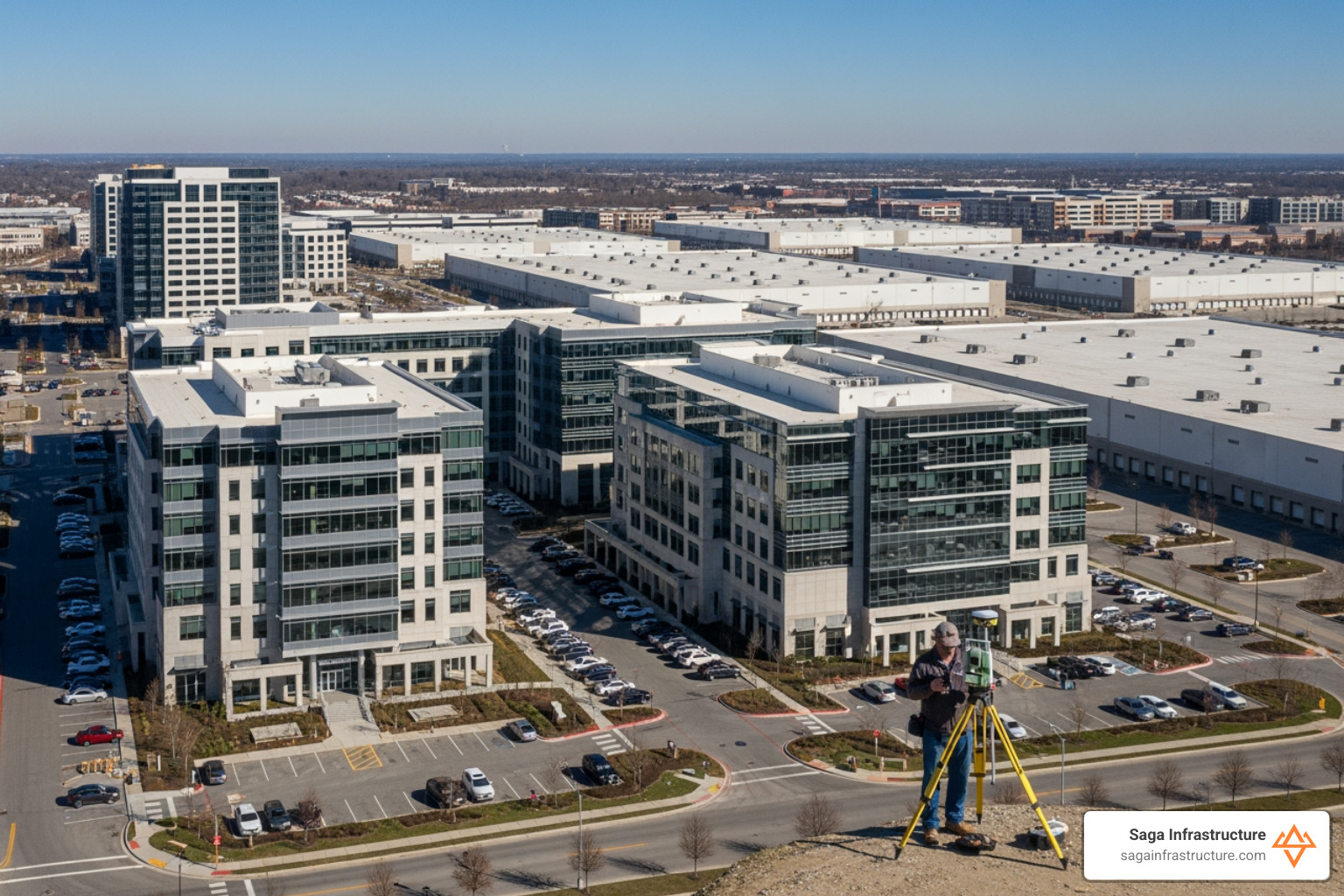
commercial real estate survey

A commercial real estate survey is a very important tool. It can mean two different things depending on who you ask.

Here is a quick look:

Type What It Does Who Uses It
Market survey Checks if people feel good about buying buildings Investors and banks
Land survey Maps out property lines and pipes Builders and cities

Both help people make big choices. Right now, market surveys show that people are happy. A big survey showed that 63% of people say things are better than last year and 70% think they will get even better. Land surveys are also important. They help us build things like roads and buildings safely.

I am Don Larsen, CEO of Saga Infrastructure. I have worked in building and business for a long time. I know how these surveys help us make good choices. In the sections below, I will explain what these surveys show us.
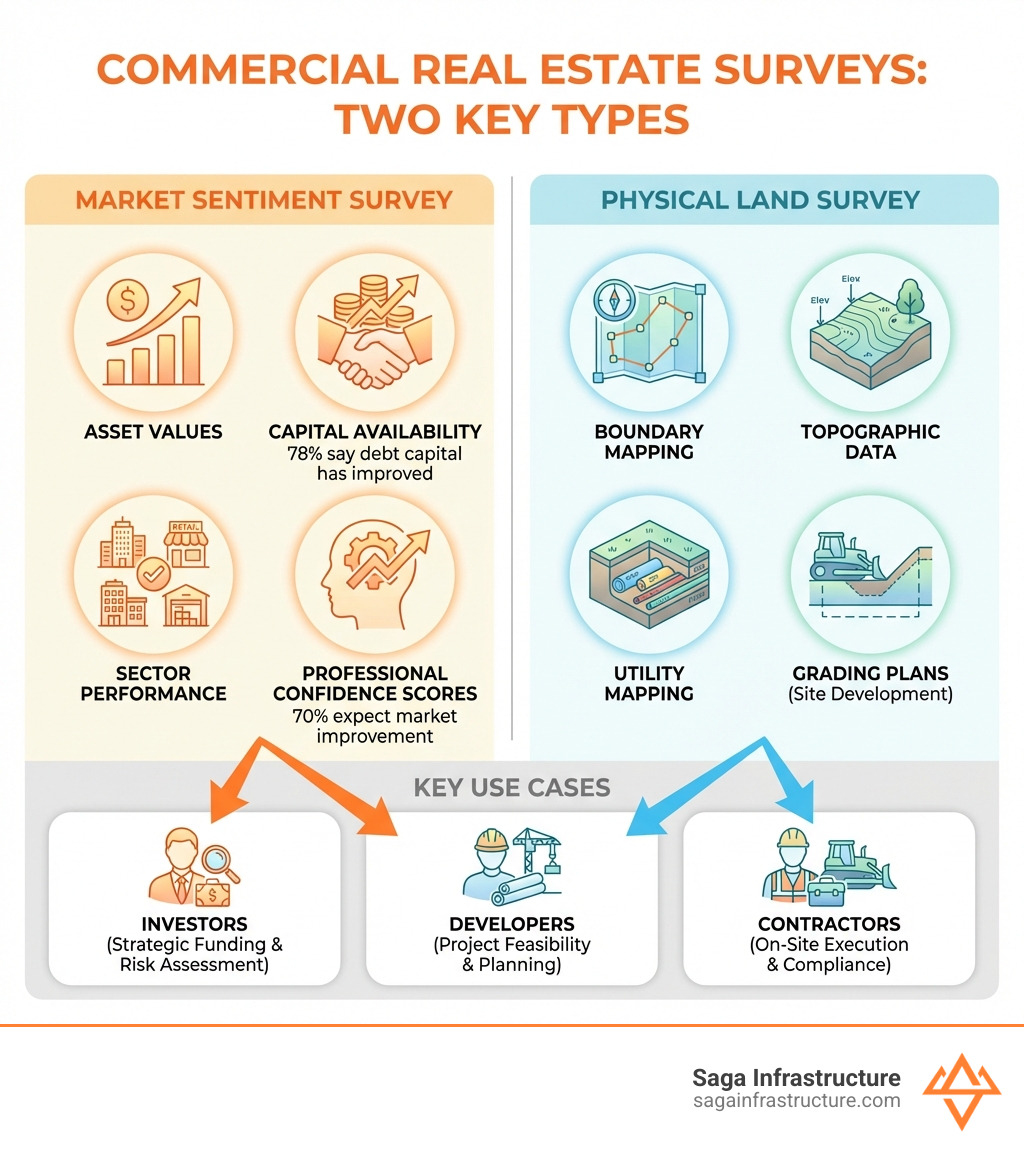
Infographic showing the two types of commercial real estate surveys: (1) Market Sentiment Survey with icons for asset values, capital availability, sector performance, and professional confidence scores with example statistics like 70% expect market improvement and 78% say debt capital has improved; (2) Physical Land Survey with icons for boundary mapping, topographic data, utility mapping, and grading plans used in site development; both types shown side by side with arrows pointing to their key use cases for investors, developers, and contractors - commercial real estate survey infographic

Understanding the Market Survey

modern office building - commercial real estate survey

A commercial real estate survey is like a “mood check” for the industry. It asks big bosses if they think the future looks good.

For 2026, the outlook is bright. Almost everyone (97%) thinks the market will stay strong or grow. In states like Florida, Texas, and Arizona, people are excited. One boss said it feels like “coming out of the fog.” When people feel good, they start new projects. This means we get to build more roads and foundations.

How Surveys Help People Buy

If you want to buy a building, you need to know if the price is fair. A commercial real estate survey about prices helps you decide. In late 2025, many leaders thought prices were starting to go up. This is a sign that the market is getting healthy again.

Staying Safe with Surveys

Surveys also help us avoid big mistakes. We use them to check:

  • Land Use: What can we build on this dirt?
  • City Rules: Does the city allow a warehouse here?
  • Site Planning: How do we fit the building and the parking lot?

For example, when we build projects like The Vue Clermont, we check every inch. If you skip a survey, you might build in the wrong spot. That is a very expensive mistake!

Land Surveys for Building

Now let’s talk about the survey where people wear orange vests and use lasers. This is a physical commercial real estate survey. It is the start of everything we do at Saga Infrastructure.

Before we dig, we need a map. This map shows exactly where the land ends. These are often called ALTA surveys. They show everything: fences, pipes, and where water flows when it rains.

Important Data for Building

When we build things like the Hills of Minneola Crooked Can Infrastructure, we need three main things from a survey:

  1. Dirt Plans: This tells us how to move dirt so the ground is flat for buildings.
  2. Pipe Maps: We need to know where the water and power lines are. We don’t want to break them!
  3. Land Shape: This shows the hills and holes on the land.

At Saga, we say “measure twice, cut once.” Good maps help us build things the right way.

Different Types of Buildings

Not all buildings are the same. Depending on what you build, the “weather” in the market might be sunny or rainy.

  • Offices: Many people work from home now. This means some old offices are empty. But new, fancy offices are still doing well.
  • Shops: Stores are doing okay! People still like to go to the store for food or the gym.
  • Warehouses: These are the stars. We need them to store all the things people buy online.
Type How it looks Main Challenge
Office Changing Empty rooms
Shops Steady Buying online
Warehouses Very Strong Finding big land

Projects like Skyline at Westfall show how this works. When a sector is strong, we build the roads and pipes to help it grow.

Money for Building

You cannot build without money. A commercial real estate survey often looks at where the money comes from.

For a while, it was hard to get a loan because interest rates were high. In 2022, rates were around 3.9%. By 2025, they were up to 6.6%. That makes a big difference in how much a builder can spend.

But there is good news! Banks are starting to relax. In 2023, many banks made it hard to get a loan. By 2025, only a few were still doing that. This means more projects are getting the green light.

Other Ways to Get Money

If a bank says no, builders can find money from other groups. These might be private funds or wealthy families. Last year, these groups helped a lot. There is a lot of extra cash waiting to be spent on new buildings, like the ones at Mirror Lake.

Where You Build Matters

Where you build is just as important as what you build. States like Florida, Texas, and Arizona are the best places to be right now.

  • Florida and Texas: Lots of people are moving to these states. More people means we need more houses, shops, and roads.
  • Arizona: Many companies are building high-tech factories there. This creates a need for big buildings.

At Saga Infrastructure, we focus on these fast-growing areas. We know that local builders understand their own land best. We give them the tools they need to build for the future.

Common Questions about Commercial Surveys

What is the outlook for 2026?

It looks very good! About 97% of experts think the market will be stable or grow. Interest rates should stay steady. In states like Florida and Texas, things will grow even faster because so many people are moving there.

What is the difference between the two surveys?

Think of it like this: One survey tells you if you should build. The other tells you how to build. You need both to be successful.

Why is it easier to get money now?

Banks feel better because building values are steady. Also, new groups are ready to lend money. When it is easier to get money, it is easier for builders to start working.

Conclusion

Building can be like a maze, but a commercial real estate survey is your map. Whether it is a survey about feelings or a map of the dirt, this data keeps things moving.

At Saga Infrastructure, we help local building companies. We take great local teams—like Foshee Construction—and give them the help they need to grow. We think local builders are the heroes. They have the heart and the local knowledge.

If you run a building company and want a partner, or if you are a builder who needs help, let’s talk.

Let’s start the conversation

Categories
Blog

How to Sell Your Family Business Without Collapsing the Foundation

How to Sell Your Family Business Without Collapsing the Foundation

Why Buying a Construction Company Matters Now

More people are buying construction companies than ever before. In 2025, there were 562 sales. This is a big jump from the year before. For owners, this is a big chance to make money. But it can also be scary to sell what you built.

Why are people buying these companies in 2026?

  • Hard to find workers – Most builders cannot find enough help. Buying a company is a fast way to get a good team.
  • High prices – Buyers are paying a lot of money for good businesses.
  • Lots of work – We need more data centers, power lines, and houses.
  • Growing is hard – Small companies need more help to handle big rules and costs.
  • Retirement – Older owners want to leave their business in good hands.

Selling to the wrong person can be bad. Your company name might go away. Your team might lose their jobs. But waiting too long can also be a mistake. You want a partner who likes your culture and your people.

I am Don Larsen from Saga Infrastructure. I have spent my life building construction businesses. I know how to keep what you built safe while helping it grow.

Infographic showing the civil construction company acquisition process: 1) Discovery and confidential business evaluation, 2) Valuation and buyer selection based on cultural fit and financial terms, 3) Due diligence including backlog review and workforce assessment, 4) Transaction structuring with leadership and brand preservation, 5) Post-closing integration with operational support and shared resources - civil construction company acquisition infographic

What is Happening in Construction Sales?

Construction is changing fast. Many people want to buy construction companies right now. In 2025, there were many sales. This is because there is a lot of work to do. We need to fix bridges, build roads, and help the power grid.

Heavy machinery operating on a large-scale civil infrastructure job site - civil construction company acquisition

Big companies want to buy smaller ones. They want your tools and your workers. If you own a family business, you might get a call from a buyer soon.

How Much is Your Company Worth?

We look at how much money your business makes to find its price. Some buyers pay more than others.

  • Investment Groups: They often pay the highest prices.
  • Other Construction Companies: They pay a bit less but know the work well.

In 2025, investment groups bought more than half of the companies. They have a lot of cash. But the highest price is not always the best. You want a buyer who knows how to move dirt and fix pipes.

Your Future Work

Buyers love to see that you have a lot of work planned for the future. This is called your “backlog.” If you have big jobs lined up, your company is worth more. It shows the buyer that the business will keep making money after they buy it.

Why More Companies are Joining Together

It is very hard to find workers today. This is the main reason companies are buying each other. Most builders say they cannot find enough people to do the work. If a company needs 50 workers, it is easier to buy a company that already has them.

Costs are also going up. Things like tools and pay for workers cost more now. Small companies have a hard time paying these high costs. Joining a bigger group like Saga Infrastructure can help.

Areas That are Growing Fast

Three areas are very busy right now:

  1. Data Centers: Computers need big buildings. These need a lot of digging and pipe work.
  2. Power: We need to fix the power grid. This means more work for many years.
  3. Houses: People still need new homes in states like Florida.

Specialized Workers

Companies that do special work, like paving or electrical, are being bought fast. Big firms want to own every part of the job. They want to own the trucks, the tools, and the crews.

Picking the Right Buyer

Picking a buyer is a big choice. You have two main types of buyers:

1. Investment Groups: These groups have a lot of money. They like to buy many small companies and turn them into one big company.

2. Other Construction Companies: These are builders like you. They might want your tools or your location. They understand the work, but they might change your company name.

Why Sell Now?

Selling can help you stay safe. Construction is getting more expensive. By joining a bigger group, you get:

  • Better prices on tools.
  • Help with hiring workers.
  • Better pay and benefits for your team.
  • More help with the hard parts of the business.

Keeping Your Name and Your People

Selling a business is personal. You do not want your name taken off the trucks. You do not want your workers to lose their jobs.

At Saga Infrastructure, we do things differently. We want you to keep your local name. We want to help you grow while keeping your team safe.

Keeping Your Culture

Some buyers try to change everything on the first day. This makes workers unhappy. We do not do that. We keep your leaders in place. We keep your culture the same.

Kevin and Cindi Foshee built a great company in Florida. When they sold, they wanted a partner who liked their team. They said Saga was the perfect partner. We respected their work and their people.

How We Help

We help with the office work like taxes and hiring. This lets you focus on the construction work. We also bring better safety rules to keep your crew from getting hurt. You still run your business, but we give you the tools to do more.

Common Questions About Selling

How much will I get for my company?

It depends on your tools and how much work you have planned. Companies in states like Texas and Florida often sell for more money.

Does it matter if I can’t find workers?

If you have a good team that stays with you, your company is worth more. Today, a good crew is worth more than the machines they use.

Can I keep my company name?

Many buyers will change it. But with Saga Infrastructure, you keep your name. We like your reputation and want to keep it.

Conclusion

Now is a great time to sell your construction company. There is a lot of work to do in states like Florida, Texas, and Arizona. You can make sure your family is set for the future.

Your business is more than just money. It is the roads you paved and the people who work for you. You deserve a partner who cares about those things.

At Saga Infrastructure, we want to be your partner. We have the money and tools to help you grow. But we also make sure your local name stays strong.

Let’s talk. We can help you see what your options are for the future.

Categories
Blog

The Ultimate Guide to Paving Contractors in Florida

The Ultimate Guide to Paving Contractors in Florida

Why Finding the Right Paving Workers in Florida Matters

Paving workers in Florida fix small driveways and big highways. If you pick a bad worker, it will cost a lot of money. Your road will not last long.

Here is what to look for:

Factor What to Look For
Experience 30+ years in business
License Valid Florida license
Grade A+ rating
Services Asphalt and concrete
Area They work in your town
Tests They pass their inspections

There are many paving workers in Florida. Some cities have over 500 of them. You must know how to pick the best one.

Florida is very hot. It also rains a lot. This is hard on roads. A good worker knows how to build roads that last in this weather.

I am Don Larsen. I lead a company called Saga Infrastructure. We partner with great paving workers in Florida. I know what makes a paving company good or bad.

Infographic showing the key criteria for evaluating paving contractors in Florida: licensing and permits with 90%+ inspection pass rate, BBB rating of A or A+, years of experience over 30 years, services offered including asphalt concrete sealcoating and site development, geographic coverage across Florida counties, and material quality including owned asphalt plants - paving contractors in florida infographic

What Paving Workers Do in Florida

Paving workers in Florida do more than just pour black tar. They help plan the whole project. They fix the dirt and paint the lines.

Common jobs include:

  • Asphalt Paving: This is used for roads and driveways.
  • Concrete Work: This is for sidewalks and curbs.
  • Sealcoating: This is a paint that protects the road from the sun.
  • Fixing Cracks: This stops small holes from becoming big ones.
  • Painting Lines: This makes parking lots safe.
  • Drainage: This helps move rain water away so it does not flood.

You can Play Overview Video: Paving Experts to see how they work. You can also find more info about civil construction to see how big projects get done.

Keeping Roads Good

It is cheaper to fix a small problem now than a big one later. We tell people to clean and seal their roads often. This helps the road stay strong in the Florida sun. If a curb breaks, water can get under the road and ruin it.

Big Projects

Some paving workers in Florida work on very big jobs. They build airport runways and big highways. They also put in utility infrastructure, like water pipes, under the ground before they pave.

How to Pick a Good Paving Team

There are many workers to choose from. How do you pick the best one? Look at their grades. In some cities, the best workers pass their tests 95% of the time. If a worker fails tests, they are doing a bad job.

What to Check

  • Permits: Good companies always get the right papers from the city.
  • Special Skills: Some workers are better at concrete. Others are better at asphalt. Pick the one you need.
  • Years in Business: Look for teams with 30 or 40 years of work. They know how to handle Florida weather.

Good workers often own their own tools and trucks. This means they can start the job faster.

Feature Asphalt Concrete
Strength Bends a little Very hard, lasts long
Heat Gets very hot Stays cooler
Fixing Easy to fix Hard to fix
Price Costs less Costs more

Florida Weather and Your Road

crew applying sealcoating - paving contractors in florida

Florida is hard on roads. The hot sun makes the black road turn gray and break. We also get a lot of rain every year.

Water is the Enemy

Water can ruin a road. If the road is not slanted right, water will sit on top. Then it sinks into cracks and washes away the dirt underneath. This makes big holes. Sealcoating acts like a skin to keep water out.

The Hot Sun

In Florida, the road can get as hot as 140 degrees. This can make the road soft. Good workers use a special mix of rocks and oil so the road stays hard even when it is very hot.

Big Jobs and Small Jobs

Different jobs need different plans. A big store needs a different road than a house.

Working for Stores

Stores need to stay open while we work. We fix one half of the parking lot at a time. This way, cars can still park. We help store owners plan their repairs over many years so they don’t have to pay all at once.

Working for Houses

For houses, people want the driveway to look pretty. We use stones and bricks to make driveways look nice. A good driveway makes a house worth more money. It is also safer for kids to play on.

Common Questions

How many paving workers are in Florida?

There are over 1,000 workers, but only a few can do very big jobs. Only about 266 teams focus just on concrete.

How do I know if a worker is good?

Look for an A+ grade. They should have been in business for 30 years. They should have a license and insurance. They should show you old jobs that still look good today.

Do they do more than just pave?

Yes. The best teams can move dirt, fix water pipes, and tear down old buildings. Some even recycle old roads to make new ones. This is good for the earth and saves money.

Conclusion

At Saga Infrastructure, we help local builders. We give them money and tools to do a better job. They keep their name and their team. We just help them grow so they can build for a long time.

If you own a paving company and want to grow, or if you need a partner for a big project, start a conversation with Saga Infrastructure. We are here to help you build.

Categories
Blog

The Essential Guide to Grading and Drainage Systems

The Essential Guide to Grading and Drainage Systems

The Essential Guide to Grading and Drainage Systems

Why Hiring the Right Grading & Excavation Contractor Is Important

A grading & excavation contractor is a worker who gets the land ready for building. They move dirt, shape the ground, and dig holes for foundations. Here is what they do:

  • Cleaning the land — taking away trash, plants, and old buildings
  • Digging — making holes for the bottom of the house and for pipes
  • Leveling — making the ground flat so water flows away
  • Filling and packing — putting dirt back and pressing it down tight
  • Water control — making sure rain does not wash the dirt away

Every building starts in the dirt. Before you build walls, the ground must be ready. That is the job of a grading and excavation contractor.

If they do a good job, the rest of the building goes well. If they do a bad job, the house might crack or flood. Experts who have worked for 40 years say that you must not skip this step.

I am Don Larsen, CEO of Saga Infrastructure. I have seen how important this work is for every building. In this article, I will tell you about the machines, the costs, and how to pick the right helper.

Infographic showing 5 steps of site development: Step 1 Site Investigation and Soil Testing with icon of soil layers and survey markers; Step 2 Land Clearing and Demolition with icon of bulldozer removing debris; Step 3 Excavation and Foundation Digging with icon of backhoe digging a trench; Step 4 Grading and Drainage Setup with icon of laser level and water flow arrows; Step 5 Backfilling, Compaction, and Site Cleanup with icon of compaction roller and clean finished lot - grading & excavation contractor infographic roadmap-5-steps

What Does a Grading & Excavation Contractor Do?

Building starts with “heavy lifting.” A grading & excavation contractor does more than just play in the dirt. They make sure the ground is strong enough to hold a heavy building. They clear the land, dig holes, and make paths for water and power lines.

excavator at work on a construction site - grading & excavation contractor

Excavation vs. Grading

These two words mean different things. Excavation is for digging out. Grading is for shaping.

Feature Excavation Grading
Goal Taking dirt away to make a hole. Making the ground flat or sloped.
Tasks Digging for foundations or pools. Smoothing dirt for water flow.
Tools Big diggers and backhoes. Bulldozers and levels.
Result A hole for a building or pipe. A flat or angled surface.

Why Good Work Matters

If you rush this work, the building can sink. This makes the walls crack. Experts know how to check the soil. They know if the ground is sandy or has sticky clay. They also make sure utility pipes are put in the right way so they do not break later.

Steps to Get the Land Ready

Before the big machines start, we check the land. We test the soil to see if it can hold a building. We also look for water under the ground. This is very important in places like Florida or Texas.

Managing Water and Dirt

Water can ruin a building site. It can wash the dirt away. We use fences to keep dirt in place. We also dig small ditches to lead rain away from the building.

We often work with experts like Foshee Construction. They are great at moving dirt and water. Good drainage keeps your site safe and dry.

Planning and Permits

You cannot just start digging. You need a plan. This includes:

  1. Marking Lines: We call to find gas and power lines under the ground. We do not want to hit them!
  2. Permits: You need permission from the city to dig. This keeps everyone safe.
  3. Blueprints: We follow a map to make sure we move the dirt to the right spot.

It is best to find good construction companies that know how to handle these rules.

Tools Used by a Grading & Excavation Contractor

Moving dirt uses high-tech tools today. We use lasers to be very exact. A laser sends a beam across the land. The bulldozer has a sensor that sees the beam. This helps the machine make the ground perfectly flat.

Homes vs. Big Buildings

The work changes based on what we are building.

  • Homes: We dig for house foundations or pools. We have to work in small spaces. Projects like Skyline at Westfall show how we make the land look good and stay dry.
  • Big Buildings: We move a lot of dirt for parking lots and big warehouses. This takes many big machines.

Other Special Jobs

Sometimes we do other jobs too:

  • Septic Systems: In the country, we dig holes for waste tanks.
  • Retaining Walls: If the land is on a hill, we build walls to hold the dirt back. This stops the hill from sliding. You can see this in the Mirror Lake project.

Solving Problems with Dirt

Building things does not always go as planned. Sometimes we find a huge rock or an old pipe hidden in the dirt.

To stay safe, we use supports to keep the walls of a hole from falling in. We also use pumps to get rid of water if it rains too much.

Staying Safe

Safety is the most important thing. Dirt is very heavy. We train our teams to:

  • Stay Safe in Holes: Never go into a deep hole without protection.
  • Check Machines: Look at the brakes and parts every day.
  • Watch for Danger: Look for power lines before starting.

Putting Dirt Back and Cleaning Up

After the building is started, we put the dirt back. This is called backfilling. We put it back in small layers and press it down. If we just dump it all at once, the ground will sink later. Then, we clean up the mess so the next workers can start.

Common Questions

How much does it cost?

The price depends on a few things:

  • Size: Big jobs take more time and fuel.
  • Soil: Digging in sand is easy. Digging in rock is hard and costs more.
  • Machines: Special tools cost more to use.
  • Location: If the site is far away, it costs more to bring the machines.

Do I need a permit?

Yes, almost always. Even for small jobs, you need permission. This makes sure you do not hit pipes or cause flooding.

How do I pick a good contractor?

Look for these three things:

  1. Experience: Have they been working for a long time?
  2. Good Reviews: Do other people say they did a good job?
  3. Insurance: Make sure they are insured so you do not have to pay if there is an accident.

Conclusion: A Strong Start

At Saga Infrastructure, we want to build things that last. We work with local companies that have been doing this for a long time in Florida, Texas, and Arizona. We help these small businesses grow.

Your project needs a strong start. Picking a good grading & excavation contractor is the most important step. They make sure the ground is ready for your dream.

If you own a business and want to grow with us, let’s talk. Together, we can build the future, one site at a time.

Categories
Blog

Top Civil Engineering Firms in Florida You Should Know

Top Civil Engineering Firms in Florida You Should Know

Top Civil Engineering Firms in Florida You Should Know

Why Florida Civil Engineering Firms Are Shaping the State’s Future

Florida civil engineering firms are very busy. Florida is growing fast. It has a lot of water and many people. This makes it a hard place to build things. Engineers here have to be very smart.

Here are some top Florida civil engineering firms:

Firm What they do Why they are good
Kimley-Horn Many types of building Very big with many workers
TLC Engineers Building systems Many offices in Florida
A.D.A. Engineering Water and roads Helps the coast stay safe
Johnson Engineering Site design and roads Good at getting permits
ACES Soil and testing Owned by women and minorities
AEG Water and roads Over 30 years of work

Florida has over 350 engineering companies. They have more than 20,000 workers. These firms design roads, bridges, and water systems.

Choosing the right firm is important. It helps make sure projects are safe. I am Don Larsen. I lead Saga Infrastructure. We help local builders grow. I know what makes a firm great.

Infographic showing Florida civil engineering firms landscape: 350+ ACEC Florida member companies, 20,000+ employees, key specialties including coastal engineering, transportation, water resources, structural design, and geotechnical services; top firms by specialty; licensure through Florida Board of Professional Engineers; certifications including FDOT approvals and M/WBE status; geographic reach from Panhandle to South Florida - florida civil engineering firms infographic

Essential Services Offered by Florida Civil Engineering Firms

Florida civil engineering firms do many jobs. They don’t just draw maps. They solve puzzles with dirt, water, and concrete. They help build the things we use every day.

In our work at Saga Infrastructure, we see how these jobs help our towns. From From Airports to Wastewater: What Utility Infrastructure Contractors Build, the work is very big.

Here is what a firm in Florida does:

  • Building Design: Making sure buildings are safe and strong in high winds.
  • Land Checks: Checking the ground before building to keep it clean.
  • Site Work: Turning empty land into a place for houses or stores.
  • Road Planning: Designing roads so traffic moves well.
  • Water Help: Making sure we have clean water to drink and getting rid of waste.
  • Permits: Getting permission from the state to build.

Engineers reviewing site plans for a new Florida development project - florida civil engineering firms

Public vs. Private Needs

Cities and private builders need different things. Here is how they compare:

Job Area Cities and State Private Builders
Goal Helping the community Making money and finishing fast
Projects Roads, schools, and parks Houses, malls, and offices
Permits Working with other agencies Getting local permits
Money Tax money Private loans

Special Skills in Florida

Florida has special needs. Because we are near the ocean, we need experts for the coast. Firms like A.D.A. Engineering help stop floods. They use computers to see how storms will hit the coast.

Bridges are also important. The state has a list of FDOT Approved Specialty Engineers. These are the experts for bridges. You can Search for a licensed engineer online to be safe.

How These Firms Help

The work of these firms helps everyone. Better roads make your drive shorter. Better water plants keep our rivers clean.

We see this in our projects. At Skyline at Westfall, engineers helped make a safe place to live. At Project Mirror Lake, they helped stop floods. Firms now build things that can stay strong during a big hurricane.

Key Clients and Major Infrastructure Projects

Who hires Florida civil engineering firms? Many people do.

  • The Government: They build big roads and water plants.
  • Private Builders: They build new houses and stores in places like Clermont.
  • Schools: They make sure schools are safe and dry.
  • Contractors: We work with engineers to build their plans.

A good example is The Vue Clermont. This project needed many people to work together. Safety is the most important thing. Engineers must follow strict rules. You can find Scientific research on Florida building safety to see the rules they follow.

Certifications and Professional Standards in the Sunshine State

In Florida, being an engineer is a big deal. You must have a special license. This shows you know how to build things safely.

The Role of ACEC Florida

ACEC Florida is a group that helps engineers. They speak for 20,000 workers. They work with the state to make sure roads and pipes are built right.

Diverse Businesses

Some firms are owned by women or minorities. An example is ACES. This is good because it helps many different people work on big projects.

Rules and Licenses

Every engineer has a special stamp. This stamp is a promise that their work is safe. If you hire a firm, you should check their license first.

Innovation and Sustainability in Project Approaches

The best Florida civil engineering firms find ways to build things better and for less money. This is called “Value Engineering.”

A good example is the Hills of Minneola Crooked Can Infrastructure project. Engineers used smart plans for water and pipes. This helped a local business grow.

New Tools

Engineers use cool tools today:

  • Computers: To see how water moves during a big storm.
  • Ocean Study: To keep bridges safe from the waves.
  • Green Building: To help the earth and save energy.

These tools help make sure things stay strong for 50 years or more.

Career Growth and Culture within Leading Firms

Florida is a great place to work as an engineer. Many firms take good care of their workers. They help them learn new things.

What Makes a Firm Good?

  • Teams: Working with different experts helps you learn fast.
  • Local and Big: We like firms that know their town but have big resources.
  • Learning: Many firms have programs for students to learn how to build.

If you want to find a good place to work, check our guide on The Best Civil Construction Companies Near Me.

Frequently Asked Questions about Florida Civil Engineering Firms

How do I check if a firm is good?

You can look at a list from the Florida Board of Professional Engineers. Every firm must have a license to work in the state.

What do engineers in Florida do most?

They work on many things, but these are the most common:

  1. Roads and Bridges
  2. Water (Keeping it clean and safe)
  3. Buildings (Making them strong for storms)
  4. Nature (Protecting the land)
  5. Soil (Checking the dirt)

Why is the coast important?

Florida has a lot of beaches. Engineers help protect them from storms and rising water. This keeps our cities safe and helps people enjoy the beach.

Conclusion: Protecting the Legacy of Florida’s Builders

At Saga Infrastructure, we like the firms that build Florida. Every road and bridge has a story. We want to help these local firms grow. We want to keep Florida strong for a long time.

We partner with local firms. We give them the money and tools they need to grow. We want to keep their local name and culture exactly as they are.

If you want to help your firm grow, Start a conversation about your legacy. Let’s build the future together.

Categories
Blog

The Groundwork Essentials for Your New Construction Project

The Groundwork Essentials for Your New Construction Project

The Groundwork Essentials for Your New Construction Project

What Is Site Preparation for Building (And Why It Matters)

Site preparation for building is getting land ready for a new house. You do this before you build walls or a foundation. It includes checking the land, testing the dirt, and clearing trees. You also need to plan for water and power.

Here are the main steps:

  1. Site Surveying – Map the edges of the land.
  2. Soil Testing – See if the dirt is strong and dry.
  3. Site Clearing – Remove trees, roots, and trash.
  4. Permits – Get permission from the city.
  5. Grading – Make the land flat and dig for the base.
  6. Drainage – Make sure water flows away from the house.
  7. Utilities – Put in power, water, and sewer lines.

If you rush these steps, you will have big problems. Bad water flow can flood a basement. This can cost $15,000 to fix. If the dirt is not packed down, driveways can sink. These problems happen when people skip the hard work at the start.

Site prep is not fancy, but it is very important. It stops expensive problems before they start.

I am Don Larsen, the head of Saga Infrastructure. I have worked in building for a long time. I know that good site prep keeps a building safe for years. I will show you how it works so you can plan your project.

Infographic showing the 7 steps of site preparation for building: 1. Site Surveying with icons for boundaries and elevations, 2. Soil Testing showing perc test and geotechnical analysis, 3. Site Clearing and Grubbing with tree and stump removal visuals, 4. Permitting checklist with zoning and building permit icons, 5. Grading and Excavation with slope and foundation diagrams, 6. Drainage and Erosion Control showing silt fences and French drains, 7. Utility Installation with power, water, and septic line icons; each step includes a brief one-line description and is displayed in a sequential horizontal flow chart with color-coded stages - site preparation for building infographic

Why Site Preparation is the Most Critical Phase

We say you win or lose a project in the dirt. You might want to look at floor plans or kitchens first. But the house needs a strong base. Site prep is important because it stops the house from cracking or flooding.

In places like Florida, Texas, and Arizona, the land is different. Some places have lots of water. Other places have dirt that grows when it gets wet. At Saga Infrastructure, we make sure the ground is ready. We did this for The Vue Clermont to make sure it was built right.

Avoiding Common Mistakes and Risks

Problems that show up years later usually start with bad site prep. Here are common mistakes:

  • Loose Dirt: If the dirt is not packed down, the house will sink and crack.
  • Leaving Roots: If you leave tree roots in the ground, they rot. This leaves holes that make the ground sink.
  • Bad Water Planning: If the land does not slope away from the house, water will flood the basement.
  • Wrong Lines: If you build too close to the edge of your land, you might have to tear it down.

The Essential Steps of Site Preparation for Building

Good site preparation for building is more than moving dirt. It is a plan to turn wild land into a flat spot for a house. We look at the soil, the hills, and any old buildings that need to go.

Site Surveying and Soil Testing

Before a machine starts, you need a survey. This shows where your land ends. It also shows where you are allowed to build.

Testing the soil is also key. A pro tests the dirt to see how it holds water. In Texas or Arizona, some dirt swells up when it rains. If you do not plan for this, your house foundation will crack.

Clearing, Grubbing, and Permits

Next, we clear the land. We take away trees and bushes. “Grubbing” means pulling up the roots and stumps. You cannot build over old roots.

We also get the right papers. You need permits from the city. Most places will not let you start until you have these. We know the rules in Florida and Texas, so we can help with this.

Managing Water: Grading, Drainage, and Erosion Control

Water is the enemy of a house. Good site preparation for building keeps water away from the base of the house.

excavator creating a drainage swale - site preparation for building

Grading means making the land slope. We move dirt to make a flat spot for the house. We make sure rain flows into drains. We also stop the dirt from washing away during a storm.

Preventing Erosion and Flooding

To keep the site safe, we use these tools:

  • Silt Fences: These stop mud from washing into the street.
  • French Drains: These are pipes under the ground that carry water away.
  • Sediment Basins: These are small ponds that catch muddy water so the dirt can sink to the bottom.

Our work at Mirror Lake shows how we protect the land and the building.

Utility Installation and Infrastructure Planning

You do not want to dig up a new driveway to fix a pipe. That is why we plan for power and water early.

We put in water and power lines at the start. We also set up power for the workers. We make sure septic systems are in the right spot where the dirt is good.

Access Roads and Staging Areas

A building site is busy. We make gravel paths for big trucks. This keeps them from getting stuck in the mud. It also keeps the road clean. We also pick a spot to keep tools and materials safe.

Timelines, Costs, and Project Variations

How long does site preparation for building take? On flat land, it might take 2 or 3 weeks. If there are many trees and no power, it can take 2 months or more.

Costs change based on the size of the job. Here is a simple guide:

Service Small Building Large Building
Clearing $250 – $600 $1,200 – $2,800
Surveying $200 – $2,000 $200 – $2,000
Soil Testing $700 – $1,800 $700 – $1,800
Site Plan $750 – $2,500 $750 – $2,500
Grading $800 – $4,000 $4,000 – $20,000

Factors Influencing Your Budget

Some things make the price go up. If you need to bring in power from far away, it can cost a lot. We suggest saving extra money for surprises like big rocks under the dirt. At Saga Infrastructure, we tell you the costs upfront. You can read more about us here.

Choosing the Right Team for Your Groundwork

The team that moves the dirt is very important. You want a team that knows your area. A team from far away might not know about the dirt in Florida or Arizona.

When you pick a team, look for:

  • License and Insurance: This keeps you safe if something goes wrong.
  • Good Tools: Using lasers and GPS helps them be very exact.
  • Good Reviews: Ask to see other jobs they have done.
  • Local Knowledge: They should know the local rules and the land.

Frequently Asked Questions about Site Preparation for Building

How long does site preparation typically take?

The physical work takes 2 to 4 weeks. But getting permits and testing the soil can take 1 or 2 months. Rain can also slow things down.

What are the biggest risks of poor site prep?

The biggest risks are cracks in the house and water damage. If the dirt is not ready, the house will sink. These problems are very hard to fix later.

How does site prep differ for barns or shops?

Barns and shops hold heavy things. They need a very strong base. Some farm buildings use poles in the ground instead of a flat concrete floor. This changes how we dig.

Conclusion

At Saga Infrastructure, we know every great building starts in the dirt. We are a big company with local experts. Whether you are in Florida or Arizona, we make sure your project starts on strong ground.

We care about the land and your building. If you are ready to start, visit us at Saga Infrastructure. Let’s get to work!

Categories
Blog

Building Futures: A Guide to Civil Construction Management

Building Futures: A Guide to Civil Construction Management

Building Futures: A Guide to Civil Construction Management

Understanding Civil Construction Management

Civil construction management is a job that helps plan and build big projects. A builder does the physical work. But a construction manager (CM) talks to everyone. They help the owner, the designers, and the workers work together.

We focus on three main things: the work, the time, and the cost. We also care about safety and quality. We want every project to be safe for people to use. We work on roads and big water projects like The Hills of Minneola.

Civil engineering is about designing things like bridges. Civil construction management turns those designs into real things. At Saga Infrastructure, we help local companies grow while keeping their local feel.

Managers vs. Engineers

Engineers and managers have different jobs. Engineers are the “thinkers.” They do math to make sure a bridge is strong. They work mostly in offices.

Managers are the “doers.” They take the plans and get the big trucks to the site. They make sure workers are safe and the project stays on budget.

Feature Civil Engineering Civil Construction Management
Main Job Design and math Building and leading
Where they work Office Construction site
Skills Math and science Leading and talking
Goal Strong buildings Finishing on time

Different Types of Building

Some managers build houses or offices. This is called vertical building. Civil construction management is often called “heavy civil.” It is about horizontal things like roads and bridges. These projects can be many miles long. They include:

  • Public Works: Roads and bridges.
  • Utilities: Water and power systems.
  • Earthworks: Moving dirt for dams or flat land.

These projects use tax money. This means the government watches them closely.

What Managers Do

Civil construction management is a big job. We don’t just lead people. We also look after the land. On projects like Mirror Lake, we make sure the work is good for the town.

Heavy equipment working on a bridge construction site, showing cranes and concrete forms over a riverbed - Civil construction management

Managing Big Projects

Building a bridge is like a giant puzzle. We have to move pipes before we dig. We have to keep the water clean. Safety is very important. We build roads while cars are still driving nearby. We must be very careful.

Daily Tasks

A manager’s day is busy. They spend most of their time outside. They do things like:

  • Team Meetings: Quick talks to plan the day.
  • Safety Checks: Walking around to make sure everyone is safe.
  • Money Checks: Making sure the project does not cost too much.
  • Quality Checks: Making sure the concrete is strong.

Projects like The Vue Clermont show how this hard work helps the town for a long time.

Skills and Jobs

Do you like seeing a hole in the ground turn into a highway? Then you might like this job. But you need to learn a lot first.

More people will be hired for this job soon. In states like Texas and Arizona, there is a lot of building to do.

Growing Your Career

Most people go to college first. Then they follow these steps:

  1. Assistant: Learning how the site works.
  2. Project Manager: Being in charge of the money and the schedule.
  3. Senior Manager: Leading many projects at once.

The pay is good. Many managers earn over $100,000 a year.

A project manager wearing a hard hat and safety vest, leading a team meeting with diverse crew members around a set of blueprints on a construction site - Civil construction management

Important Skills

You need to be good at talking to people. You are a leader and a problem-solver.

  • Talking: You must explain things to the city and the workers.
  • Leading: You must be fair so the crew respects you.
  • Solving Problems: If you find a pipe that was not on the map, you have to fix it fast.

At Saga, we look for leaders who care about their town.

Technology and Problems

Managers don’t just use paper anymore. They use new tools to work better. Using technology helps companies grow.

A construction manager on a job site using a tablet to review a 3D BIM model while standing in front of an active excavation area - Civil construction management

New Tools

  • 3D Models: We make a digital version of the project first. This helps us find mistakes before we build.
  • Drones: These flying cameras look at the site from above. They can map a big area very fast.
  • Computer Programs: Everyone can see the schedule on their phones or tablets.

Hard Parts of the Job

There are some hard things to deal with:

  • Not enough workers: It is hard to find people to do the work.
  • High costs: The price of steel and concrete goes up and down.
  • Rules: There are many rules to keep the earth clean.

Some owners join Saga to get help with these problems. This lets them focus on building.

Common Questions

What is the difference between an engineer and a manager?

An engineer designs the project and does the math. A manager makes sure the project gets built on time and for the right price.

How much do managers earn?

Most earn about $104,900 a year. Some earn more if they work on very big projects.

What are the best certificates to get?

The Certified Construction Manager (CCM) is a great one to have. It shows you know how to lead a project well.

Conclusion

Civil construction management is about helping our towns. We make sure the roads and water systems we use every day are built well.

At Saga Infrastructure, we help local building companies. We give them the money and tools they need to grow. We want to keep their local history alive while they build more.

If you want to help your company grow, let’s talk. We can build great things together for a long time.

Categories
Blog

Ready to Hang Up Your Hard Hat? Selling Your Construction Business in Jacksonville Made Easy

Ready to Hang Up Your Hard Hat? Selling Your Construction Business in Jacksonville Made Easy

Ready to Hang Up Your Hard Hat? Selling Your Construction Business in Jacksonville Made Easy

Why Selling Your Construction Business in Jacksonville Needs a Plan

How to sell my construction business Jacksonville FL is a big question. You worked hard to build your team. You did many jobs in Florida. Now you want to move on. You want to sell without losing what you built.

Quick Answer: 5 Steps to Sell Your Business

  1. Find the Value – See what your business is worth. Most sell for 2 or 3 times their profit.
  2. Get Papers Ready – Collect your tax and bank papers.
  3. Find a Buyer – Look for someone who knows construction. Keep it a secret for now.
  4. Check Everything – Let the buyer look at your books and tools.
  5. Finish the Sale – Sign the papers and help the new owner for a few months.

Jacksonville is growing fast. Many people want to buy businesses here. Most sell in 6 to 12 months. You need the right buyer. You want someone who will take care of your crew.

I am Don Larsen. I help people sell their construction companies. I have done this many times. I can help you protect what you built.

Infographic showing the 5-step process to sell a construction business in Jacksonville FL: Step 1 Determine Business Value (2-3x SDE valuation, asset appraisal, project pipeline review), Step 2 Prepare Documentation (tax returns, financials, bonding capacity, contracts), Step 3 Find Qualified Buyers (specialized brokers, strategic acquirers, confidential NDAs), Step 4 Due Diligence (clean books, equipment records, client contracts), Step 5 Close and Transition (attorney coordination, SBA financing, 30-90 day transition period). Timeline shows 6-12 months total with Jacksonville market conditions favoring sellers in 2026 - how to sell my construction business jacksonville fl infographic

How to Sell My Construction Business Jacksonville FL: The Steps

We think of selling as a partnership. At Saga Infrastructure, we have a simple plan.

First is Discovery. We talk to you. We want to know your goals for the company.

Second is Partnership Design. We make a plan that is good for your workers. We want them to be happy.

Third is Legacy Growth. Your business keeps its name. But now it has more money to grow. This is better than just selling to anyone. You can learn more on our Business Owners page.

How Long Does It Take?

Selling a business in Florida usually takes 6 to 12 months. You need to have your papers ready. You also need to show that people want your services.

How to Get the Best Price

Buyers look at your profit. They look at your “SDE.” This is the money the business makes plus some extras. To get a high price, keep your books clean. It also helps if the business can run while you are away.

Feature Selling Assets Selling the Whole Company
What is sold? Tools and name The whole business
Risk Buyer takes less risk Buyer takes all risk
Taxes Better for buyer Better for seller
Work More paperwork Less paperwork

Finding the Value of Your Jacksonville Company

Price is not just about one year of taxes. We look at your tools and your future jobs. If you have questions, see this FAQ page.

What Businesses Sell For

In Florida, construction companies sell for 2 to 3 times their profit.

  • Roofing and AC: These often sell for more money.
  • Roads and Pipes: These are worth a lot because they have long contracts.
  • General Builders: The price depends on how many jobs are coming up.

How to Make Your Business Worth More

Do these things before you sell:

  1. Clean your books: Make sure your money records are perfect.
  2. Fix your tools: Good tools show you care.
  3. Hire good managers: The business should work even if you are not there.
  4. Get long contracts: Future work makes the business worth more.

Getting Your Papers Ready

Good papers help you sell faster. You need 3 years of tax and bank records.

organized financial documents for business sale - how to sell my construction business jacksonville fl

Construction companies also need:

  • Bonding: Proof you can do big jobs.
  • Staff Papers: Agreements that your best people will stay.
  • Safety Records: A good safety record is very important.

Checking the Business

The buyer will check everything. This is called due diligence. You should stay for 30 to 90 days after the sale. This helps the new owner learn the ropes.

Don’t Make These Mistakes

Don’t tell everyone you are selling too soon. If workers find out, they might leave. Don’t ask for too much money. Be honest about how the business is doing.

Finding the Right Buyer

You need a buyer who knows the building business. We work with Business Investors who like construction.

Why Use a Special Helper?

A regular broker might not know about construction tools or licenses. A special helper knows how to value your fleet. They know people who want to buy construction companies.

How Buyers Pay

Many buyers use a loan from the bank. These are called SBA loans. To get one, your books must be very clean. You might also let the buyer pay you over time. This shows you trust the business to do well.

The Jacksonville Market

Jacksonville is a big city. We need many roads and buildings. The city is growing fast. This is good for people selling a business.

In 2026, the market looks strong. Companies that build roads or fix pipes are in high demand.

What is Selling Fast?

  • City Building: Companies that build the main parts of the city.
  • Utility Work: Important jobs like water and power.
  • Home Services: Roofing and AC are always needed.

Keeping it a Secret

In Jacksonville, people talk. To keep your sale private, we:

  • Hide the Name: We don’t say which business is for sale at first.
  • Sign Papers: Buyers must promise not to tell anyone.
  • Safe Rooms: We keep your papers in a safe place online.

Common Questions

When should I sell?

Sell when your business is making good money. Don’t wait until you are too tired. Sell when you have many jobs lined up.

How long does it take to sell in Jacksonville?

It takes about 6 to 12 months. This gives the buyer time to get a loan and check your records.

Can I sell if I am not making money?

Yes. A buyer might want your trucks, tools, or your great team of workers.

Conclusion

Selling your business is a big step. You want your company to keep helping Jacksonville. At Saga Infrastructure, we want to help local builders grow.

We won’t change your company’s name. We want to help it stay strong. Kevin and Cindi Foshee said they felt happy knowing their business was in good hands.

If you want to talk about selling, Let’s start the conversation today. We help what you built grow even more.

Categories
Blog

Don’t Just Walk Away from Your Construction Firm

Don’t Just Walk Away from Your Construction Firm

Don’t Just Walk Away from Your Construction Firm

Why Your Construction Business Exit Strategy Is Important

construction business exit strategy

A construction business exit strategy is a plan for when you leave your company. It helps you get the most money for your work. It also keeps your business safe. It is best to start planning 5 to 10 years early.

Ways to Leave Your Business:

How to Leave How Long It Takes Who It Is For
Partner with a new owner 3-6 months Owners who want the business to stay the same
Give it to family or managers 8-12 years Owners with kids or workers who can lead
ESOP (Employee Plan) 3-6 months to start Companies that want workers to own it
Sell to a stranger 9-19 months Very strong companies with great records

Many owners feel sad after they leave. Most do not have a written plan. Many construction firms will change owners soon because people are retiring. But many owners fail to sell their business. This happens because the business depends too much on the owner.

If you don’t have a plan, your business might close. Your workers could lose their jobs. Your name might be forgotten.

But it can be different. A good plan keeps your business going. It gives you money and helps the company grow.

I am Don Larsen. I help construction owners make plans that keep their names and teams safe while they retire.

construction business exit strategy timeline infographic showing 5-year planning window with key milestones: Year 5 - understand valuation and retirement needs, Year 3 - strengthen financials and management team, Year 2 - protect assets and confirm value, Year 1 - select exit team and market business, Exit - transition with legacy preserved - construction business exit strategy infographic

Why You Must Plan Early

Many owners think they have plenty of time. They love their work. But if you wait until you are ready to quit, it might be too late. You might not get all the money your work is worth.

You should start your construction business exit strategy 5 to 10 years early. It takes time to make a business work without you. If you wait, you will have fewer choices.

Planning Early vs. Planning Late

Feature 5-10 Years Early 2 Years or Less
Value You can make it worth more You get what it is worth now
Choices You have many choices You have very few choices
Taxes You can pay less in taxes You might pay a lot in taxes
Team You have time to train a leader No time to train anyone

Most owners need the money from selling their business to retire. If you don’t have a plan, you are taking a big risk. A plan helps you see how much money you need for your future. We can help you reach that goal.

Without a plan, you might be sad after you leave. We want to make sure your name stays on the trucks and your workers keep their jobs.

Common Ways to Leave Your Business

Every owner has a different dream. Some want their kids to take over. Some want their workers to own it. Some just want the money. Here are the most common ways to leave.

1. Family Takeover

You give the business to your kids. This is a common dream. But it is hard. Many family businesses do not last. You must be sure your kids can handle the hard work and the money.

2. Selling to Managers

You sell the company to your top workers. This is good for the team. But managers often do not have enough money to buy the business. It can take 7 to 10 years for them to pay you back.

3. Employee Stock Plan (ESOP)

This is a special plan where the company buys your shares for the workers.

  • Good: You can save a lot on taxes.
  • Bad: It costs a lot of money to set up.
  • Fact: It takes 5 to 10 years to get all your money.

4. Selling to a Stranger

Most construction companies are hard to sell to strangers. If the business cannot run without you, a stranger will not buy it.

5. Partnering with a Group Like Saga

This is what we do. We look for great companies. We help you retire, but your name and team stay the same.

founder meeting with a trusted partner to discuss construction business exit strategy - construction business exit strategy

You can learn more about your choices on our website.

The Saga Way: Keeping Your Hard Work Alive

We are not like big companies that change everything. We think your local name is very important.

Our model is simple:

  • Keep Your Name: Your name stays on the door.
  • Keep Your Team: Your workers keep their jobs.
  • More Help: We give you better insurance and safety tools.
  • More Money: We provide the money to buy new trucks and tools.

You can step back while your company gets stronger. It is the best of both worlds. See how we help at Saga’s website.

How to Make Your Business Worth More

To get the best price, you must look at your business like a buyer. A buyer wants to see that the business will make money in the future. You need to clean up how you run things.

Fix Your Money Records

This is very important. Do not pay for personal things with company money. A buyer wants to see exactly how much the business earns. Work with an accountant to get your records ready three years before you sell.

Make the Business Run Without You

If you are the only one who can do the work, the business is worth less. A good business can run while the owner is on vacation. Build a strong team. Train your managers. If the business can work without you, it is easier to sell.

Take Care of Your Tools

Your trucks and machines are very important. Keep them in good shape. It shows a buyer that you care about your business. Rusty, broken tools are a bad sign.

Find Different Customers

Do not get all your work from just one person. If they stop hiring you, your business will be in trouble. Try to get work from many different places. You can read about how to grow your firm on our site.

Solving Hard Problems

Construction is hard. There are many challenges. But you can still have a good plan.

  • Ups and Downs: Construction changes with the economy. We understand that. We look at the long-term value.
  • Bonds: This is a big problem for many sales. New owners might not be able to get the insurance they need. When you partner with us, we handle the bonds so the work keeps going.
  • Finding Workers: A good team is worth a lot. We help you keep your workers happy.

For more help, read our tips on growing your business.

Common Questions About Leaving Your Business

When should I start planning?

You should start 5 to 10 years before you want to retire. This gives you time to fix your records and build a team. If you live in a place where lots of building is happening, you might get more money.

Who should help me sell?

You should not do this alone. You need a team:

  1. A Lawyer: Someone who knows construction rules.
  2. An Accountant: To help with taxes.
  3. A Money Manager: To make sure your money lasts a long time.
  4. A Partner: Like Saga Infrastructure, to help you find the right value.

What about bonds?

Bonds are like insurance for your jobs. If you sell to your workers, they might not be able to get bonds. This can stop them from getting new work. Your plan must show how the bonds will stay in place. This is why many owners work with us. We make sure the bonds are always there.

Conclusion: Finding the Right Partner

You worked hard to build roads and pipes. You worked in the heat and the dust. You should not lose your hard work when you retire.

A construction business exit strategy is about more than money. It is about taking care of what you built. It is about making sure your workers are safe and your name stays on the job site.

At Saga Infrastructure, we do more than buy companies. We partner with you. We help your company stay strong for many years. You get to enjoy your retirement.

Do not leave your hard work to chance. Make a plan today.

Talk to us today. We want to hear about what you built.