
Digging Deep into the World of Subsurface Utility Engineering
Why Subsurface Utility Engineering Matters Before You Break Ground
Subsurface utility engineering (SUE) is a way to find and map pipes and wires under the ground. We do this before we build. It helps us avoid bad surprises.
Quick answer: SUE uses science and tools to find buried pipes and cables. It has four levels. It starts with looking at old maps. It ends with digging safe holes to see the pipes. This helps workers stay safe and save money.
Here is what SUE does:
- What it is: A smart way to plan, not just a tool
- Why it matters: Hitting hidden pipes causes big delays and costs a lot of money
- How it works: Four steps make the maps more and more accurate
- Who uses it: Road builders, city planners, and construction teams
- The payoff: Studies show that every $1 spent on SUE saves about $4.62
This has been a problem for a long time. The government says that finding buried pipes is very hard. Old maps are often wrong or missing. If you hit a pipe while digging, it can be dangerous and costly.
SUE solves this. It takes away the guessing. Engineers can change their plans before they start digging.
I am Don Larsen, CEO of Saga Infrastructure. We work with great local teams who do subsurface utility engineering every day. I know how important good maps are. They keep projects safe, on time, and on budget.
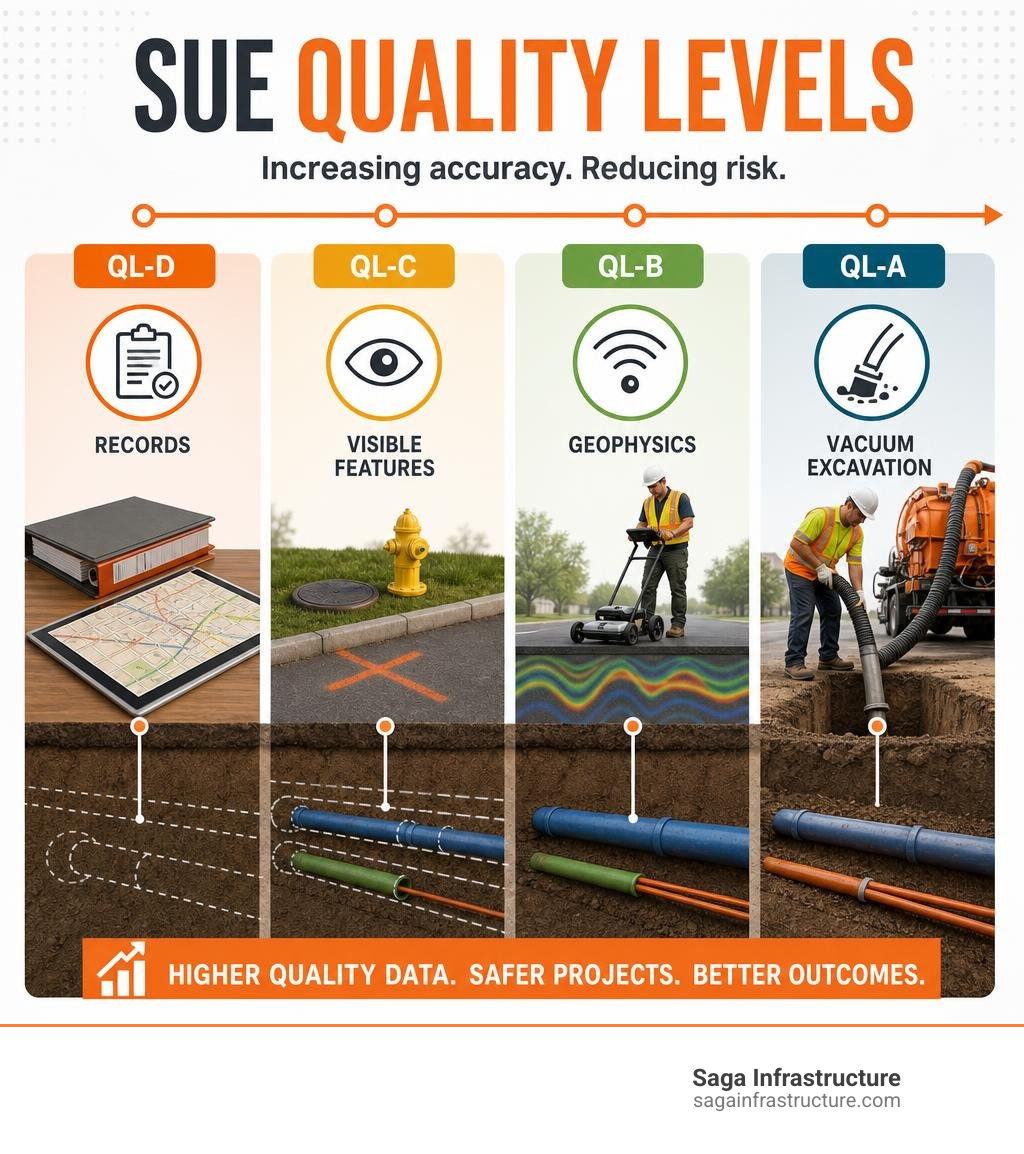
Know your Subsurface utility engineering terms:
What is Subsurface Utility Engineering?
Think about what is under our streets. There is a giant web of pipes and wires. They carry water, gas, electricity, and internet to our homes.
We cannot just guess where these pipes are. If we do, we might hit a power line or break a water pipe. That is why we use Subsurface utility engineering, or SUE.
SUE is a professional way to find these pipes. It uses three main fields:
- Civil engineering: To plan the project and keep it safe.
- Geophysics: To use special tools that “see” through the dirt.
- Surveying: To mark the exact spots on a map.
Some people think SUE is just like calling 811. You might have seen colored paint on the street before digging. That is a basic locate.
Calling 811 is great for safety, but it has limits. Those locators only look for active pipes. They do not tell you how deep they are. Sometimes, their marks are not in the right spot.
SUE is much better. We do not just guess. We look at old maps, find metal covers on the street, use radar, and dig safe test holes. This gives us a very accurate map. To see how this helps at the start of a project, read The Groundwork Essentials for Your New Construction Project.
The Four SUE Quality Levels Explained
Engineers use a standard called ASCE 38-22 to talk about utility maps. This standard has four Quality Levels (QL). They go from Level D (lowest accuracy) to Level A (highest accuracy).
Think of these levels like a ladder. As you go up, the maps get much better. This makes the project safer. But higher levels take more time and special tools.
Here is how the four levels work:
| Quality Level | Name | How We Get the Data | What It Tells Us | When to Use It |
|---|---|---|---|---|
| QL-D | Records Research | Looking at old maps and plans. | A general idea of what is there. | Early planning. |
| QL-C | Visible Feature Survey | Finding things on the surface like manholes. | Helps fix mistakes on old maps. | Early design. |
| QL-B | Utility Designation | Using radar and sensors on the ground. | Shows where the pipes run left to right. | Detailed design. |
| QL-A | Utility Locating | Digging safe holes with air or water. | Shows the exact depth, size, and material. | Right before digging. |
Let’s look at each level.
Quality Levels D and C: Records and Visible Features
We start with Quality Level D (QL-D). This level only uses old paper maps and records.
But old maps can be wrong. Sometimes workers put a pipe in a different spot than the map says. In fast-growing states like Florida, Texas, and Arizona, old records are often missing.
To make the map better, we move to Quality Level C (QL-C). Our team goes to the site. We look for things we can see, like:
- Manhole covers
- Water valves
- Gas meters
- Fire hydrants
We map these points. If the old map says a pipe is in the middle of the road, but the valves are on the side, we know the map is wrong. We use high-tech tools to map these spots. You can learn more in The Ultimate Guide to Modern GPS Land Surveying Techniques.
Quality Level B: Subsurface Utility Engineering Designating
Next is Quality Level B (QL-B). This is also called designating.
We use special tools to find pipes without digging. The two main tools are:
- Electromagnetic (EM) tools: We send a safe electric signal down a pipe. Then we use a receiver on top of the ground to trace it.
- Ground Penetrating Radar (GPR): We roll a radar tool over the ground. It sends radio waves into the dirt to find plastic or concrete pipes.
QL-B shows us exactly where the pipes run. This helps engineers design around them. To see how this fits with other tests, read 5 Top Site Testing Services Revealed.
Quality Level A: Subsurface Utility Engineering Locating
The best level is Quality Level A (QL-A). This is also called locating or potholing.
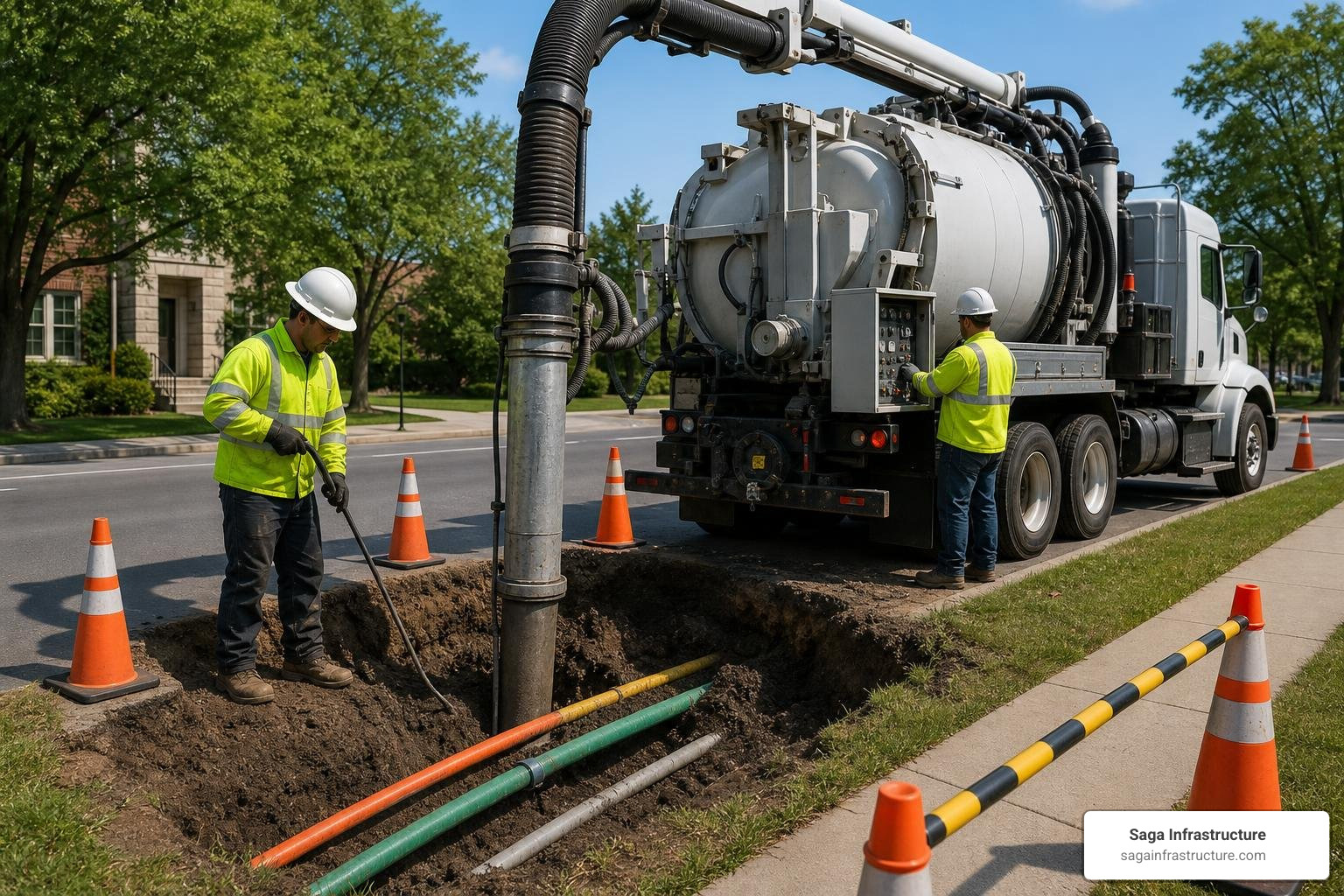
We do not guess. We actually look at the pipe. To do this safely, we use vacuum excavation.
We do not use a sharp metal digger. That could break the pipe. Instead, we use strong air or water to loosen the dirt. Then, a big vacuum hose sucks the dirt away. This leaves a clean hole.
Now we can see and measure:
- Exactly how deep the pipe is
- Its exact location
- How big it is
- What it is made of (like plastic or metal)
- What shape it is in
This gives us a perfect 3D map. QL-A is very important for big projects. If you are doing sewer work, you must know exactly where other pipes are. Read more in The Best Underground Utility Contractors for North Texas Sewer Repair.
SUE in Infrastructure Project Development and Benefits
How does SUE help a real project?
Imagine we are building a new road in Florida, Texas, or Arizona. Using SUE early is a very smart move.
First, we get Level D and Level C maps. This gives us a basic idea of what is under the ground. As we design the project, we use Level B tools to map the pipes where we want to dig.
Next, we make a utility conflict matrix. This is just a list of clashes. It shows where our new pipes or roads might hit old pipes. For example, if a new drain is going right where an electric line is, we have a clash.
Now, our engineers can change the design. We might move a wall by two feet or change the depth of a ditch. This means we do not have to move the utility pipe. This saves a lot of time and money. To learn more about preparing a site, read The Essential Guide to Grading and Drainage Systems.
If we cannot change the design, we dig Level A test holes. This tells us the exact depth so we can plan safely.
SUE has huge benefits:
- Saves Money: A famous study by Purdue University and the Federal Highway Administration (FHWA) looked at 71 big projects. It found that every $1 spent on SUE saves $4.62 in total costs. Some projects saved even more!
- Fewer Delays: If a worker hits a pipe, all work stops. Everyone has to wait for repairs. SUE stops these surprises so work keeps moving.
- Lower Bids: When builders know exactly where the pipes are, they do not have to charge extra for “unknown risks.” They can give lower, better prices.
- Better Safety: Hitting a gas line or power line is very dangerous. SUE keeps workers and neighbors safe.
Knowing what is underground is the key to success. You can read more about big builds in Everything You Need to Know About Heavy Earthmoving and Site Development and From Airports to Wastewater: What Utility Infrastructure Contractors Build.
Frequently Asked Questions about SUE
What is the difference between SUE and 811?
The main difference is that 811 is for safety right before you dig, while SUE is for planning and design.
When you call 811, a worker marks the ground with paint or flags. This shows where active pipes are so you do not hit them. But 811 does not tell you how deep the pipes are. It does not find old, empty pipes.
SUE is a complete engineering process. A professional engineer checks all the data and signs the maps. SUE gives you exact 3D maps long before any digging starts.
How much money does SUE save?
Studies show SUE saves an average of $4.62 for every $1.00 you spend.
You save money by:
- Designing around pipes instead of moving them
- Avoiding costly delays and broken lines
- Getting lower prices from builders
Spending $50,000 on SUE early can save hundreds of thousands of dollars later.
When should SUE be done?
SUE should always be done early in the design phase.
If you wait until construction starts, it is too late to change your plans. You will have to deal with broken pipes, delays, and extra costs.
Starting early lets engineers make smart choices. For state rules on utility work, you can check the Arizona Department of Transportation (ADOT) website.
Conclusion
At Saga Infrastructure, we believe the best projects are built on trust, safety, and accuracy. We partner with top local builders. We give them the tools, money, and safety systems they need to grow while keeping their local names and relationships.
Our teams do great work in Florida, Texas, Arizona, and beyond. We bring local builders and national strength together. We protect local legacies and use smart engineering like subsurface utility engineering to keep our communities growing safely.
If you are planning a new project and need accurate underground maps, we can help.
Contact Saga Infrastructure for site testing and utility services today. Let’s build together!