Categories
Blog

The Groundwork Essentials for Your New Construction Project

The Groundwork Essentials for Your New Construction Project

The Groundwork Essentials for Your New Construction Project

What Is Site Preparation for Building (And Why It Matters)

Site preparation for building is getting land ready for a new house. You do this before you build walls or a foundation. It includes checking the land, testing the dirt, and clearing trees. You also need to plan for water and power.

Here are the main steps:

  1. Site Surveying – Map the edges of the land.
  2. Soil Testing – See if the dirt is strong and dry.
  3. Site Clearing – Remove trees, roots, and trash.
  4. Permits – Get permission from the city.
  5. Grading – Make the land flat and dig for the base.
  6. Drainage – Make sure water flows away from the house.
  7. Utilities – Put in power, water, and sewer lines.

If you rush these steps, you will have big problems. Bad water flow can flood a basement. This can cost $15,000 to fix. If the dirt is not packed down, driveways can sink. These problems happen when people skip the hard work at the start.

Site prep is not fancy, but it is very important. It stops expensive problems before they start.

I am Don Larsen, the head of Saga Infrastructure. I have worked in building for a long time. I know that good site prep keeps a building safe for years. I will show you how it works so you can plan your project.

Infographic showing the 7 steps of site preparation for building: 1. Site Surveying with icons for boundaries and elevations, 2. Soil Testing showing perc test and geotechnical analysis, 3. Site Clearing and Grubbing with tree and stump removal visuals, 4. Permitting checklist with zoning and building permit icons, 5. Grading and Excavation with slope and foundation diagrams, 6. Drainage and Erosion Control showing silt fences and French drains, 7. Utility Installation with power, water, and septic line icons; each step includes a brief one-line description and is displayed in a sequential horizontal flow chart with color-coded stages - site preparation for building infographic

Why Site Preparation is the Most Critical Phase

We say you win or lose a project in the dirt. You might want to look at floor plans or kitchens first. But the house needs a strong base. Site prep is important because it stops the house from cracking or flooding.

In places like Florida, Texas, and Arizona, the land is different. Some places have lots of water. Other places have dirt that grows when it gets wet. At Saga Infrastructure, we make sure the ground is ready. We did this for The Vue Clermont to make sure it was built right.

Avoiding Common Mistakes and Risks

Problems that show up years later usually start with bad site prep. Here are common mistakes:

  • Loose Dirt: If the dirt is not packed down, the house will sink and crack.
  • Leaving Roots: If you leave tree roots in the ground, they rot. This leaves holes that make the ground sink.
  • Bad Water Planning: If the land does not slope away from the house, water will flood the basement.
  • Wrong Lines: If you build too close to the edge of your land, you might have to tear it down.

The Essential Steps of Site Preparation for Building

Good site preparation for building is more than moving dirt. It is a plan to turn wild land into a flat spot for a house. We look at the soil, the hills, and any old buildings that need to go.

Site Surveying and Soil Testing

Before a machine starts, you need a survey. This shows where your land ends. It also shows where you are allowed to build.

Testing the soil is also key. A pro tests the dirt to see how it holds water. In Texas or Arizona, some dirt swells up when it rains. If you do not plan for this, your house foundation will crack.

Clearing, Grubbing, and Permits

Next, we clear the land. We take away trees and bushes. “Grubbing” means pulling up the roots and stumps. You cannot build over old roots.

We also get the right papers. You need permits from the city. Most places will not let you start until you have these. We know the rules in Florida and Texas, so we can help with this.

Managing Water: Grading, Drainage, and Erosion Control

Water is the enemy of a house. Good site preparation for building keeps water away from the base of the house.

excavator creating a drainage swale - site preparation for building

Grading means making the land slope. We move dirt to make a flat spot for the house. We make sure rain flows into drains. We also stop the dirt from washing away during a storm.

Preventing Erosion and Flooding

To keep the site safe, we use these tools:

  • Silt Fences: These stop mud from washing into the street.
  • French Drains: These are pipes under the ground that carry water away.
  • Sediment Basins: These are small ponds that catch muddy water so the dirt can sink to the bottom.

Our work at Mirror Lake shows how we protect the land and the building.

Utility Installation and Infrastructure Planning

You do not want to dig up a new driveway to fix a pipe. That is why we plan for power and water early.

We put in water and power lines at the start. We also set up power for the workers. We make sure septic systems are in the right spot where the dirt is good.

Access Roads and Staging Areas

A building site is busy. We make gravel paths for big trucks. This keeps them from getting stuck in the mud. It also keeps the road clean. We also pick a spot to keep tools and materials safe.

Timelines, Costs, and Project Variations

How long does site preparation for building take? On flat land, it might take 2 or 3 weeks. If there are many trees and no power, it can take 2 months or more.

Costs change based on the size of the job. Here is a simple guide:

Service Small Building Large Building
Clearing $250 – $600 $1,200 – $2,800
Surveying $200 – $2,000 $200 – $2,000
Soil Testing $700 – $1,800 $700 – $1,800
Site Plan $750 – $2,500 $750 – $2,500
Grading $800 – $4,000 $4,000 – $20,000

Factors Influencing Your Budget

Some things make the price go up. If you need to bring in power from far away, it can cost a lot. We suggest saving extra money for surprises like big rocks under the dirt. At Saga Infrastructure, we tell you the costs upfront. You can read more about us here.

Choosing the Right Team for Your Groundwork

The team that moves the dirt is very important. You want a team that knows your area. A team from far away might not know about the dirt in Florida or Arizona.

When you pick a team, look for:

  • License and Insurance: This keeps you safe if something goes wrong.
  • Good Tools: Using lasers and GPS helps them be very exact.
  • Good Reviews: Ask to see other jobs they have done.
  • Local Knowledge: They should know the local rules and the land.

Frequently Asked Questions about Site Preparation for Building

How long does site preparation typically take?

The physical work takes 2 to 4 weeks. But getting permits and testing the soil can take 1 or 2 months. Rain can also slow things down.

What are the biggest risks of poor site prep?

The biggest risks are cracks in the house and water damage. If the dirt is not ready, the house will sink. These problems are very hard to fix later.

How does site prep differ for barns or shops?

Barns and shops hold heavy things. They need a very strong base. Some farm buildings use poles in the ground instead of a flat concrete floor. This changes how we dig.

Conclusion

At Saga Infrastructure, we know every great building starts in the dirt. We are a big company with local experts. Whether you are in Florida or Arizona, we make sure your project starts on strong ground.

We care about the land and your building. If you are ready to start, visit us at Saga Infrastructure. Let’s get to work!

Categories
Blog

Building Futures: A Guide to Civil Construction Management

Building Futures: A Guide to Civil Construction Management

Building Futures: A Guide to Civil Construction Management

Understanding Civil Construction Management

Civil construction management is a job that helps plan and build big projects. A builder does the physical work. But a construction manager (CM) talks to everyone. They help the owner, the designers, and the workers work together.

We focus on three main things: the work, the time, and the cost. We also care about safety and quality. We want every project to be safe for people to use. We work on roads and big water projects like The Hills of Minneola.

Civil engineering is about designing things like bridges. Civil construction management turns those designs into real things. At Saga Infrastructure, we help local companies grow while keeping their local feel.

Managers vs. Engineers

Engineers and managers have different jobs. Engineers are the “thinkers.” They do math to make sure a bridge is strong. They work mostly in offices.

Managers are the “doers.” They take the plans and get the big trucks to the site. They make sure workers are safe and the project stays on budget.

Feature Civil Engineering Civil Construction Management
Main Job Design and math Building and leading
Where they work Office Construction site
Skills Math and science Leading and talking
Goal Strong buildings Finishing on time

Different Types of Building

Some managers build houses or offices. This is called vertical building. Civil construction management is often called “heavy civil.” It is about horizontal things like roads and bridges. These projects can be many miles long. They include:

  • Public Works: Roads and bridges.
  • Utilities: Water and power systems.
  • Earthworks: Moving dirt for dams or flat land.

These projects use tax money. This means the government watches them closely.

What Managers Do

Civil construction management is a big job. We don’t just lead people. We also look after the land. On projects like Mirror Lake, we make sure the work is good for the town.

Heavy equipment working on a bridge construction site, showing cranes and concrete forms over a riverbed - Civil construction management

Managing Big Projects

Building a bridge is like a giant puzzle. We have to move pipes before we dig. We have to keep the water clean. Safety is very important. We build roads while cars are still driving nearby. We must be very careful.

Daily Tasks

A manager’s day is busy. They spend most of their time outside. They do things like:

  • Team Meetings: Quick talks to plan the day.
  • Safety Checks: Walking around to make sure everyone is safe.
  • Money Checks: Making sure the project does not cost too much.
  • Quality Checks: Making sure the concrete is strong.

Projects like The Vue Clermont show how this hard work helps the town for a long time.

Skills and Jobs

Do you like seeing a hole in the ground turn into a highway? Then you might like this job. But you need to learn a lot first.

More people will be hired for this job soon. In states like Texas and Arizona, there is a lot of building to do.

Growing Your Career

Most people go to college first. Then they follow these steps:

  1. Assistant: Learning how the site works.
  2. Project Manager: Being in charge of the money and the schedule.
  3. Senior Manager: Leading many projects at once.

The pay is good. Many managers earn over $100,000 a year.

A project manager wearing a hard hat and safety vest, leading a team meeting with diverse crew members around a set of blueprints on a construction site - Civil construction management

Important Skills

You need to be good at talking to people. You are a leader and a problem-solver.

  • Talking: You must explain things to the city and the workers.
  • Leading: You must be fair so the crew respects you.
  • Solving Problems: If you find a pipe that was not on the map, you have to fix it fast.

At Saga, we look for leaders who care about their town.

Technology and Problems

Managers don’t just use paper anymore. They use new tools to work better. Using technology helps companies grow.

A construction manager on a job site using a tablet to review a 3D BIM model while standing in front of an active excavation area - Civil construction management

New Tools

  • 3D Models: We make a digital version of the project first. This helps us find mistakes before we build.
  • Drones: These flying cameras look at the site from above. They can map a big area very fast.
  • Computer Programs: Everyone can see the schedule on their phones or tablets.

Hard Parts of the Job

There are some hard things to deal with:

  • Not enough workers: It is hard to find people to do the work.
  • High costs: The price of steel and concrete goes up and down.
  • Rules: There are many rules to keep the earth clean.

Some owners join Saga to get help with these problems. This lets them focus on building.

Common Questions

What is the difference between an engineer and a manager?

An engineer designs the project and does the math. A manager makes sure the project gets built on time and for the right price.

How much do managers earn?

Most earn about $104,900 a year. Some earn more if they work on very big projects.

What are the best certificates to get?

The Certified Construction Manager (CCM) is a great one to have. It shows you know how to lead a project well.

Conclusion

Civil construction management is about helping our towns. We make sure the roads and water systems we use every day are built well.

At Saga Infrastructure, we help local building companies. We give them the money and tools they need to grow. We want to keep their local history alive while they build more.

If you want to help your company grow, let’s talk. We can build great things together for a long time.

Categories
Blog

Ready to Hang Up Your Hard Hat? Selling Your Construction Business in Jacksonville Made Easy

Ready to Hang Up Your Hard Hat? Selling Your Construction Business in Jacksonville Made Easy

Ready to Hang Up Your Hard Hat? Selling Your Construction Business in Jacksonville Made Easy

Why Selling Your Construction Business in Jacksonville Needs a Plan

How to sell my construction business Jacksonville FL is a big question. You worked hard to build your team. You did many jobs in Florida. Now you want to move on. You want to sell without losing what you built.

Quick Answer: 5 Steps to Sell Your Business

  1. Find the Value – See what your business is worth. Most sell for 2 or 3 times their profit.
  2. Get Papers Ready – Collect your tax and bank papers.
  3. Find a Buyer – Look for someone who knows construction. Keep it a secret for now.
  4. Check Everything – Let the buyer look at your books and tools.
  5. Finish the Sale – Sign the papers and help the new owner for a few months.

Jacksonville is growing fast. Many people want to buy businesses here. Most sell in 6 to 12 months. You need the right buyer. You want someone who will take care of your crew.

I am Don Larsen. I help people sell their construction companies. I have done this many times. I can help you protect what you built.

Infographic showing the 5-step process to sell a construction business in Jacksonville FL: Step 1 Determine Business Value (2-3x SDE valuation, asset appraisal, project pipeline review), Step 2 Prepare Documentation (tax returns, financials, bonding capacity, contracts), Step 3 Find Qualified Buyers (specialized brokers, strategic acquirers, confidential NDAs), Step 4 Due Diligence (clean books, equipment records, client contracts), Step 5 Close and Transition (attorney coordination, SBA financing, 30-90 day transition period). Timeline shows 6-12 months total with Jacksonville market conditions favoring sellers in 2026 - how to sell my construction business jacksonville fl infographic

How to Sell My Construction Business Jacksonville FL: The Steps

We think of selling as a partnership. At Saga Infrastructure, we have a simple plan.

First is Discovery. We talk to you. We want to know your goals for the company.

Second is Partnership Design. We make a plan that is good for your workers. We want them to be happy.

Third is Legacy Growth. Your business keeps its name. But now it has more money to grow. This is better than just selling to anyone. You can learn more on our Business Owners page.

How Long Does It Take?

Selling a business in Florida usually takes 6 to 12 months. You need to have your papers ready. You also need to show that people want your services.

How to Get the Best Price

Buyers look at your profit. They look at your “SDE.” This is the money the business makes plus some extras. To get a high price, keep your books clean. It also helps if the business can run while you are away.

Feature Selling Assets Selling the Whole Company
What is sold? Tools and name The whole business
Risk Buyer takes less risk Buyer takes all risk
Taxes Better for buyer Better for seller
Work More paperwork Less paperwork

Finding the Value of Your Jacksonville Company

Price is not just about one year of taxes. We look at your tools and your future jobs. If you have questions, see this FAQ page.

What Businesses Sell For

In Florida, construction companies sell for 2 to 3 times their profit.

  • Roofing and AC: These often sell for more money.
  • Roads and Pipes: These are worth a lot because they have long contracts.
  • General Builders: The price depends on how many jobs are coming up.

How to Make Your Business Worth More

Do these things before you sell:

  1. Clean your books: Make sure your money records are perfect.
  2. Fix your tools: Good tools show you care.
  3. Hire good managers: The business should work even if you are not there.
  4. Get long contracts: Future work makes the business worth more.

Getting Your Papers Ready

Good papers help you sell faster. You need 3 years of tax and bank records.

organized financial documents for business sale - how to sell my construction business jacksonville fl

Construction companies also need:

  • Bonding: Proof you can do big jobs.
  • Staff Papers: Agreements that your best people will stay.
  • Safety Records: A good safety record is very important.

Checking the Business

The buyer will check everything. This is called due diligence. You should stay for 30 to 90 days after the sale. This helps the new owner learn the ropes.

Don’t Make These Mistakes

Don’t tell everyone you are selling too soon. If workers find out, they might leave. Don’t ask for too much money. Be honest about how the business is doing.

Finding the Right Buyer

You need a buyer who knows the building business. We work with Business Investors who like construction.

Why Use a Special Helper?

A regular broker might not know about construction tools or licenses. A special helper knows how to value your fleet. They know people who want to buy construction companies.

How Buyers Pay

Many buyers use a loan from the bank. These are called SBA loans. To get one, your books must be very clean. You might also let the buyer pay you over time. This shows you trust the business to do well.

The Jacksonville Market

Jacksonville is a big city. We need many roads and buildings. The city is growing fast. This is good for people selling a business.

In 2026, the market looks strong. Companies that build roads or fix pipes are in high demand.

What is Selling Fast?

  • City Building: Companies that build the main parts of the city.
  • Utility Work: Important jobs like water and power.
  • Home Services: Roofing and AC are always needed.

Keeping it a Secret

In Jacksonville, people talk. To keep your sale private, we:

  • Hide the Name: We don’t say which business is for sale at first.
  • Sign Papers: Buyers must promise not to tell anyone.
  • Safe Rooms: We keep your papers in a safe place online.

Common Questions

When should I sell?

Sell when your business is making good money. Don’t wait until you are too tired. Sell when you have many jobs lined up.

How long does it take to sell in Jacksonville?

It takes about 6 to 12 months. This gives the buyer time to get a loan and check your records.

Can I sell if I am not making money?

Yes. A buyer might want your trucks, tools, or your great team of workers.

Conclusion

Selling your business is a big step. You want your company to keep helping Jacksonville. At Saga Infrastructure, we want to help local builders grow.

We won’t change your company’s name. We want to help it stay strong. Kevin and Cindi Foshee said they felt happy knowing their business was in good hands.

If you want to talk about selling, Let’s start the conversation today. We help what you built grow even more.

Categories
Blog

Acquiring a Construction Company What You Need to Know

Acquiring a Construction Company What You Need to Know

Acquiring a Construction Company What You Need to Know

Why Buying a Construction Company is a Smart Choice

Buying a construction company is faster than starting a new one from zero. You get a business that is already making money. You also get workers, tools, and the licenses you need. You don’t have to spend years trying to find customers. You start with everything ready to go on the first day.

Good things about buying a company:

  • Money Right Away – You get paid from jobs that are already started.
  • Ready Workers – You have a team that already knows how to do the work.
  • Tools and Trucks – You get the machines you need without buying them new.
  • Licenses – The company already has the permits to work.
  • Happy Customers – People already know and trust the business name.

Many older owners are ready to retire soon. This means there are many great companies for sale. These businesses are strong, but they need a new leader to keep them growing.

But you must be careful. You need to check the tools and the work history. You should also look at the taxes. My name is Don Larsen. I lead a company called Saga Infrastructure. We buy construction businesses in the South. I have learned that you must look at the money and the people to do a good job.

Infographic showing the 7 steps of acquiring a construction company: 1. Define your acquisition criteria and investment thesis, 2. Research the market and find target companies, 3. Conduct preliminary due diligence and financial analysis, 4. Submit letter of intent and negotiate terms, 5. Perform comprehensive due diligence on operations and legal matters, 6. Secure financing and finalize purchase agreement, 7. Execute transition plan and integrate operations - Buying a construction company infographic

Why Buying a Company Helps You Grow

Completed infrastructure project - Buying a construction company

Buying a business is safer than starting a new one. The government says that old businesses stay open longer than new ones. Only about 3 out of 10 new businesses last for ten years.

When you buy a company, you skip the hard first years. You buy a name that people already like. This helps you grow in places like Florida, Texas, and Arizona. In these states, knowing people is very important.

Having Workers and Tools

Right now, it is hard to find good workers. When you buy a company, you get a team that already knows the rules. You also get trucks and machines. Buying new machines takes a long time and costs a lot of money. If you buy a company, you get the tools right away.

Making Money

Is it a good deal? Most owners make about $100,000 a year, but many make much more. Some big companies make over $1 billion!

What You Get Starting New Buying a Company
Time to make money 6 to 18 months Day 1
Tools Costs a lot Costs less
Workers Hard to find Already there
Risk Very high Medium

How Much is the Company Worth?

Figuring out the price of a company is not just simple math. We look at how much money the company makes before paying bills like taxes.

Other ways to find the price:

  • Look at the tools: Add up the value of all the trucks and machines.
  • Look at the future: Guess how much money the company will make later.
  • Look at other sales: See what other companies nearby sold for.

Two Ways to Buy

How you buy the company matters for taxes.

  • Buying Assets: You buy the trucks and the tools. This is usually better for the buyer. It helps you pay less in taxes later.
  • Buying the Whole Entity: You buy the whole legal name. Sellers like this because they pay less tax. But you might also get the company’s old problems.

Location Matters

Where the company is located is very important. We like the “Sun Belt” because many people are moving there. A company in a growing town is worth more than one in a town where no one is building.

Checking the Business Carefully

You must check everything before you buy. Look at the list of jobs the company is doing now.

A long list of jobs is good, but only if the company makes money on them. We check:

  • Future Jobs: Is there enough work for the next year?
  • Getting Paid: Do the customers pay their bills on time?
  • Suppliers: Does the company owe money to people who sell them dirt or pipes?

Reading the Rules

Construction has many contracts. You must read them to make sure they stay valid after you buy the company. You also need to check for old mistakes. If a pipe breaks in three years, who has to fix it? You also need to make sure the company can get insurance for big jobs.

Checking the Team

A company is only as good as its workers. Check their safety record. If workers get hurt a lot, insurance will cost too much. If only the owner knows how to do the work, the company will be hard to run without them.

How to Find and Pay for a Company

Finding a good company to buy takes work. Some are listed on websites like LoopNet. But the best deals are found by talking to people in the industry. At Saga, we talk to owners long before they are ready to sell.

Ways to Pay

You do not need all the cash at once. You can:

  • Get a Government Loan: The SBA helps people buy small businesses.
  • Pay the Owner Over Time: The seller lets you pay them back using the money the business makes.
  • Find Partners: Other people can give you money to own a part of the business.

Where to Look

You can look at:

  • Groups for Builders: Local clubs for construction workers.
  • Experts: Ask accountants or lawyers if they know anyone retiring.
  • Just Ask: Sometimes you can just ask an owner if they want to sell.

Managing Risks and Starting Out

Buying a business is like getting married. The wedding is easy, but the marriage takes work.

The biggest risks are:

  1. The Owner Leaves: Customers might only like the old owner.
  2. Hidden Problems: Old lawsuits or unpaid taxes.
  3. Safety Issues: A bad safety record can stop you from getting government jobs.

How to Stay Safe

We test the business. We ask, “What if the market gets bad?” We use insurance and experts to check the books. Always have a pro look at the trucks to make sure they aren’t broken.

Making a Good Start

At Saga, we want to keep the good things the old owner built. To do this:

  • Keep the Workers: Tell the team their jobs are safe.
  • Meet the Customers: Have the old owner introduce you to the big bosses.
  • Go Slow: Don’t change everything on the first day. Keep what works and fix the rest slowly.

Common Questions

Why is buying better than starting new?

Buying gives you a history. In construction, having a history helps you win jobs. You get a head start that a new business does not have.

How do I know the price of a trade company?

Companies like electricians or plumbers make good money. We look at their tools and their list of future jobs to find the right price.

What are the biggest risks?

The biggest risks are hidden money problems, losing the best workers, or the housing market going down. Checking everything carefully is the best way to stay safe.

Conclusion

Buying a construction company can help you make a lot of money. It is about more than just math. It is about taking over a business that someone worked hard to build.

At Saga Infrastructure, we want to help these businesses grow. We partner with owners in Florida, Texas, and Arizona. We keep their local name but help them get bigger. If you own a business and want to retire, talk to us today. Let’s build the future together.

Categories
Blog

The Blueprint for Success: Understanding Construction Funding Options

The Blueprint for Success: Understanding Construction Funding Options

The Blueprint for Success: Understanding Construction Funding Options

What is Capital for Construction?

Capital for construction is not just money in a bank. Capital is anything that helps you make money. It is the cash in your pocket. It is the big machines in your yard. It is also the wood and bricks on the job site.

Business Owners must manage these things carefully. You need cash to pay bills. You also need tools to do bigger jobs. Most builders use three main types of capital to keep working.

Working Capital

Working capital is very important. It is the money you have right now to pay for things. It helps you pay your workers every Friday. It helps you buy materials before the price goes up.

In places like Florida or Arizona, work can change fast. Having cash on hand helps you stay in business. Business Funding for Construction Companies helps you get cash when you are waiting to be paid by a customer.

Debt Capital

Debt capital means borrowing money. You must pay it back with a little extra called interest. This is a good way to buy big things that last a long time.

Builders use debt for:

  • Big Machines: Buying a new digger without using all your cash.
  • Land: Buying a place to park your trucks and tools.
  • Trucks: Getting your team to the job site in Texas or Arizona.

Using debt keeps your cash free for daily costs. If the new machine helps you make more money than the loan costs, it is a smart move. But you need a good credit score to get these loans.

Construction Loans vs. Regular Loans

Regular business loans give you all the money at once. Construction is different. Money for building comes in steps.

Banks give you money as you finish parts of the project. For example, you get money after the floor is done. This keeps the bank safe. It also makes sure you have money when you need it for the next part of the build.

Type of Loan What it is for How long it lasts
Construction Loan Building from the ground up 6 to 24 months
Bridging Loan Quick money for a short time 1 to 12 months
Development Finance Very big projects Up to 36 months

Getting these loans can be hard for First-Time Property Developers. Banks want to know you can finish the job on time and stay on budget.

Big Projects and Quick Loans

Development finance is for big projects like many houses or new roads. Bridging loans are for moving fast. If you see a great piece of land in Florida, you might use a bridging loan to buy it quickly before someone else does. Our Saga Team sees many builders use these.

Getting Paid Faster

Sometimes you finish a job but have to wait 90 days to get paid. Invoice financing helps you get that money sooner. You sell your bill to a company. They give you the cash right away. This is not a loan. It is just getting your own money faster so you can start the next job.

How to Get the Money You Need

You must know how much money you need before you talk to a bank. You need a good plan.

contractor in a hard hat reviewing financial documents and blueprints - Capital for construction

At Saga, we help you look ahead. You need to know the Gross Development Value (GDV). This is what the project will be worth when it is finished.

Always save extra money for surprises. We suggest saving 10% more than you think you need. Things like rain or high prices can happen. You can see how we help on our About Us page.

What Banks Want to See

To get a loan in Texas or Florida, you need:

  1. A Plan: A list of what you will build and when.
  2. Permits: Papers from the city saying you are allowed to build.
  3. Money Records: Papers showing how much money you made in the past.
  4. Insurance: To protect you if something goes wrong on the site.

Picking the Right Partner

Don’t just pick the bank with the lowest price. Pick a partner who knows building. If a storm hits Florida, will they help you change your plan? Look for a partner who understands your town. If you work in Minneola or San Antonio, Contact Us to talk.

Common Questions

How long does it take to get a loan?

It usually takes 4 to 8 weeks. It takes time to check your plans and get all the papers ready.

How much can I borrow?

Most banks lend 70% to 80% of the total cost. You must pay for the rest with your own money.

Can new builders get loans?

Yes, but it is harder. Banks might charge more interest because they don’t know you yet. It helps to have an expert on your team to show the bank you can do the work.

Conclusion

Getting Capital for construction is about finding the right help. You need money to run your business every day and money to grow.

finished infrastructure project showing a clean new road and utility layout - Capital for construction

At Saga Infrastructure, we believe in local builders. We want to help you grow your business in Florida, Texas, and Arizona.

If you have a great company and want to grow, let’s talk. We can build a great future together.

Categories
Blog

From Local to National: Uncovering the Best Construction Companies for Your Project

From Local to National: Uncovering the Best Construction Companies for Your Project

From Local to National: Uncovering the Best Construction Companies for Your Project

What Highway Construction Companies Do

Highway construction companies are teams that build roads. They do everything from moving dirt to painting lines. In states like Florida, Texas, and Arizona, many people are moving in. These states need more roads and bridges to help people get around. A good company helps cities grow safely.

These companies do many kinds of jobs. Moving dirt is usually the first step. They move huge piles of earth to make the ground flat for new roads.

Common jobs include:

  • City Roads: Building big highways in busy cities.
  • Country Roads: Connecting small towns with simple roads.
  • Entry Roads: Making paths to new houses or stores.
  • Bridges: Building roads that go over water or other roads.
  • Water Pipes: Putting in pipes so rain does not flood the road.

They also fix old roads. They fix holes and paint new lines so drivers can see at night.

Special Jobs

Companies have different teams to make sure every part of the job is done right. Some companies do all the work themselves. They use their own workers and tools. This helps them do a better job.

Special jobs include:

  • Leveling: Making the ground flat.
  • Paving: Laying the smooth black asphalt we drive on.
  • Concrete: Building walls and bridge supports.
  • Pipes: Putting water and power lines under the ground.
  • Clearing Land: Getting the ground ready for big buildings.

New Tools

Companies now use high-tech tools. This helps them work fast and save money. It also makes the road last a long time.

They use GPS on big tractors. This helps the machines move dirt perfectly. They also use drones to fly over the site and take pictures. This helps them see the progress and find problems early.

U.S. Industry Rates and trends - highway construction companies infographic

Other new tools include:

  • 3D Maps: Making a computer model of the road first.
  • Smart Machines: Using sensors to guide big tools.
  • Road Sensors: Putting small tools in the road to check traffic.

How Big Road Projects Work

construction site plan - highway construction companies

Building a road is like leading a big team. There are many parts that must happen in the right order. At Saga Infrastructure, we help local companies manage these big jobs. You can learn more About Us.

Here are the steps to build a road:

  1. Planning: Deciding where the road goes and finding money.
  2. Design: Engineers draw the plans for the road.
  3. Building: Workers clear the land and lay the foundation.
  4. Managing: Keeping the work on time. This means making sure there is enough gravel and asphalt. Good managers plan for rain or other delays.

Ways to Buy a Project

There are different ways to pay for and plan a project.

Way What it is Best For
Bid-Build The plan is finished first, then companies give a price. Simple roads.
Design-Build One team does the plan and the building. Fast projects.
Partnerships Private companies help pay for the road. Very big projects.

Costs and Rules for Companies

Building a highway costs a lot of money. It can cost millions or even billions of dollars. A few things change the price:

  • The Land: Is it flat or a mountain? Rocks and swamps make it cost more.
  • Materials: The price of asphalt and concrete changes often.
  • Water: If the area floods, the pipes must be bigger and cost more.

Because roads use public money, highway contractors must be checked first. This makes sure the company is good at its job and has enough money.

Applying can take 60 days. The state looks at the company’s safety and money. They want to know the job will be finished. Small companies can join Saga Infrastructure to get the money help they need to win big jobs.

Safety and the Earth

Safety is the most important thing. Working near cars is dangerous. Companies use strict rules and training to keep everyone safe. They have meetings every day and wear bright gear to prevent accidents.

Companies also care about the earth. They try to recycle 80% of what they use. They can grind up old roads and use them to make new ones. This saves money and keeps the earth clean.

Ways they help the earth:

  • Protecting Animals: Keeping local animals and water safe.
  • Recycling: Using old road bits again.
  • Cleaning Dirt: Fixing any dirty soil they find.
  • Filtering Water: Cleaning rain water before it goes into streams.

Companies use special codes to show what kind of work they do.

Common Questions

Why do roads cost so much?

Roads cost more if the land is hard to build on, like a swamp. The price of materials and workers also adds up. If many heavy trucks use the road, the pavement must be thicker. Thicker roads cost more but last longer.

How do workers stay safe?

Workers use cones and walls to stay away from cars. They also wear special vests. Some vests even vibrate if a truck gets too close. This helps them stay safe in busy areas.

Can I work in road building?

Yes! This industry has many good jobs. You can help your community and earn good pay. Jobs include:

  • Engineers: People who plan the roads.
  • Drivers: People who drive big tractors and pavers.
  • Managers: People who watch the budget and time.
  • Builders: People who work with concrete or power lines.

Conclusion

At Saga Infrastructure, we believe in local companies with big support. We help builders in Florida, Texas, and Arizona. We want these local teams to stay strong.

We give them money and tools so they can grow. They keep their names and their workers. Whether it is a new road or a big bridge, we help build things that last. We are proud to help local builders.

If you want to help your company grow, Contact Us today. Let’s build something great together.

Saga Infrastructure — Protecting What Built America.

Categories
Blog

Essential Infrastructure Projects Explained

Essential Infrastructure Projects Explained

Essential Infrastructure Projects Explained

Why Building Water Treatment Plants is Important

Water treatment plant construction is how we build places that make water safe. These plants turn dirty water into clean water that we can drink. They also clean water from our sinks and toilets before it goes back into the river.

Building these plants has five main steps:

  1. Picking a spot – Finding a safe place near water.
  2. Building the main parts – Making big tanks, pipes, and pumps.
  3. Adding cleaning tools – Putting in systems that kill germs.
  4. Testing – Making sure the water is clean before people drink it.
  5. Planning for the future – Making sure the plant stays in good shape.

These projects are very big. Some cost millions of dollars. A big plant can clean enough water to fill 68 huge swimming pools every day.

Building these plants is hard work. Builders must know how to work with big pipes and strong concrete. They also have to follow many rules to keep the water safe.

I am Don Larsen. I lead a company called Saga Infrastructure. We work with local builders to make these important plants. I have seen how much these plants help towns grow and stay safe.

Infographic showing the key stages of water treatment plant construction: Planning and Design (site selection, capacity planning, treatment technology selection), Permitting and Approvals (environmental review, regulatory compliance, local permits), Site Preparation (excavation, grading, foundation work), Structural Construction (basins, tanks, buildings, pipe installation), Equipment Installation (treatment systems, pumps, controls, SCADA), and Testing and Commissioning (water quality verification, system performance, operational training) - water treatment plant construction infographic

The Main Parts of a Water Plant

A water plant is a big group of buildings and pipes. It has huge pipes to move water and big tanks to hold it. It also has pumps to push water where it needs to go.

The first part of the plant is called the “Headworks.” This part catches big trash like sticks and rocks. This is important because it stops the trash from breaking the expensive machines later on.

Using the Right Materials

We have to use very strong materials. Water and chemicals can wear things out quickly. We use special concrete and metal that does not rust. This helps the plant last for a long time without breaking.

How the Water is Cleaned

Modern plants use special tools to clean water. Two common ways are using Ozone gas and UV light.

Feature Ozone UV Light
How it works A gas is put into the water Special light kills germs
What it does Makes water taste and smell better Kills tiny bugs that make people sick
What is needed Big machines to make the gas Special light bulbs and power

We also use sand and charcoal to filter the water. This catches tiny bits of dirt. Finally, we add a little bit of chlorine to keep the water clean as it travels to your house.

How We Plan and Build

You cannot just start digging to build a plant. You need a good plan first. You have to pick the right spot. It must be near water and safe from earthquakes.

One plant in Montana was built to hold extra water. This way, if there is a flood or a spill, the town still has clean water for weeks.

New Ways to Build

We use new tools to build better and faster:

  • Computer Models: We make a digital version of the plant first. This helps us find mistakes before we start building.
  • Building in Shops: We build some parts of the plant in a factory and then move them to the site. This is safer and faster.
  • Digital Tracking: We use computers to see how much work was done each day.

Solving Problems

Building is not always easy. Sometimes it rains too much or parts are hard to find. Safety is our most important rule. We want every worker to stay safe on the job.

We also follow many rules. These rules make sure the water is very clean. We want our plants to be the best they can be for the environment.

Fixing Old Plants

Sometimes we have to fix old plants instead of building new ones. Over time, tiny bugs can eat away at the concrete.

sewer repair work - water treatment plant construction

We fix these by:

  • Using special strong cement.
  • Filling cracks so dirty water does not leak out.
  • Putting a new surface on old walls.

New Ideas and Staying Strong

We build plants to be ready for anything. This means they must work even after a big storm or earthquake. We want the water to be back on in two days so families stay safe.

Helping the Earth

We use new ideas to help the earth:

  • Solar Power: We put solar panels on the tanks to get power from the sun.
  • Turning Waste into Power: We can turn the waste from the water into gas to run the plant.
  • Smart Computers: We use computers to watch every part of the plant. This helps us find problems fast.

We also build backup systems. If one pump breaks, another one starts working right away. This keeps the water flowing to the city.

Great Projects and How They Help

We have built many big plants. Some of these projects cost over a billion dollars! They are very important for the people who live nearby.

How These Plants Help You

When a town builds a new water plant, it helps everyone:

  1. Clean Water: You don’t have to worry about dirty water.
  2. Safety: The plant works even during bad weather.
  3. Jobs: New businesses move to towns that have good water.
  4. Nature: The rivers and lakes stay clean for everyone to enjoy.

Common Questions

What are the main parts of a water plant?

Plants have screens to catch trash, tanks where dirt sinks to the bottom, and filters to catch tiny bits. They also use special lights or gas to kill germs.

How long does it take to build a plant?

It usually takes 2 to 4 years to build a big plant. Planning and getting permission can take even longer.

Why must they be strong?

Water is needed to fight fires and help people in hospitals. The plant must stay standing even if there is an earthquake.

Conclusion

At Saga Infrastructure, we care about our communities. We work with local builders to make sure your water is safe and clean. We build things that will last for your children and grandchildren.

If you are a builder who wants to help your town grow, let’s talk. We can build the future together. You can learn more about us on our website.

Categories
Blog

Beyond the Blueprint: Growing Your Construction Business

Beyond the Blueprint: Growing Your Construction Business

Beyond the Blueprint: Growing Your Construction Business

How to Grow Your Construction Company

Growing a construction company is a big goal. It is not just about winning more jobs. You need a good plan and smart choices.

Here are some ways to grow:

  • Plan Ahead: Set clear goals for your future.
  • Good Team: Hire great people and be a good leader.
  • Money: Watch your cash and make sure you can pay bills.
  • Tools: Use new tech to work faster.
  • Ads: Build a good name so people trust you.
  • Safety: Avoid big risks that could hurt the business.

Growing is good. It lets you do bigger jobs. But do not grow too fast. If you grow too fast, you might run out of money. You need a strong base first. Growth does not happen by accident. It takes a good plan.

I am Don Larsen. I help companies grow. This guide will show you how to do it right.

Infographic showing key strategies for sustainable construction company growth, including team building, strategic planning, financial management, technology adoption, effective marketing, and risk mitigation. - construction company growth infographic

The Four Main Parts of Growing Your Business

Real growth stays strong even when times are hard. It is built on four things: your team, your leaders, your work quality, and your money.

Think of these like the legs of a chair. If one is weak, the chair falls. In places like Florida and Texas, many people want new buildings. It is easy to try to grow too fast. But if your workers are too tired, your business will break. You want to grow the right way.

Leading People

You manage tools and money. But you lead people. Your workers are your most important part. To grow, you must keep your workers happy.

A good workplace means people care about each other. We focus on safety and health. When workers feel safe, they do better work. This helps you find the best workers in places like Arizona or Florida.

Doing Good Work

When you get bigger, you cannot be everywhere. You need a system.

To keep doing good work, you need:

  • Checklists: Check every part of the job.
  • Rules: Have a plan for how to fix mistakes.
  • Trust: Your name is only as good as your last job.

If your work gets bad, people will stop calling you. Word-of-mouth is very important in construction.

Picking a Plan to Grow

blueprint and hard hat - construction company growth

Growth is different for every company. You must pick the right path. Do you want to do more of the same work? Do you want to move to a new city? Or do you want to add new types of jobs?

Choosing Your Path

Do not try to do everything at once. That is too hard. Instead, pick one way to grow:

  1. Be the Best: Be the best at one job, like fixing bridges.
  2. Buy a Partner: Buy a company that helps you do your work.
  3. New Places: Move to fast-growing areas like Texas or Arizona.

Working Together

You do not have to work alone. You can partner with other companies. This helps you share the work and the risk.

Type of Growth Good Things Bad Things
Grow on Your Own You are in charge It is slow
Buy a Company You get big fast It costs a lot of money
Partner Up Less risk You have to share the money

Making Your Office Stronger

To get bigger, your office must be strong. Many companies fail because their office work is too slow.

Using Tech to Grow

Computers and apps help you grow. They help you work faster.

  • Job Apps: Keep all notes and plans in one place.
  • Digital Files: No more lost papers or arguments.
  • Smart Tools: Use data to plan for the future.

Finding the Right Jobs

Winning work should be a plan, not a guess. Track how many bids you win. Do not bid on every job. Only bid on jobs where you know you can do great work.

Watching Your Money While You Grow

Growing costs money. For every new dollar you make, you might need 15 cents in the bank. If you grow by $10 million, you need over $1 million in cash. This pays for things while you wait for clients to pay you.

Money Numbers to Watch

You must know your numbers. To grow, watch these:

  • Late Payments: How long do people take to pay you?
  • Debt: Do you owe too much money?
  • Cash on Hand: Do you have enough money to pay your bills today?

If you run out of cash, your business will fail. This has happened to many big companies.

Insurance and Bonds

You need ‘bonding’ to get big jobs. To get this, you need to show you make money and work safely. If you have too many accidents, your insurance will cost too much. This makes it hard to grow.

Following the Rules in Ontario

Growing in Ontario means following many rules. You must work with groups like the WSIB and the HCRA. Following rules is a must.

Safety Rules

In Ontario, safety is the law. You must:

  • Height Training: Workers must learn how to work high up safely.
  • Safety Kits: Many job sites must have first aid kits for drugs (Naloxone).
  • Clearance Papers: Make sure your partners follow the rules too.

Home Rules

If you build houses, you must join the Tarion group. You should also follow energy rules. This helps you win jobs with people who care about the earth. You can use the BizPaL tool to find all the permits you need.

Common Questions About Growing

How fast should I grow?

Most people say 15% to 25% each year is good. It is fast but not too fast. If you go faster, you might have too many problems.

What are signs of growing too fast?

Watch for these signs:

  • You win too many bids (your price might be too low).
  • You start making mistakes on jobs.
  • Your team is working too many hours.
  • You do not have enough cash to pay bills.

Should I do one job or many?

Doing one job well usually makes more money. Doing many types of jobs is safer if one type of work slows down. Most big companies start with one job and then add more later.

Conclusion

Growing a construction company is like a long race. You must protect what you have while you reach for more. At Saga Infrastructure, we know your company is your life’s work.

We buy local construction firms. We give them the money and tools they need to grow. We keep their local name and culture. We believe local builders are very important. We want to help you get stronger.

If you want to grow your business, let’s talk.


To learn more about us, visit our About Us page.

Categories
Blog

Heavy Civil Construction: Trends, Markets, and the Contractors Who Build It

Heavy Civil Construction: Trends, Markets, and the Contractors Who Build It

Heavy Civil Construction: Trends, Markets, and the Contractors Who Build It

Why Heavy Civil Construction Matters to Our Towns

Heavy civil construction is very important. It builds the big things that help us every day. This includes roads, bridges, and water systems. These projects help people move around and keep our cities running.

What is Heavy Civil Construction?

  • What it is: Building big things like highways, dams, and bridges for everyone to use.
  • Size: These are very large projects. They can take many years to finish.
  • Goal: To build things that last for a long time.
  • The Difference: It builds things for the public, like roads. General construction builds private things, like houses.
  • Examples: Roads, bridges, sewers, tunnels, and airports.

Heavy civil construction is different from building a house. First, it is for everyone, not just one person. Second, it is usually flat and long (like a road) instead of tall (like a building). Third, it is built to last a very long time.

About 1.2 million people work in this field. Workers earn good money. They use big machines like excavators and bulldozers. They also use strong materials like special concrete to make sure things do not break.

Why This Work Matters

These projects are hard to do. They need a lot of planning before they start. Many government groups must say it is okay to build. It can be noisy and dusty for people living nearby. But we need this work. Without it, we would not have clean water or good roads.

I am Don Larsen. I lead a company called Saga Infrastructure. We help build these big projects in the Southeast and Southwest. I have spent my career learning how to do this work well. In this guide, I will explain why this work is special and what the future looks like.
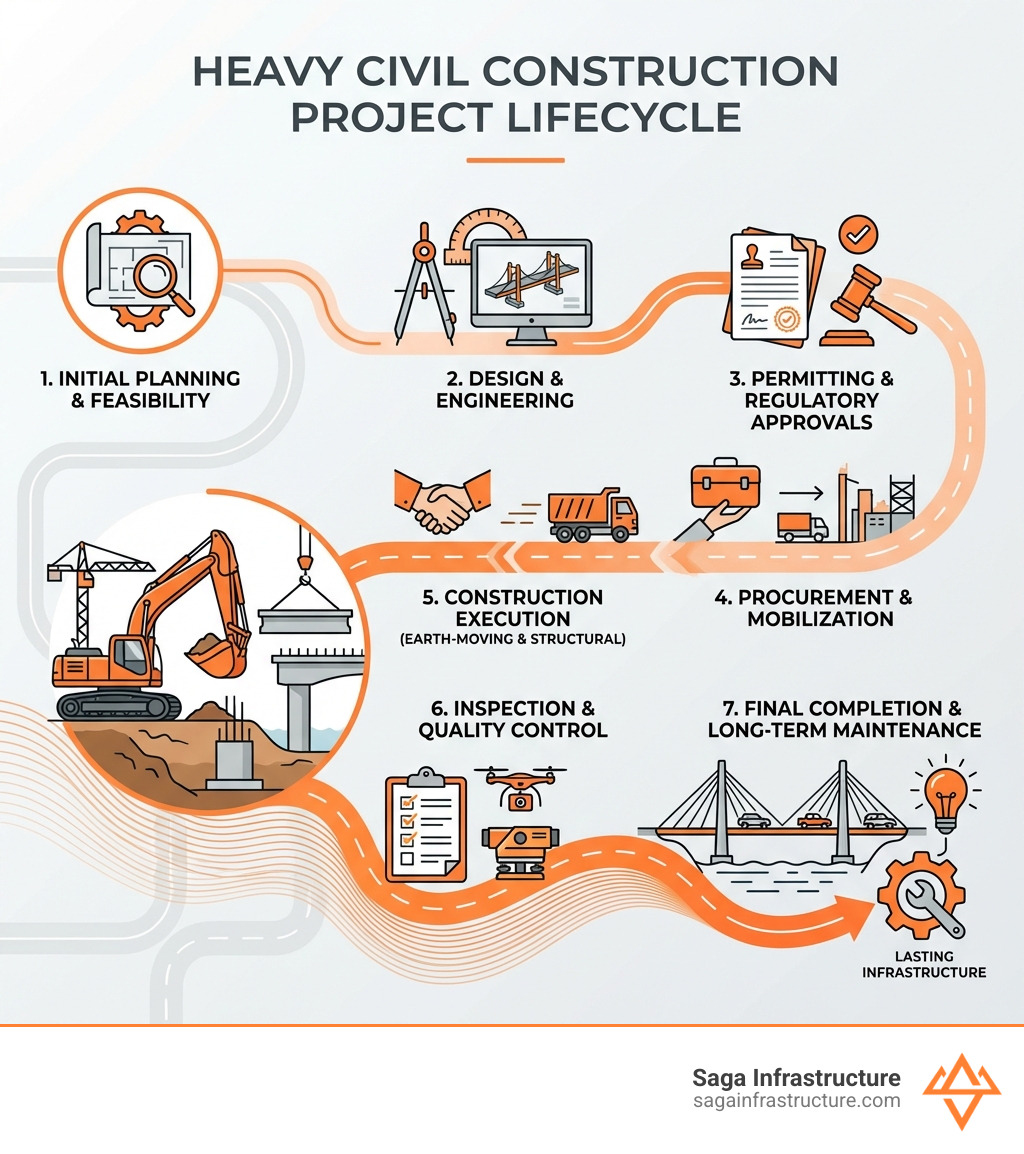
Infographic showing the heavy civil construction project lifecycle from initial planning and feasibility studies through design and engineering, permitting and regulatory approvals, procurement and mobilization, construction execution with earth-moving and structural work, inspection and quality control, to final completion and long-term maintenance - Heavy civil construction infographic

Heavy Civil vs. General Construction

Most people think of houses or stores when they hear the word construction. That is called general construction. But heavy civil construction is different. It is about the big things that keep our towns running.

The main difference is who the project is for. General construction is for private owners, like a person building a store. Heavy civil construction is for the public. It builds the roads you drive on and the pipes that bring water to your house.

Another difference is how the work looks. General construction goes “up” to make a building. Heavy civil goes “across” the ground. We move a lot of dirt and lay miles of pipe. We want these things to last for 100 years.

You can learn more here: Heavy Civil Construction: A Comprehensive Guide to Its Differences with General Construction.

Feature Heavy Civil Construction General Construction
Main Goal Things for everyone Things for one person
Project Type Flat (Roads, Bridges) Tall (Buildings, Malls)
Size Very large One building
Tools Big Diggers, Dozers Cranes, Forklifts
Money Government Private owners

Building Water and Power Systems

A big part of our work is underground. You cannot see it, but it is very important. We put in water and sewer lines. In fast-growing places like Florida and Texas, we are always busy.

For example, we worked on the Hills of Minneola – Crooked Can Infrastructure project. We put in big pipes to handle heavy rain. This keeps the neighborhood safe and dry. We also help build power lines and internet lines.

Common Types of Heavy Civil Projects

There are many kinds of heavy civil construction. If it is big and helps the public, it is likely in this group.

Highways and Bridges

These are the projects you see most often. Building a highway is more than just paving. We have to make the soil strong and plan for cars to move safely. Bridges are even harder to build. They need very deep foundations. We are proud of projects like Skyline at Westfall that help people travel safely.

Tunnels

Tunnels are very hard to make. We use giant machines to dig through the earth. We look at big projects like the world’s longest railway tunnel in Switzerland to learn how to do it better.

Dams and Water Control

Dams hold back water. They help make power and stop floods. A huge example is the Grand Ethiopian Renaissance Dam. At home, we build walls and systems to keep water out of neighborhoods.

Marine Ports

Ports are where big ships bring goods. We have to dig deep into the water and build strong docks. Projects like the Contrecœur Terminal help the economy by moving goods in and out.

Strong Materials

We use very strong materials so things last a long time.

  • Strong Concrete: This concrete does not break easily in bad weather.
  • Steel: We use big steel bars to make bridges strong.
  • Special Fabrics: These help keep the dirt in place under roads.
  • Asphalt: We make our own road surface to fit the local weather.

We used these materials at Mirror Lake to make it look good and stay strong.

Challenges and How We Work

Working in heavy civil construction is exciting. Every job site has new things to learn.
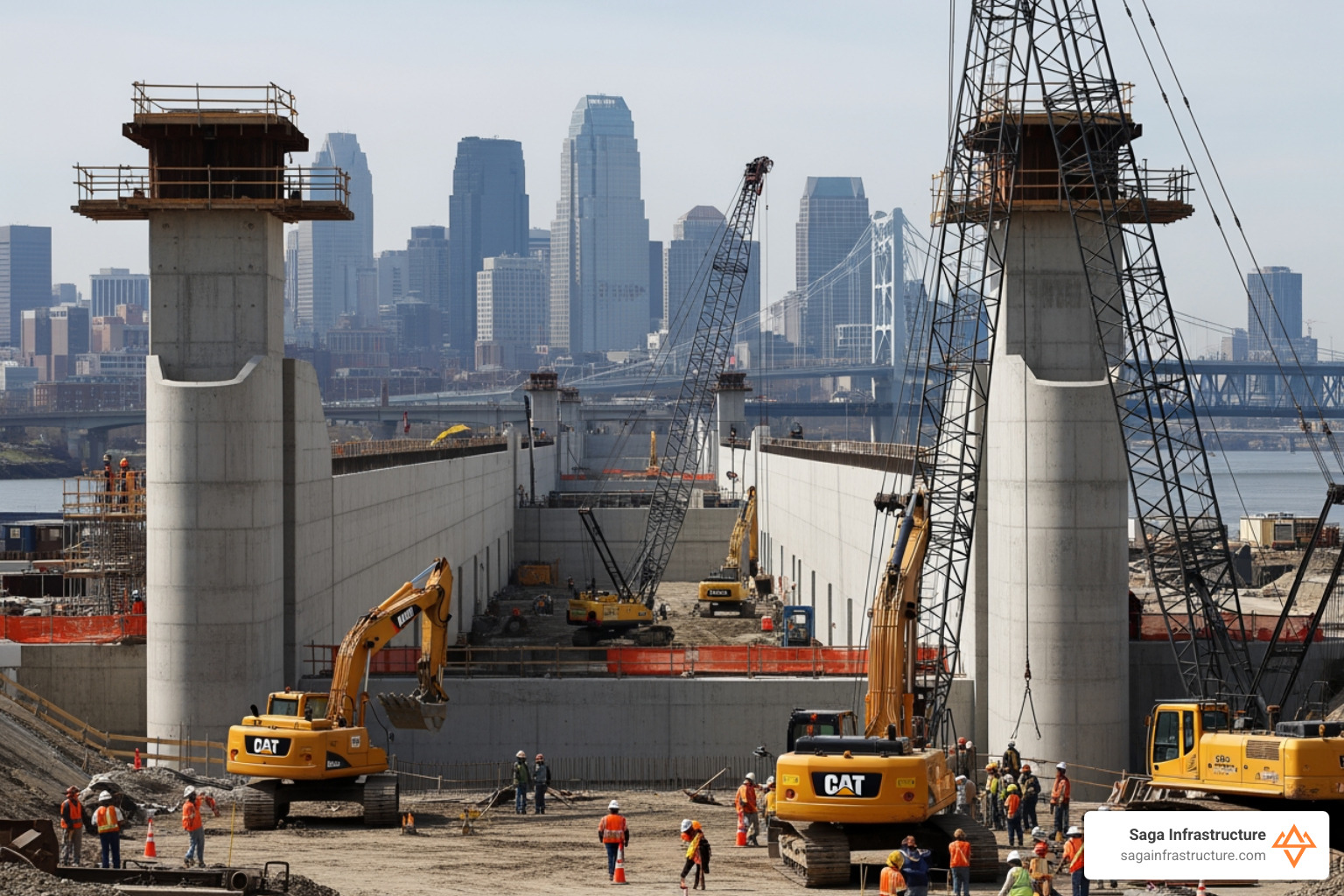
massive flood barrier construction site - Heavy civil construction

Getting the Site Ready

Before we build, we must prepare the land. This can take a long time. We move tons of dirt and make sure the ground is solid. Since these are public projects, many people watch our work. This includes the government and the people who live nearby.

The Downtown Flood Barrier is a good example. It is a long wall that protects a city. It has to be perfect to keep people safe.

Protecting the Environment

We must take care of the land. We make sure dirt does not wash into the water. We also try to keep dust down so it does not bother neighbors. We have to get many permits from the government. We follow all the rules to stay safe and clean.

Managing Big Projects

Many big projects are done with the government. This can be complex because plans can change. We also care about the community. Construction is loud and can slow down traffic. We use signs and meetings to help people know what is happening. Projects like The Vue Clermont show how we can build without causing too much trouble.

We use computers to track our work. This helps us see problems early and stay on budget.

Workers and Safety

The people who build our roads and bridges are very important. The Heavy and Civil Engineering Construction field is growing.

Over 1.1 million people work in this job. It is a great career with good pay.

  • Laborers: They earn about $22.74 per hour.
  • Machine Operators: They earn about $62,370 per year.
  • Average Pay: Many workers earn even more.

If you want a good job, you can join our Career team.

Safety is Number One

This job can be dangerous. There are big machines and deep holes. We follow strict safety rules. We want every worker to go home safe every night. We work hard to make sure no one gets hurt on the job.

New Tools and Technology

Construction is changing. We use new tools to make our work better.

  • GPS: We use satellites to find the exact spot to build. It is very precise.
  • Smart Machines: Our bulldozers have computers. They tell the driver exactly where to move the dirt. This saves time.
  • Drones: We fly small drones to see the whole project from the sky. This helps us find problems fast.
  • Recycling: We reuse old concrete and asphalt. This helps the earth and reduces waste.

You can see what is new in our News section.

Common Questions

What is the difference between civil and heavy civil?

Civil construction builds things like libraries or city halls. Heavy civil construction builds much bigger things. It builds the roads, dams, and bridges that everyone needs to use those buildings.

Who pays for these projects?

Most of the time, the government pays for them. Sometimes, private companies help pay for a project, like a road where you pay a toll to drive.

What are the most common jobs?

Most jobs are in building roads and water lines. Many people work as laborers or drive big machines. These roles are the most common in our industry.

Conclusion: Building for the Future

At Saga Infrastructure, we want to build things that last. We help local builders grow by giving them the tools they need. We want to make sure our roads and water systems stay strong for a long time.

When we work with a local company, we want them to keep being great. We provide the money and help they need to do more. Whether it is in Florida, Texas, or Arizona, we work together. We want to keep the hard work of local founders going for many years.

We build for the future, not just for today. To learn more, visit our About Us page or meet the SAGA Team. If you own a business and want to work with us, visit our Business Owners page.

Let’s build the backbone of America together.

Categories
Blog

Navigating the World of Civil Construction Acquisitions

Navigating the World of Civil Construction Acquisitions

Navigating the World of Civil Construction Acquisitions

The World of Civil Construction Acquisitions

Civil construction acquisition is when one company buys another construction business. These businesses build roads, bridges, and water pipes.

Why do companies buy each other? Here are the main reasons:

  • To Grow: To get more customers and become bigger.
  • New Places: To start working in new cities.
  • More Jobs: To learn how to do new things, like fixing water systems.
  • Steady Pay: To get long-term jobs fixing roads.
  • Government Money: To help build projects paid for by the government.
  • Investing: To use money from big investors to grow fast.
  • Retiring: To help owners sell their business when they are ready to stop working.

Many construction companies are being bought and sold right now. In 2024 and 2025, more people are buying these businesses than before. They want to add new teams and skills.

I am Don Larsen, the leader of Saga Infrastructure. I know a lot about buying construction companies. I help businesses grow while keeping their history alive.

Infographic showing key drivers of civil construction M&A: infrastructure spending, geographic expansion, service diversification, and private equity investment. - civil construction acquisition infographic

Why More People are Buying Construction Companies

If you drive through Texas or Florida, you will see many orange cones. This is because there is a lot of building happening. This makes buying a construction company a very good idea right now.

The government is spending billions of dollars on new roads and houses. In states where many people are moving, like Arizona, there is a big need for new pipes and bridges.

Computers and AI are also helping. Big computer centers need special ground work and power lines. Companies want to buy contractors who already know how to do this hard work.

Also, many business owners are getting older. They want to retire. They may not have family to take over the business. They look for Latest news on construction M&A to see how to sell their company and keep it safe.

Why the Market is Busy

  • Government Jobs: Most big road work is paid for by the government. This means the work does not stop, even when the economy is bad.
  • New Laws: New laws give money to build factories and fix old buildings.
  • Big Investors: People with a lot of money see construction as a safe way to grow their savings.

How Much is a Construction Company Worth?

Not all companies cost the same. A company that builds big highways is often worth more than a company that builds small houses. This is because highway work is harder to do and lasts a long time.

Most people value a business by looking at its profit. Heavy construction firms often sell for a higher price because they have steady work for many years.

Fast-Growing Areas

Some types of work are very popular right now:

  1. Water Pipes: Growing cities need new ways to move water.
  2. Rock and Concrete: Companies that own their own rocks or concrete are worth a lot.
  3. Power Lines: We need more power for our homes and computers.

An image of a bridge construction project highlighting the complexity and scale of civil infrastructure. - civil construction acquisition

What Makes a Firm Valuable?

When we buy a company, we look at more than just the trucks. We look at the future work they already have signed up. A company with $50 million in future road work is very stable. This makes them a great choice for buyers.

Type of Work Price Range (Based on Profit) Why it is Worth More
Roads & Streets 5 to 7 times profit Government money, hard to start
Water & Sewer 5 to 8 times profit Everyone needs water, old pipes
Rocks & Dirt 7 to 10 times profit Hard to find new rock mines
Train Tracks 5 to 7 times profit Needs special tools and skills

Why Big Companies Buy Small Ones

Why would a big company buy a local business in a small town? It is usually for three reasons: more customers, new locations, and good workers.

It is faster to buy a local company than to start a new one. A local company already knows the people in town and has a good team. By buying them, a big company can start working in that area right away.

Buying a company also helps them do more types of jobs. A road builder might buy a pipe company so they can do both jobs at once. This makes them better than other builders.

If you want to know how this helps owners, you can find More info for business owners on our website.

Big Money Investors

Some investors buy many small companies and put them together. This makes one big, strong company. They bring in extra money and better tools to help the small companies grow faster.

Other Construction Companies

Sometimes, one construction company buys another. They do this to save money on tools and materials. They also get more skilled workers to help them finish big projects.

Rules and Contracts

Building a bridge is hard, but the legal papers can be even harder! Buying a company involves many rules, especially for government jobs.

There are strict rules for how to bid on jobs and how to stay safe. If a company does not follow these rules, it is very hard to sell it.

Common Words in a Deal

  • GMP: This is the most money a project will cost.
  • ECW: This is the cost of the actual building work.
  • CCA: This is extra money kept for surprises or mistakes.
  • Due Diligence: This is like a home inspection. The buyer checks all the tools, papers, and safety records to make sure everything is okay.

Safety is Important

Safety is not just about wearing hard hats. It is about keeping workers safe so the company can keep working. A company with a bad safety record will have to pay more for insurance. We look for companies that treat their workers like family and keep them safe every day.

Common Questions

How much do construction companies sell for?

Most sell for 5 to 8 times their yearly profit. If the company owns its own rock mine or does special utility work, the price can be even higher.

Does government money help?

Yes! When the government promises to spend money on roads for many years, it makes companies more valuable. Investors love to see steady work.

What makes a company a good target?

Buyers want three things: a good name in town, great workers, and a lot of future work already planned. If people trust your work, your company is a great candidate.

Conclusion: Keeping Your Business Strong

At Saga Infrastructure, we know your company is more than just trucks and tools. It is your life’s work. Whether you are in Florida, Texas, or Arizona, we know how hard you worked to build it.

We want to be a partner for owners who care about their legacy. We do not want to change your name or fire your team. We want to give you the money and tools to help your business grow for the next fifty years.

Kevin and Cindi Foshee worked with us. They said: “Saga was a great partner. They respected our team and made the process easy.”

If you are thinking about the future, look for a partner who will protect what you built. Let’s grow together.

If you are ready to talk, we invite you to Start the conversation. We are here to help you build for the future.