How to Stop Your Pond Banks from Going Downhill
Why Pond Banks Are Worth Protecting
Pond bank stabilization means making the edges of a pond strong. This stops dirt from washing away. It keeps the water clean and the pond safe. Here is a quick look at what works:
| Method |
Best For |
Difficulty |
| Plants |
Small waves |
Easy |
| Coconut logs |
Medium waves |
Medium |
| Rocks |
Big waves |
Hard |
| Concrete mats |
Steep hills |
Hard |
| Mix of both |
Most ponds |
Medium |
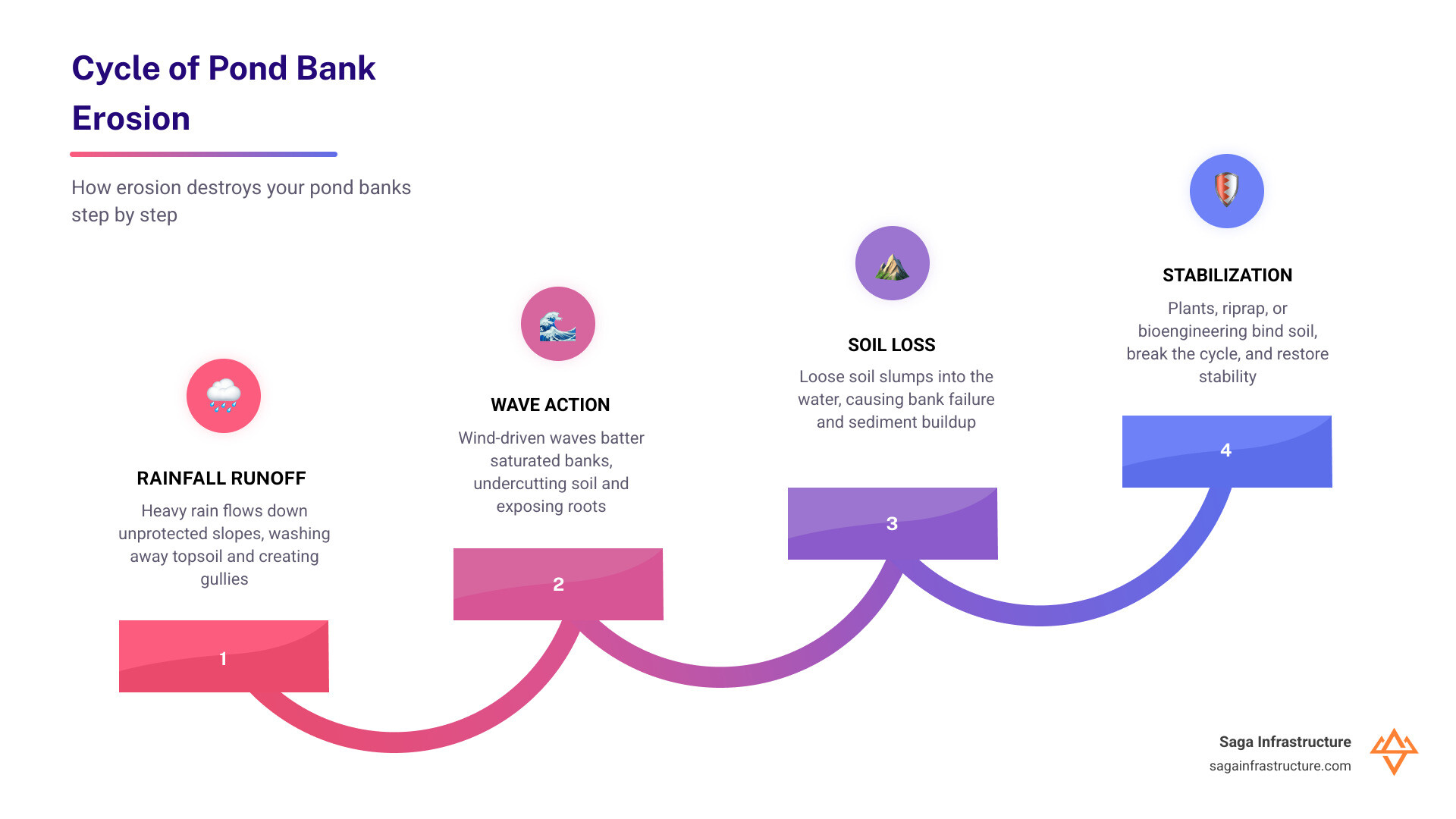
A pond looks nice, but the edges do a big job. They hold the water and the land together. But water is very strong. Rain and waves hit the dirt every day. If you don’t fix it, the bank can fall apart in big chunks.
By April 2026, heavy rain and old ponds have made fixing erosion very important for everyone.
The good news is that you can stop the damage. You can use plants or rocks to keep the dirt in place.
I am Don Larsen, the head of Saga Infrastructure. We help people fix their ponds and land. In this guide, I will show you how to keep your pond banks from falling down.
Pond bank stabilization helpful reading:
Why Pond Banks Fail: Causes and Signs
To fix a pond, we must know why it is breaking. Water is very powerful. Even calm water is always working against the dirt.
Waves and Rain
Wind makes waves. These waves hit the shore and pull dirt into the pond. This is called “undercutting.” Also, when it rains, water flows down the hills. If the grass is thin, the water takes the dirt with it.
Water Levels Changing
In places like Florida or Texas, water levels go up and down. When the water drops fast, the wet dirt on the bank gets heavy. It can slide right into the pond.
People and Animals
Walking on the bank can hurt the grass. Animals like muskrats also cause trouble. They dig holes that make the bank fall in.
The Type of Dirt
Some dirt is weak. Clay gets heavy when wet. Sand washes away very fast. Knowing your dirt is the first step. You can learn more from Expert Insights on Pond Bank Stabilization and Erosion Control by PondMedics.
Signs of Trouble
Look for these signs that your bank is failing:
- Roots Showing: If you see tree roots in the air, the dirt is gone.
- Sliding Dirt: The bank looks like it is melting into the water.
- Overhangs: The dirt under the edge has washed away.
- Muddy Water: If the pond is always muddy, the banks are falling in.
- Deep Grooves: Rain has carved paths into the hill.
Checking the Damage and Planning
Before you start, look at your land. A good plan helps the fix last a long time.
The Hill Slope
How steep is the bank?
- 1:1 Slope: Very steep. This will likely fail. It needs big rocks or concrete.
- 3:1 Slope: This is common. You can mow it, but it needs good grass.
- 6:1 Slope: This is the best. It stops waves from eating the bank. It costs a little more to build, but it saves money later.
Looking at the Bank
Walk around the pond. Are the holes in one spot or everywhere? You should also test the dirt. If the dirt is weak, you will need to fix it more often. For more help, see our Step-by-Step Guide to Erosion Control Solutions.
How Bad Is It?
- Small: Just a little dirt is washing away. You can fix this with plants.
- Medium: Small chunks are falling off. You might need coconut logs.
- Bad: Big sections are falling in. You need a pro to help with rocks.
Natural Ways to Fix Your Pond
At Saga Infrastructure, we like using nature. These ways look pretty and help birds and fish.
Using Plants
The best way to protect a pond is with living plants. Their roots hold the dirt like a net.
- Deep-Root Grass: These grasses have roots that go deep into the ground.
- Water Plants: Planting grass in the water helps break up waves.
- Buffer Zones: Don’t mow the grass right to the edge. Leave a few feet of tall plants to stop rain from washing dirt away.
Sometimes plants need help. We can use tools and plants together.
- Coconut Logs: These are logs made of fiber. We put them at the water’s edge. You can plant things inside them. As the log rots away, the plant roots take over.
- Mesh Bags (SOX): We fill big mesh bags with dirt and put them on the bank. You can grow grass right through the mesh. It makes a very strong wall.
- Rock and Garden: We put down rocks and then fill the gaps with dirt and plants. It is strong and looks like a garden.
Comparing Ways to Fix the Bank
| Feature |
Plants Only |
Mix (Logs/Mesh) |
| Cost |
Low |
Medium |
| Looks |
Very Pretty |
Pretty |
| Fast Fix |
Slow |
Fast |
| For Animals |
Great |
Great |
Using Rocks and Strong Materials
If the water is too rough, you need “Hard Armor.” This is for very bad erosion.
Riprap (Rocks)
Riprap is a layer of big rocks. You must put a special landscape cloth down first. This cloth lets water through but keeps the dirt in place. Usually, we put a 3-foot wide path of rocks along the water. This costs about $8.75 for every foot. You can learn more here: Don’t Get Washed Away: The Ultimate Riprap Erosion Defense.
Wire Baskets
These are metal baskets filled with rocks. They make very strong walls but cost more money.
Concrete Mats
These are mats made of concrete blocks. They come in rolls and are fast to put down. Grass can grow through the holes. You can even mow over them!
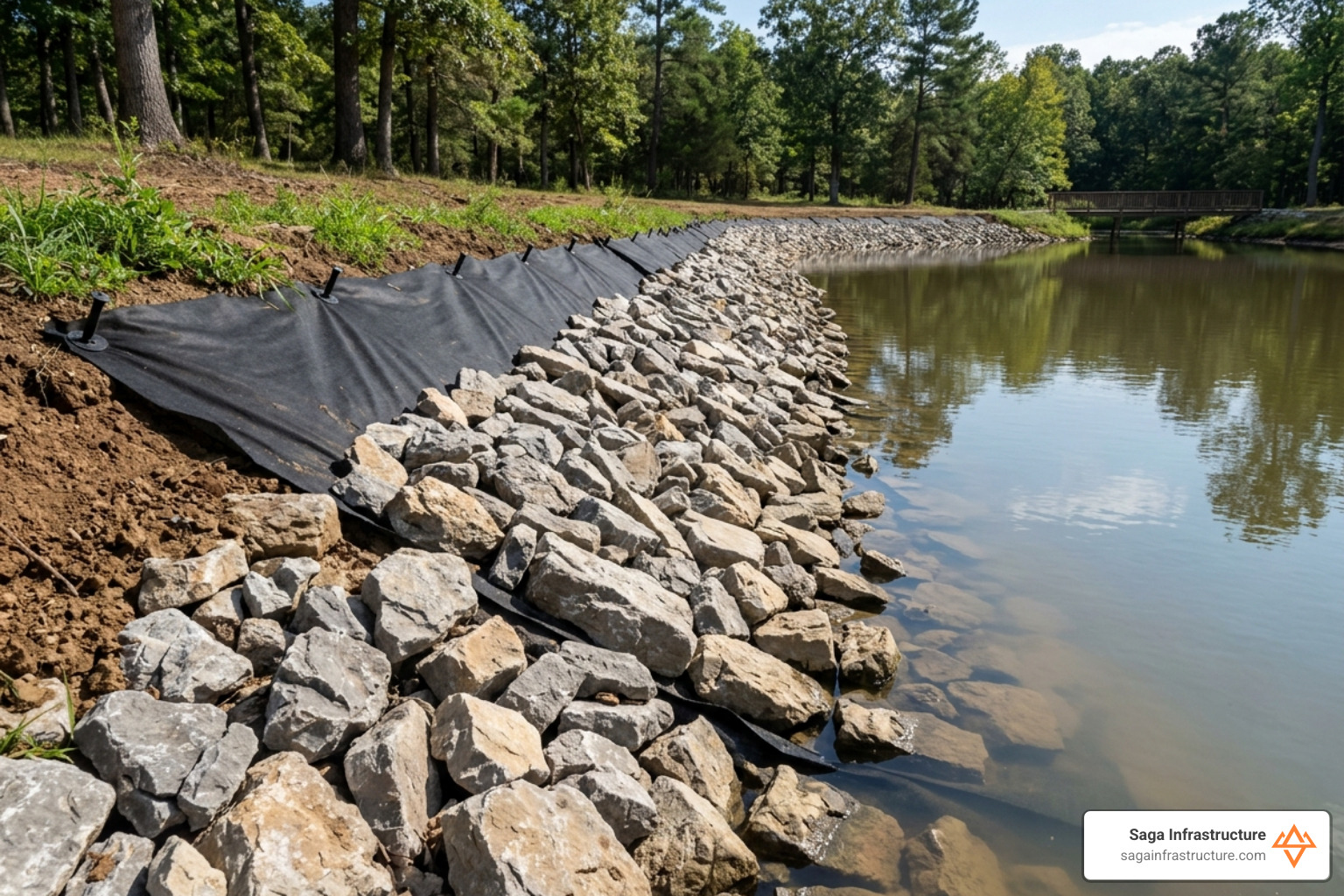
- Landscape Cloth: This cloth helps the bank last 5 years longer. It costs about $3.80 per foot.
- Straw Blankets: These are pinned over new grass seeds. They keep the seeds from washing away until they grow.
- Dirt Fences: These are used during work to keep mud out of the pond.
How to Install Rocks
- Check for Pipes: Call before you dig so you don’t hit a power line.
- Clean Up: Remove old trees and trash.
- Shape the Bank: Make the hill less steep.
- Lay the Cloth: Put down the special landscape fabric.
- Add Rocks: Place the rocks or mats on top.
Taking Care of Your Pond and Costs
Fixing the bank is not a one-time job. You must take care of it so it stays strong.
Easy Care
- Mowing: Don’t cut the grass too short near the water!
- Animal Control: Watch for muskrat holes. Fill them fast.
- Clean Up: Pick up branches and trash.
- Check Often: Look at the banks after a big storm.
Cost of Fixing Early vs. Late
Waiting until the bank falls is very expensive. Fixing a broken pond can cost a lot of money!
- Fixing Early: Using cloth and plants now is cheap.
- Fixing Late: Using big machines to move mud and rebuild walls is very pricey.
To learn more about land care, see The Essential Guide to Grading and Drainage Systems.
Professional Fixes and Pipes
Sometimes the problem is a broken pipe under the ground.
- New Pipes: We take out old, rusty pipes and put in new ones.
- Siphon Pipes: These can be put in without draining the pond.
- Pipe Lining: We can slide a new pipe inside an old one.
- Removing Mud: If the pond is full of dirt from the banks, we use machines to scoop it out.
Common Questions
What are the best plants for a pond bank?
Local plants with deep roots are best. Avoid regular lawn grass right at the edge. Its roots are too short to hold the wet dirt.
How much does it cost to put rocks on a pond bank?
A 3-foot path of rocks costs about $8.75 per foot. If you add the special cloth underneath, it costs about $11.50 per foot.
When should I call a pro?
Call a pro if big chunks of the bank are sliding into the water. Also call if the bank is too thin to drive a mower on, or if you see water leaking through the hill.
Conclusion
Your pond is important. Whether it is for fishing or for your neighborhood, the banks keep it safe.
At Saga Infrastructure, we want to protect what you have built. We work with local teams to help fix your land. We don’t just move dirt; we take care of the land for everyone.
Don’t wait until your pond bank is gone. Let’s start the conversation today. We can help you keep your pond strong for a long time.